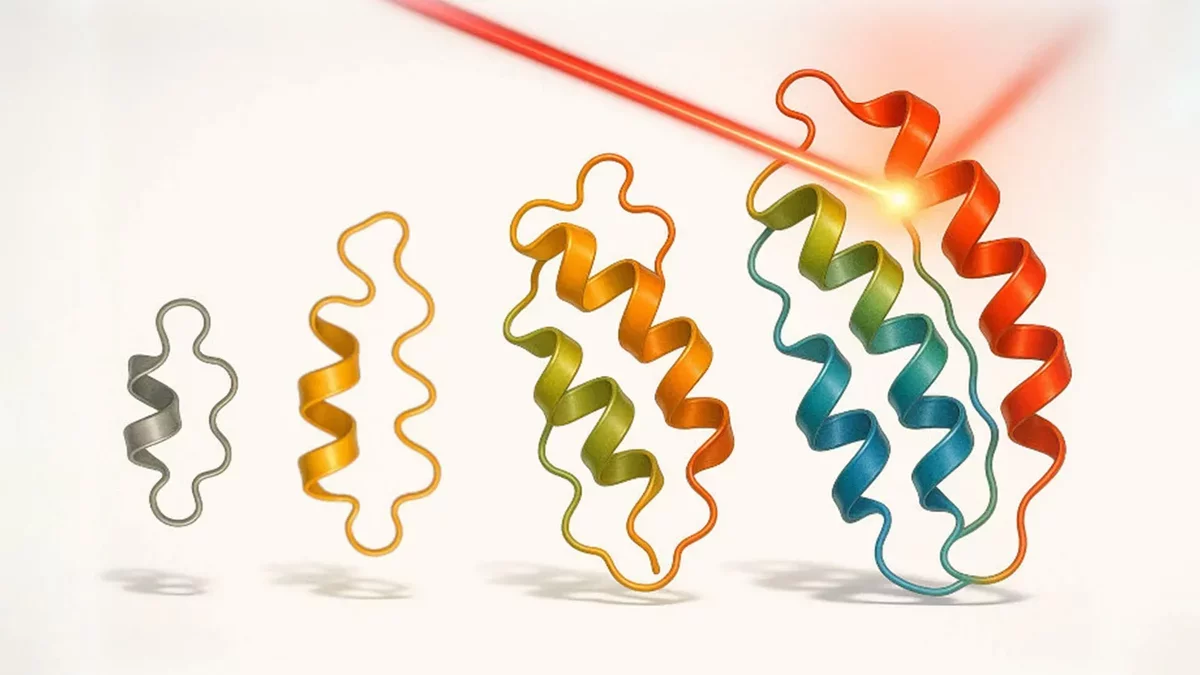
In a groundbreaking study, scientists are leveraging the principles of directed evolution to enhance proteins, particularly enzymes and antibodies, which are vital in fields ranging from medicine to industrial applications.
Challenges of Traditional Directed Evolution
While traditional directed evolution has shown remarkable success, it often operates under a constant selection pressure that favors proteins maintaining high activity levels. However, biological systems are inherently more dynamic, with many proteins functioning as signals or switches that need to adapt to varying conditions.
For instance, proteins may need to activate and deactivate in response to environmental cues. When evolutionary experiments reward only a single state, other crucial states can deteriorate, hindering the protein's ability to function properly, which can adversely affect cellular health.
Introducing Optovolution
A team led by Sahand Jamal Rahi at EPFL's Laboratory of the Physics of Biological Systems has pioneered a novel approach called "optovolution." This innovative technique utilizes light to guide the evolution of proteins capable of performing dynamic functions and executing basic computational tasks based on yes-or-no logic.
Published in the journal Cell, this research aligns directed evolution more closely with natural cellular operations, emphasizing the importance of timing and state-switching alongside signal strength.
Engineering Yeast for Optimal Protein Selection
The researchers employed the budding yeast Saccharomyces cerevisiae, a model organism in brewing and research. They modified the yeast cell cycle, linking cell division to the behavior of the evolving protein. For the yeast to thrive, the protein had to toggle effectively between active and inactive states.
By connecting the protein's output to a regulatory mechanism crucial for cell division, the scientists ensured that only yeast cells with proteins that switched states correctly would continue to divide, creating a natural selection environment.
Real-Time Evolution Control via Light
Using optogenetics, the researchers introduced precise light pulses to control the evolution process. This allowed for a rapid assessment of whether the proteins switched states appropriately during each 90-minute yeast cell cycle. The most effective proteins enabled cell survival and reproduction, while less efficient variants were phased out.
Advancements in Protein Variants
Through optovolution, the team successfully evolved various proteins, enhancing a light-controlled transcription factor with 19 new variants that exhibited increased sensitivity to light and the ability to respond to different wavelengths. They even developed a red light optogenetic system, streamlining the experimental process by utilizing existing cellular components.
Proteins as Miniature Computers
The study also showcased how optovolution could create proteins that function like tiny computers, activating genes only when specific combinations of signals were detected. This dynamic behavior is crucial for numerous biological processes, including environmental sensing and cellular decision-making.
By facilitating the continuous evolution of dynamic protein functions within living cells, optovolution holds immense potential for advancements in synthetic biology, biotechnology, and fundamental research, paving the way for smarter cellular circuits and enhanced optogenetic tools.