Understanding the complexities of olfaction has long been a challenge in the field of neuroscience. Sandeep (Robert) Datta, a professor of neurobiology at the Blavatnik Institute of Harvard Medical School, emphasizes the mysterious nature of our sense of smell compared to other senses like vision and hearing.
Groundbreaking Discovery of Smell Receptor Mapping
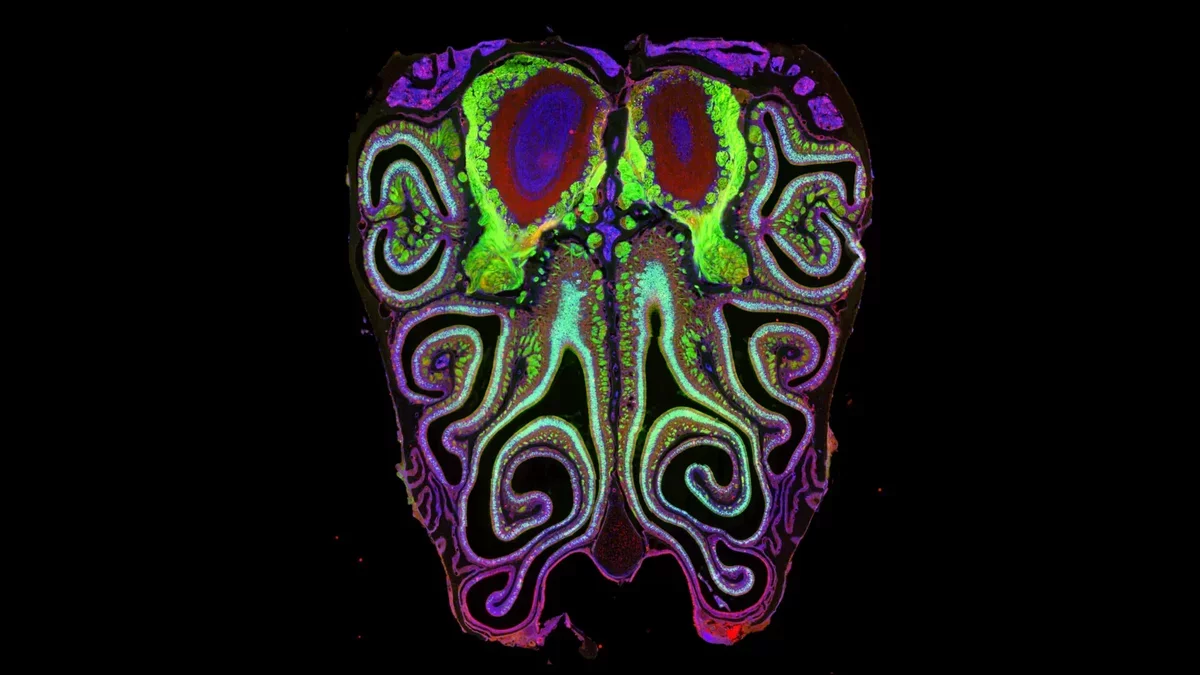
A recent study led by Datta and his team has produced the first comprehensive map detailing the arrangement of over a thousand types of smell receptors within the nose of mice. This innovative research has overturned previous assumptions about the randomness of receptor distribution, revealing a highly organized structure where neurons form distinct horizontal bands based on receptor type.
"Our findings introduce a new level of order to a system that was believed to be chaotic, fundamentally altering our understanding of olfactory function," stated Datta, the study's senior author.
Moreover, the research established a correlation between this nasal map and similar structures in the brain's olfactory bulb, providing fresh insights into how scent signals are processed within neural pathways.
The findings were published on April 28 in the esteemed journal Cell.
The Quest for a Smell Map
While the arrangement of sensory receptors in the eyes, ears, and skin has been well-documented, the olfactory system has remained largely uncharted territory. "Olfaction is the one sense that has lacked a comprehensive map for the longest time," Datta noted.
This complexity arises from the sheer number of olfactory neurons in mice--approximately 20 million, each expressing one of over a thousand receptor types. In contrast, human color vision relies on merely three receptor types, making the olfactory system significantly more intricate.
Since the identification of smell receptors began in 1991, researchers have sought to uncover patterns in their arrangement. Earlier studies suggested a limited organization, leading to the belief that receptor placement was largely random.
Revealing Hidden Patterns in Neurons
Utilizing advanced genetic techniques, Datta's team revisited this question with a large-scale analysis of approximately 5.5 million neurons from over 300 mice. By combining single-cell sequencing and spatial transcriptomics, they could pinpoint both the types of receptors expressed by each neuron and their specific locations.
"This represents one of the most sequenced neural tissues to date, and the scale of data was crucial for our understanding," Datta remarked.
The results indicated a consistent and organized pattern, with neurons forming overlapping horizontal stripes that corresponded with the receptor types. This arrangement was remarkably uniform across all examined subjects and closely aligned with the brain's olfactory mapping.
Understanding the Formation of the Smell Map
The researchers also explored the developmental processes behind this structured arrangement, identifying retinoic acid as a critical molecule that influences gene activity. A gradient of retinoic acid in the nose directs neurons to activate specific receptors based on their positioning. Alterations to this molecule's levels resulted in shifts in the entire receptor map.
"We demonstrate that development can create a remarkably precise map of a thousand different smell receptors that maintains consistency across various animals," Datta explained.
Implications for Smell Restoration
This discovery not only enhances our understanding of olfactory biology but also holds potential for practical applications. Currently, effective treatments for loss of smell are scarce, despite its significant implications for safety, nutrition, and mental health.
"Understanding the fundamental principles of olfaction is essential for developing effective treatments," Datta stated. The team aims to investigate the receptor arrangement in humans, which could lead to innovative approaches, including stem cell therapies and brain-computer interfaces, to restore the sense of smell.
"Restoring the sense of smell is vital not just for enjoyment and safety but also for overall psychological health," Datta concluded. "Without a clear understanding of this olfactory map, our efforts to create new treatments may be in vain."