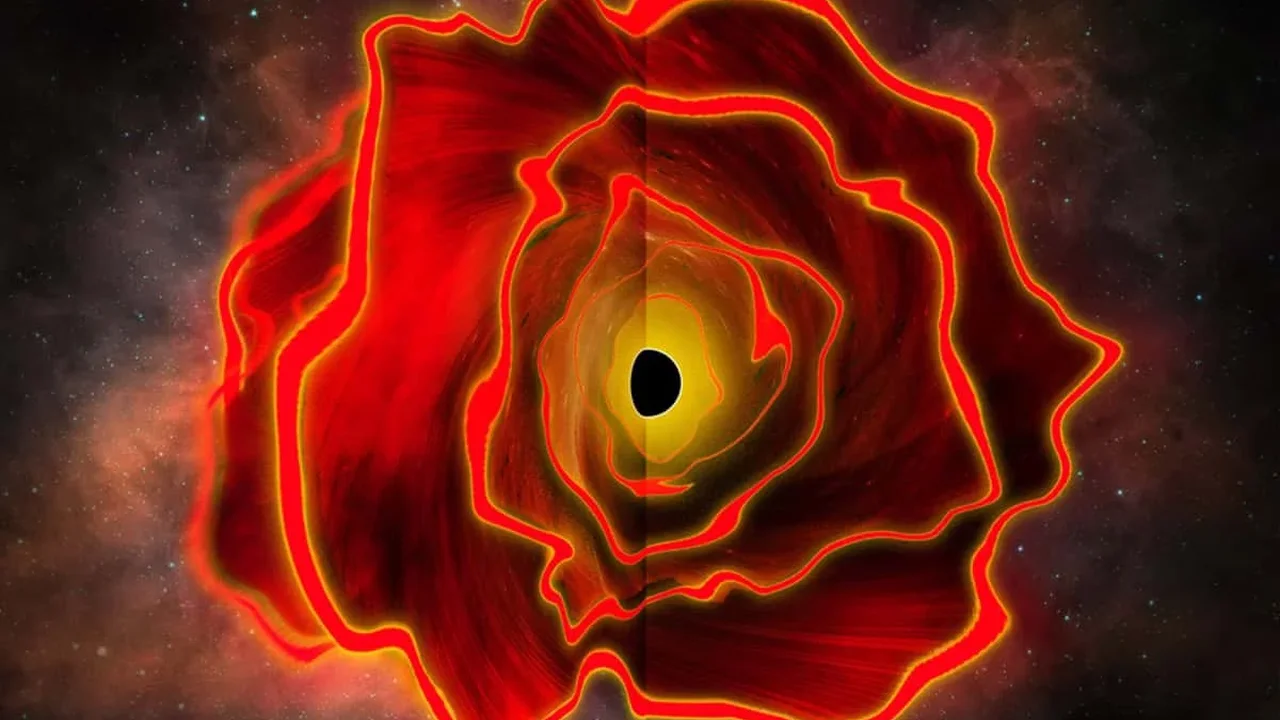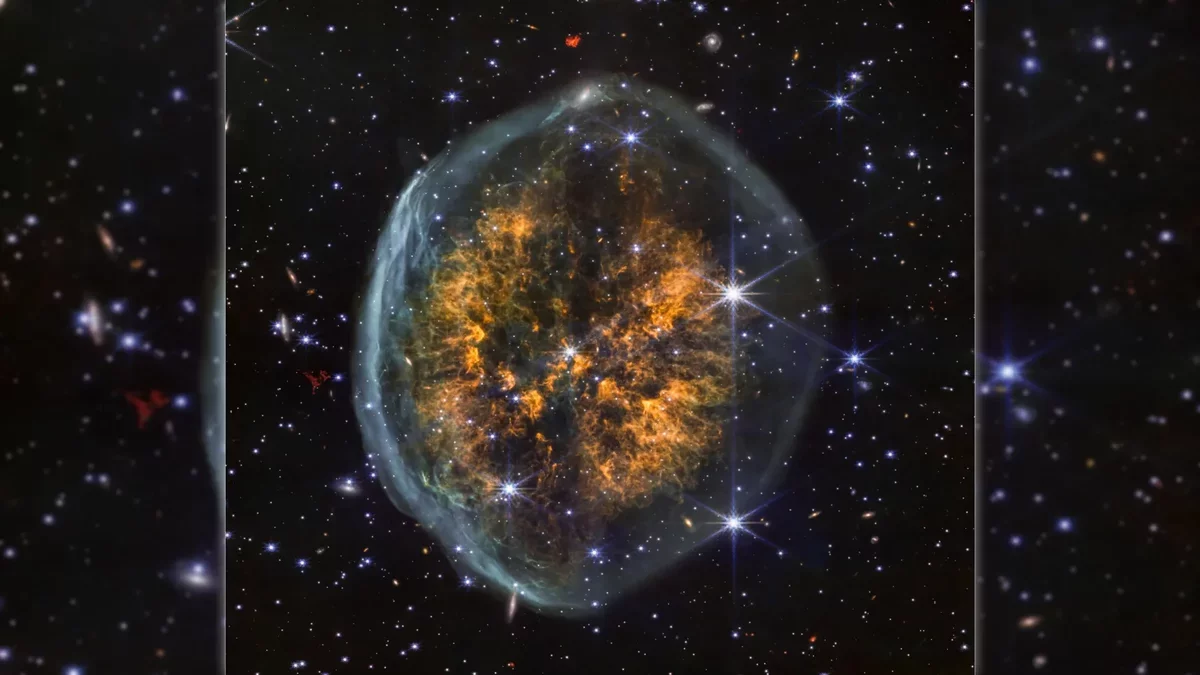
The nebula, designated as PMR 1, exhibits a striking resemblance to a brain encased in a transparent skull, earning it the nickname "Exposed Cranium" nebula. Utilizing both near-infrared and mid-infrared wavelengths, NASA's James Webb Space Telescope has unveiled features that were previously obscured. Although this nebula was initially detected over a decade ago by the now-retired Spitzer Space Telescope, Webb's advanced instruments provide a significantly clearer and more detailed perspective, accentuating its brain-like structure.
Developmental Layers and Jets
This nebula displays distinct signs of its evolutionary phases, showcasing an outer hydrogen-rich gas shell expelled earlier and a more intricate inner region filled with various gases and detailed formations. These layers illustrate the ongoing material shedding from the star.
Images captured by Webb's NIRCam (Near-Infrared Camera) and MIRI (Mid-Infrared Instrument) reveal a prominent dark lane that vertically bisects the nebula. This feature divides the cloud into two sections reminiscent of the brain's hemispheres. Webb's high-resolution imagery suggests that this dark lane could be linked to material outbursts from the central star, often propelled by twin jets moving in opposite directions. This dynamic activity is particularly evident in the MIRI imagery, where gas from the inner region appears to be expelled outward.
A Star Approaching Its End
While many aspects of this nebula remain a mystery, scientists understand it is influenced by a star nearing the conclusion of its fuel-burning phase. During this period, stars release their outer layers into space. Although this process may seem gradual, it is relatively swift on a cosmic scale.
Webb has captured a moment in this ongoing transformation. The star's ultimate destiny will depend on its mass, which is yet to be determined. If it possesses substantial mass, it could culminate in a spectacular supernova explosion. Alternatively, if it resembles our Sun, it will continue to shed material until only its dense core remains as a white dwarf, which will eventually cool over extensive periods.
The Significance of the James Webb Space Telescope
The James Webb Space Telescope stands as the most sophisticated space observatory ever constructed, designed to probe objects within our solar system, investigate exoplanets, and unravel the origins and structure of galaxies throughout cosmic history.
This international endeavor, spearheaded by NASA in collaboration with the European Space Agency (ESA) and the Canadian Space Agency (CSA), continues to provide groundbreaking insights into the formation and evolution of the universe.