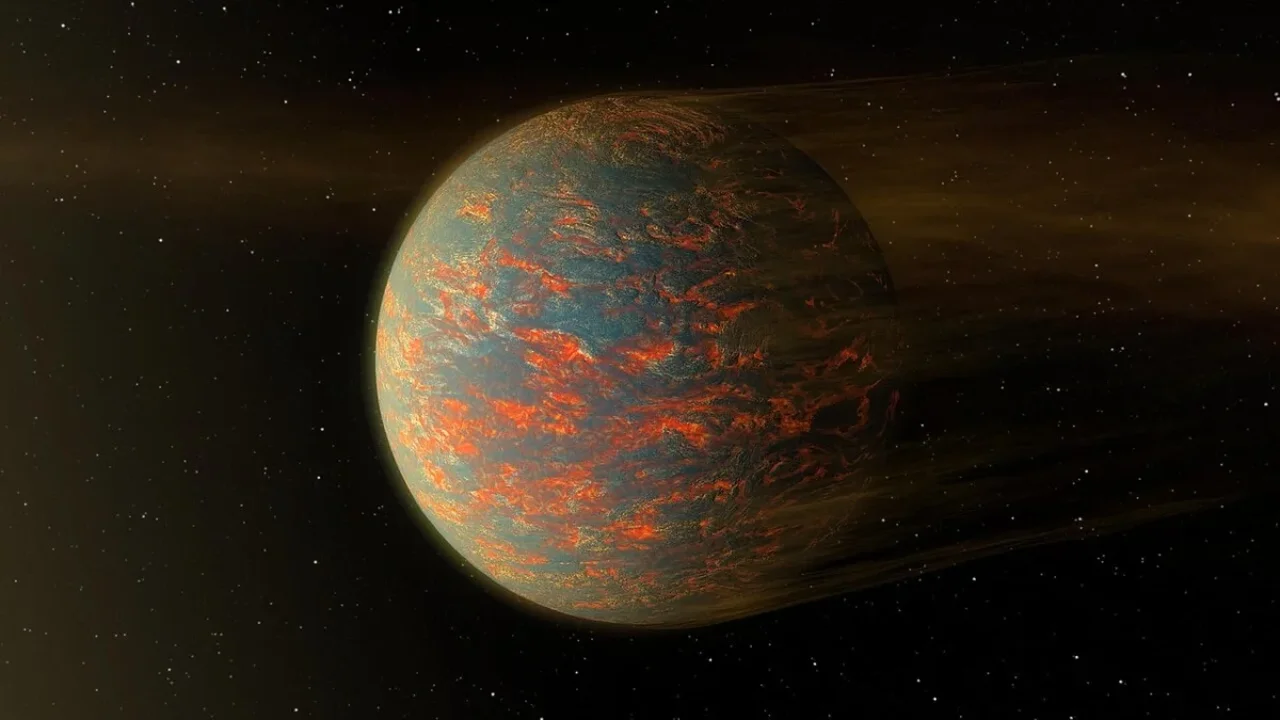
New research is reshaping how astronomers think about rocky exoplanets that orbit extremely close to their stars. Worlds like 55 Cancri e were once expected to lose any atmosphere quickly under intense heat and radiation. Yet observations from the James Webb Space Telescope suggest that some of these scorched planets may still hold onto substantial gas layers.
The study, published in The Astrophysical Journal Letters, proposes a surprising mechanism: on the hottest lava worlds, molten rock may act as a deep reservoir for volatile compounds. Instead of releasing all gases at once, the planet's magma can store them and gradually feed the atmosphere over time.
A new map for rocky planets
Researchers modeled how atmospheric escape interacts with the cooling and solidifying of a planet's interior. Their results suggest a three-zone structure: the familiar cosmic shoreline, an intermediate "airless valley," and a newly described region where atmospheres can persist even under extreme irradiation, nicknamed the cosmic sandbar.
In this framework, a planet may first struggle to keep its air as temperatures rise, then lose it, and finally regain stability at even higher heat levels if its surface remains molten enough to replenish gases from below. For some planets, tidal heating can also help maintain that molten state.
The model does not mean every close-in rocky planet will keep an atmosphere. Planet size, initial composition, stellar activity, and internal heating all matter. But the findings help explain why planets such as 55 Cancri e, and possibly TOI-561 b, continue to challenge earlier assumptions about bare rock worlds.
Beyond these extreme planets, the study offers a broader lesson: atmospheres are not just shaped by distance from a star, but by the hidden chemistry and heat inside a planet itself. That insight could guide future searches for rocky worlds with stable air, and ultimately refine how scientists assess planetary habitability in the years ahead.