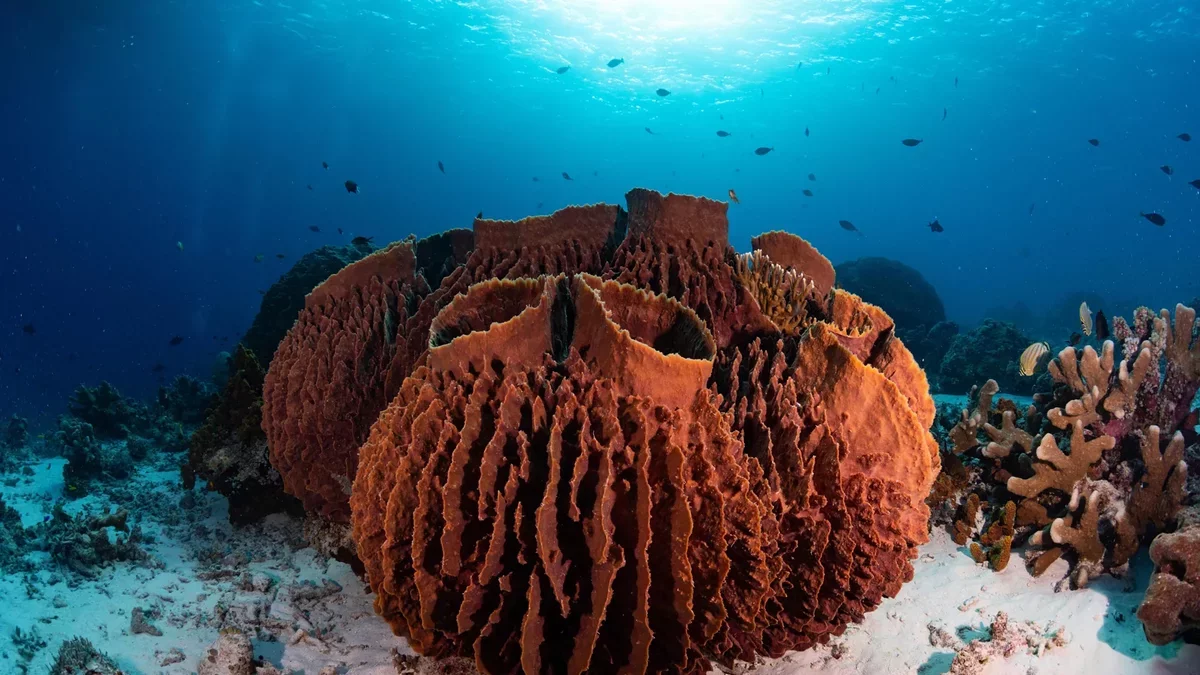
In a groundbreaking study published in the Proceedings of the National Academy of Sciences, researchers have unveiled evidence indicating that the earliest animals on Earth were likely ancient sea sponges. By examining "chemical fossils" preserved in rocks over 541 million years old, the team identified biological molecules that had been buried and altered over eons.
The key molecules discovered are known as steranes, which are stable remnants of sterols, including cholesterol, found in the cell membranes of complex life forms. Through structural analysis, scientists connected these steranes to demosponges, a prominent group of sea sponges that thrive in oceans today. These modern relatives, characterized by their diverse shapes and colors, are soft-bodied filter feeders, much like their ancient counterparts.
"While we can't precisely visualize these early organisms, we know they inhabited the ocean, were soft-bodied, and likely lacked a silica skeleton," explains Roger Summons, Emeritus Professor of Geobiology at MIT's Department of Earth, Atmospheric and Planetary Sciences.
The discovery of sponge-specific chemical signatures bolsters the argument that the ancestors of demosponges were among the first animals to evolve, appearing well before many other significant animal groups.
The research team, led by Lubna Shawar, a former MIT postdoctoral fellow now at Caltech, collaborated with experts from various institutions, including the University of California at Riverside and Cornell University.
Building on Previous Discoveries
This study expands upon earlier findings from 2009, when the team analyzed rocks in Oman and detected a high concentration of steranes believed to originate from ancient sea sponges. These rocks date back to the Ediacaran Period, a time just before the Cambrian explosion, when complex multicellular life began to flourish. Initial results indicated that sponges predated the Cambrian explosion, potentially marking them as some of the planet's earliest animals.
Despite some skepticism regarding the origin of these steranes, the new research reinforces the hypothesis that they are indeed linked to ancient sponges. The team identified additional chemical fossils in the same Precambrian rocks, strongly suggesting a biological origin.
Investigating Early Animal Life
The researchers meticulously examined Ediacaran rocks from various global locations, searching for steranes that are characteristic of all eukaryotes. "If you lack sterols or comparable membrane lipids, you aren't a eukaryote," Summons states.
Notably, the study identified a rare 30-carbon sterol associated with demosponges, and further analysis revealed a 31-carbon sterol (C31) as well. The researchers found these C31 steranes alongside previously identified C30 steranes, emphasizing their significance.
Laboratory Validation
To confirm the biological source, the team studied living demosponges, which produce C31 sterols, and synthesized various sterols in the lab. Their experiments showed that only specific synthesized sterols transformed into compounds matching the C31 steranes found in the ancient rocks, ruling out non-biological processes.
Overall, the combination of geological evidence, modern sponge analysis, and laboratory experiments strongly supports the conclusion that these steranes originated from early demosponges, which still possess the ability to produce similar compounds today.
Future Directions
With C30 and C31 sterols now recognized as reliable indicators of ancient sponges, the researchers aim to explore rocks from other regions to better understand the timeline of early animal evolution. This ongoing research, supported by various prestigious institutions, holds the promise of revealing more about the origins of life on Earth.