The Earth's crust is in a constant state of transformation, shaped by volcanic activity, erosion, and tectonic movements. While the surface undergoes continual renewal, the core of our planet presents a fascinating paradox: it is actually younger than the crust beneath our feet.
This intriguing phenomenon can be attributed to the interplay of time and gravity. Unlike the crust, which is constantly recycled, the core's age is influenced by the fundamental laws of physics. Recent calculations suggest that the Earth's core is approximately 2.5 years younger than the surface, a difference rooted in the effects of gravity on time.
Understanding the Role of Relativity
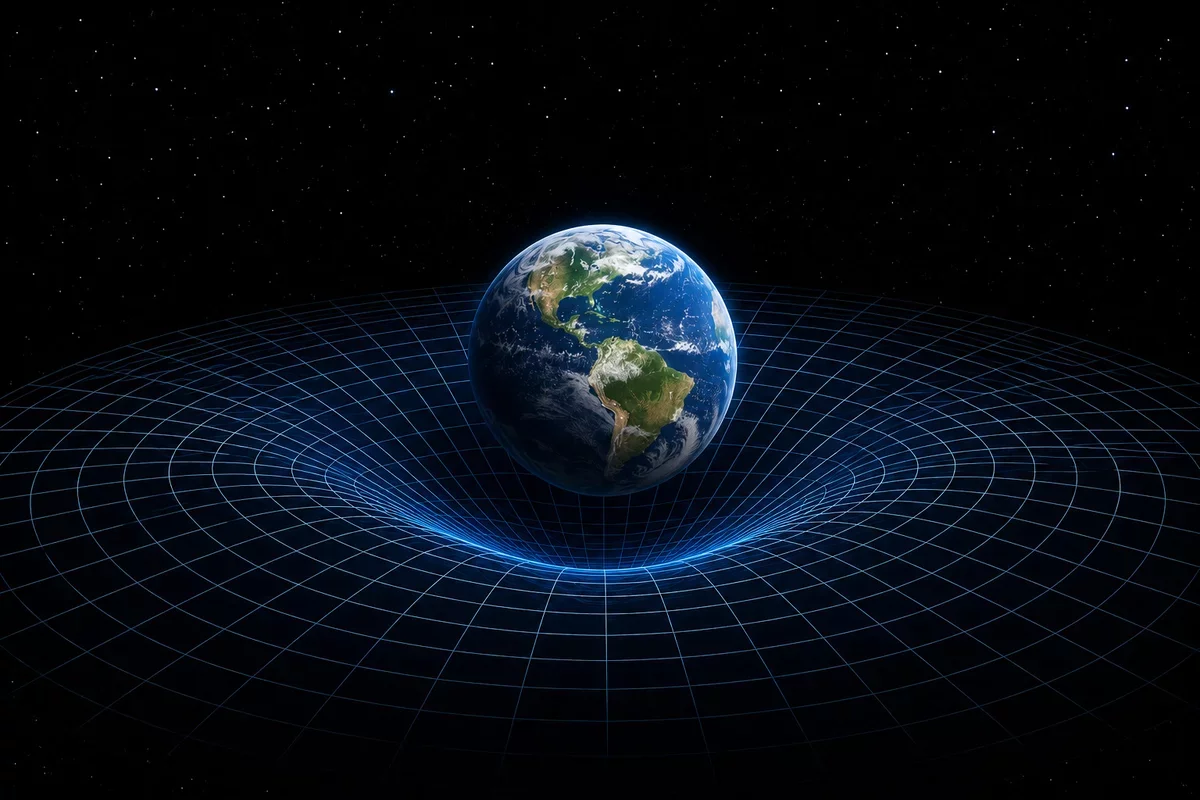
The formation of Earth dates back around 4.5 billion years, originating from cosmic dust and rock particles that coalesced under gravitational forces. However, the story shifts from geology to the realm of Einstein's general relativity. This theory revolutionized our understanding of time, demonstrating that it is not a universal constant but varies based on gravitational fields.
In essence, a clock subjected to stronger gravitational forces will tick more slowly. At the center of the Earth, where gravitational forces are balanced, time flows differently than at the surface. This means that a clock positioned at the Earth's core experiences less passage of time compared to one at the surface.
Scientific Insights and Historical Context
The concept that the Earth's core is younger was notably highlighted by Nobel laureate Richard Feynman, who speculated that the difference in age could be a matter of days. However, a 2016 study revisited this idea with precise calculations, revealing the core's age discrepancy to be around 2.5 years, due to the unique gravitational properties of our planet.
This phenomenon is not merely an academic curiosity; it has practical implications, particularly for technologies like GPS. Satellites in orbit experience different gravitational forces compared to clocks on Earth, leading to a necessary adjustment of about 38 microseconds per day to maintain accurate positioning.
Implications for Future Studies
Moreover, advancements in atomic clock technology are paving the way for innovative methods of geodesy. By comparing time differences, scientists can measure minute height variations on Earth's surface, enhancing our understanding of geological processes.
Ultimately, the relationship between geology and physics underscores the complexity of planetary time. The Earth does not possess a singular age; rather, it embodies multiple timelines shaped by its diverse layers and gravitational influences. This revelation invites us to reconsider our understanding of time itself, suggesting that it is not a linear progression but a multifaceted experience influenced by our position in the universe.