In the quest to unify various theories of gravity, physicists have explored several promising avenues, including string theory, loop quantum gravity, and canonical quantum gravity. Each of these theories has its strengths and weaknesses, but researchers have struggled to find a definitive observable effect that could validate one over the others. A recent study from TU Wien may provide a significant breakthrough in this area.
The Quest for Quantum Gravity's "Slipper"
Benjamin Koch, a researcher at the Institute for Theoretical Physics at TU Wien, likens the search for a unifying theory of quantum gravity to the Cinderella fairy tale. "Just as there are multiple candidates for the princess, we have various theories, but only one can be correct. We need a 'slipper'--an observable that will reveal the true nature of quantum gravity," he explains.
To find this 'slipper,' the team focused on geodesics, a fundamental concept in relativity. "Geodesics are the shortest paths between two points, and much of our understanding of general relativity hinges on this idea," says Koch.
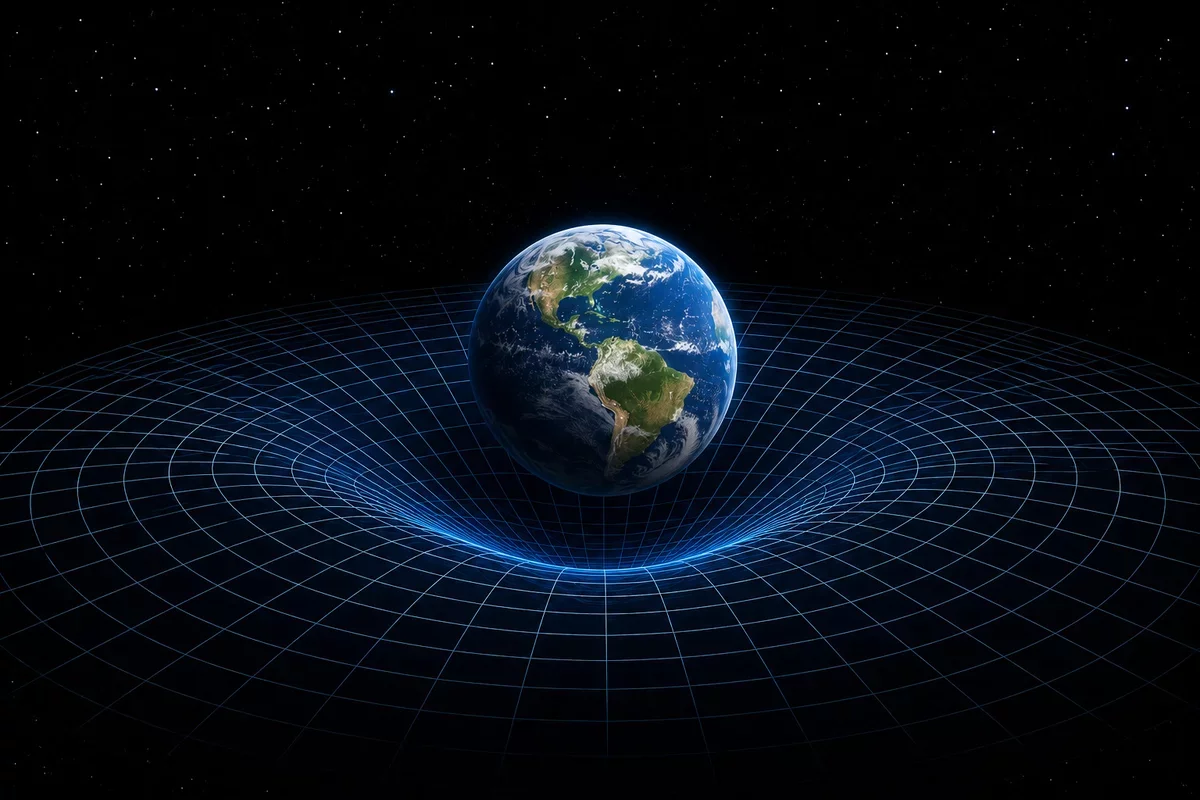
In simple terms, a geodesic on a flat surface is a straight line, while on a curved surface like Earth, it resembles a semicircle. Einstein's theory merges space and time into a four-dimensional construct known as spacetime, which is warped by massive objects, influencing the orbits of planets and stars.
Developing a Quantum Perspective
The shape of these paths is dictated by the metric, which quantifies the curvature of spacetime. "By applying quantum physics principles to this metric, we can explore how particles behave under quantum conditions," Koch notes. In quantum mechanics, particles do not possess exact positions or momenta; instead, these properties are expressed as probabilities.
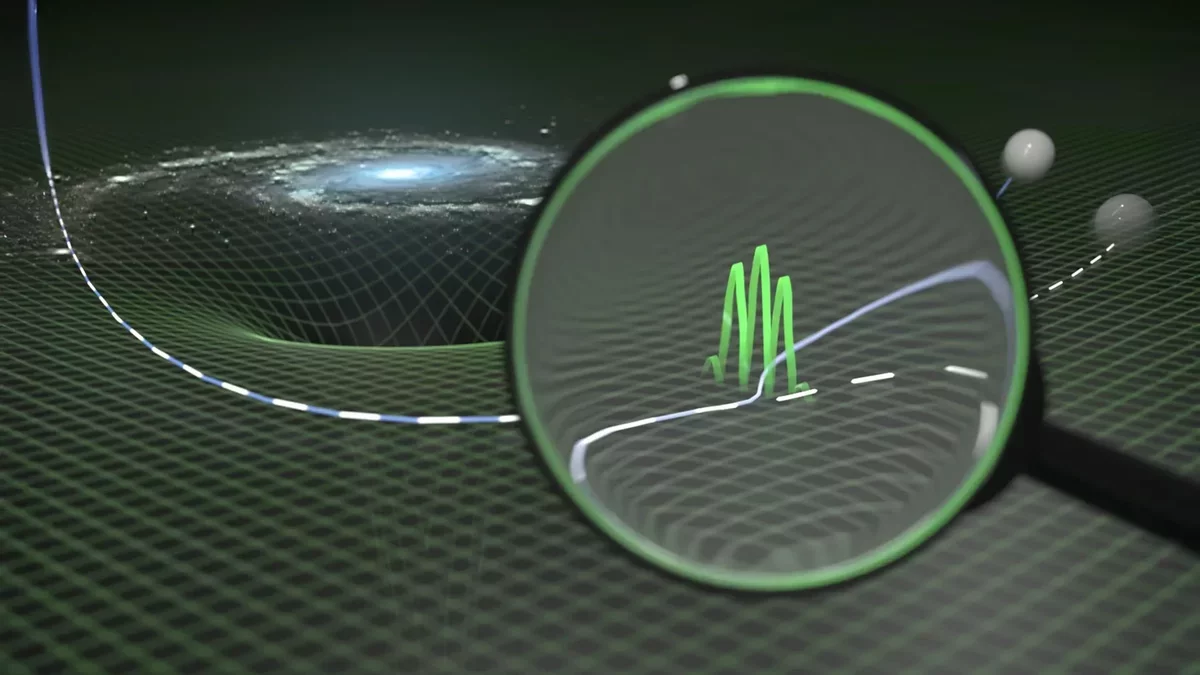
This study introduces a new equation, termed the q-desic equation, which suggests that in a quantum framework, particles may not strictly follow the shortest path predicted by classical geodesics. By analyzing how objects move through spacetime, researchers could potentially uncover quantum characteristics of spacetime itself.
Exploring Differences in Scale
The research indicates that while deviations from classical predictions are minuscule at ordinary scales--approximately 10-35 meters--significant differences emerge when considering the cosmological constant, which relates to dark energy and the universe's expansion. When incorporated into the q-desic equation, these deviations become pronounced, particularly at cosmic scales.
"Surprisingly, we found that quantum effects could lead to substantial changes in particle trajectories over vast distances, although small-scale measurements may remain elusive," Koch reveals. "This could provide new insights into unresolved issues in general relativity, particularly regarding the rotation speeds of spiral galaxies."
A New Path Forward
Published in Physical Review D, this research lays the groundwork for connecting quantum mechanics and gravity in a way that could lead to observable predictions. Koch expresses optimism about the potential for this approach to yield new insights into cosmic phenomena, suggesting that the elusive 'slipper' of quantum gravity may finally be within reach.