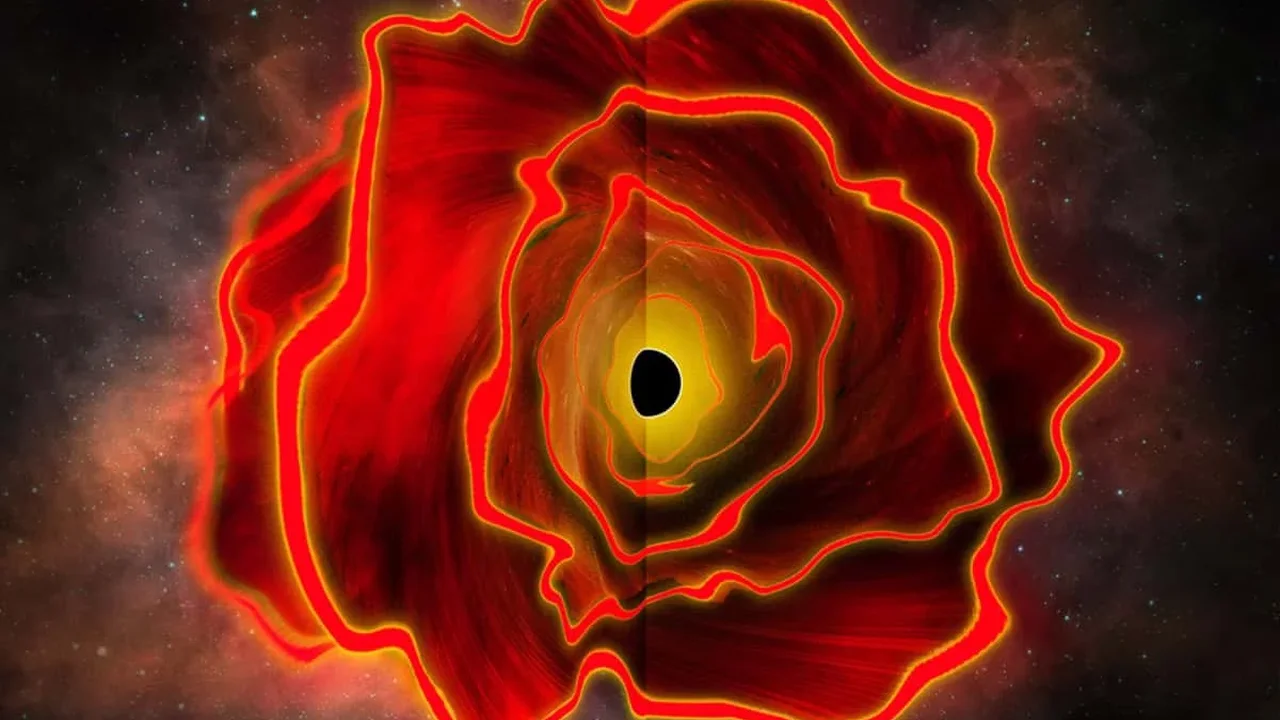
New observations from the James Webb Space Telescope are offering a sharper view of how supermassive black holes sustain themselves over time. Rather than acting as simple cosmic drains, these giants appear to participate in a dynamic cycle that sends gas out, cools it, and later draws it back in.
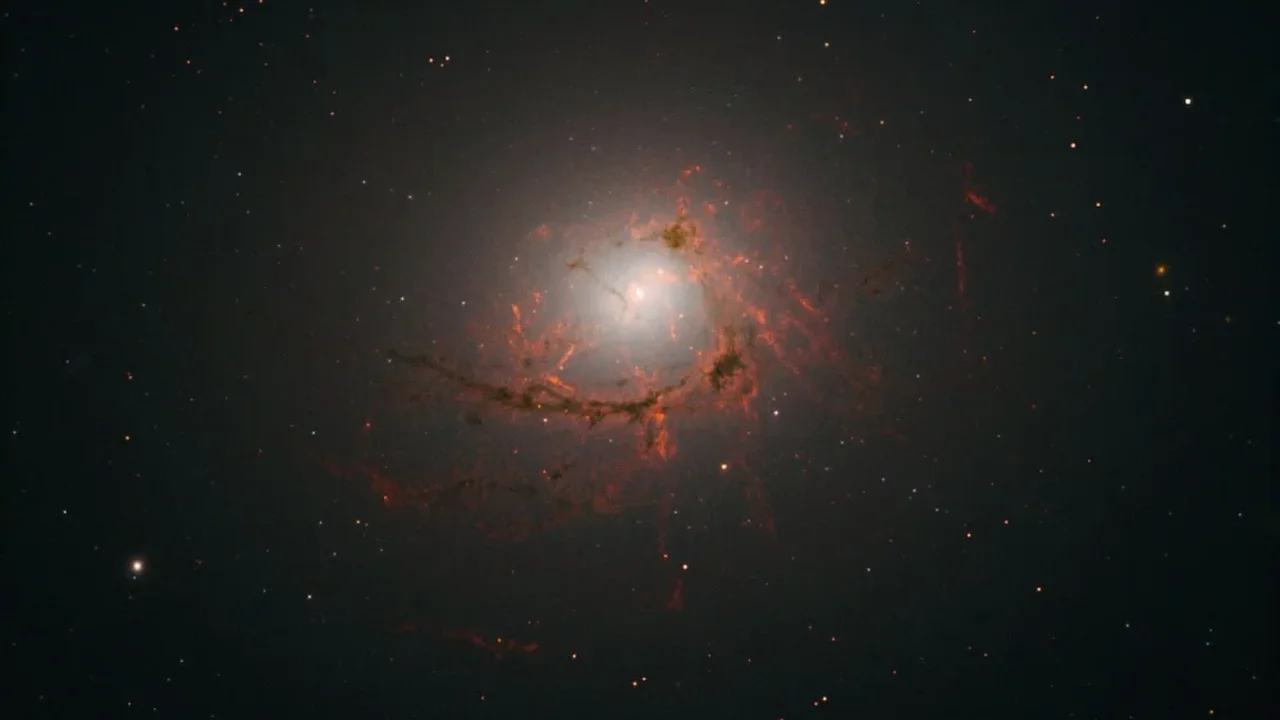
The study focuses on NGC 4696, a large galaxy at the center of the Centaurus Cluster, about 145 million light-years away. Astronomers found a clear bridge between a long gas filament and the rotating disk around the galaxy's central black hole, revealing a feeding route that had only been theorized before.
A Cosmic Recycling Loop
Black holes can launch energetic jets that heat nearby gas and push material outward. Over time, some of that gas cools into narrow filaments shaped by magnetic fields. In this case, Webb's infrared measurements show one of those filaments connecting directly to the inner disk, where gas gathers before moving closer to the black hole.
The disk itself spans roughly 120 parsecs, or nearly 800 light-years, and shows a strong velocity shift across its width. A filament at least 350 parsecs long approaches from the west with matching motion, a sign that fresh material is joining the system. The region also becomes more turbulent where the two structures meet, reinforcing the idea of active inflow.
Researchers used Webb's Near-Infrared Spectrograph to map the area in fine detail, reaching scales of about 10 parsecs. That resolution helped distinguish the flow pattern more clearly than earlier observations from Hubble, which had shown only a mysterious swirl near the galaxy's center.
The findings also fit with computer simulations tailored to NGC 4696, which produced similar filament-fed disk behavior. Together, the data suggest that black hole feedback does not only regulate growth from the outside; it may also help create the next round of fuel.
By showing how gas can return to the center after being heated and redistributed, the study adds a new layer to our understanding of galaxy evolution. It points to a future in which next-generation observatories can trace these cycles across many galaxies, revealing how black holes and their hosts evolve together.