Israel has introduced a new legislative proposal to manage antiquities in the West Bank, which has sparked significant criticism for potentially breaching international law and escalating territorial claims.
On February 8, the Israeli Knesset's Ministerial Committee on Legislation approved the bill for its initial reading. This legislation would empower Heritage Minister Amihai Eliyahu with extensive authority to appoint governing bodies, identify archaeological sites, and acquire land and artifacts throughout the West Bank. The bill is expected to undergo further readings in the Knesset Plenum and may be enacted later this month.
In a joint statement, advocacy organizations including Peace Now and the Geneva Initiative, along with the Israeli NGO Emek Shaveh, labeled the bill as an "extraterritorial annexation," warning it poses a significant threat to the prospects of a negotiated two-state solution. They also highlighted that the legislation contravenes the 1954 Hague Convention and the Fourth Geneva Convention, which forbid an occupying power from making permanent changes or asserting sovereign rights. The groups emphasized that applying Israeli authority to Areas A and B would undermine the Oslo II Accord, which designated civilian oversight of antiquities to the Palestinian Authority.
The Oslo Accords, established in the 1990s, divided the West Bank into three administrative zones: Areas A, B, and C. Under these agreements, the Palestinian Authority is responsible for managing heritage in Areas A and B, while Israel maintains authority over Area C and security in Area B. The framework acknowledged that ancient sites are a shared heritage of both Israelis and Palestinians and proposed the creation of a joint committee to oversee antiquities, although this committee has never convened.
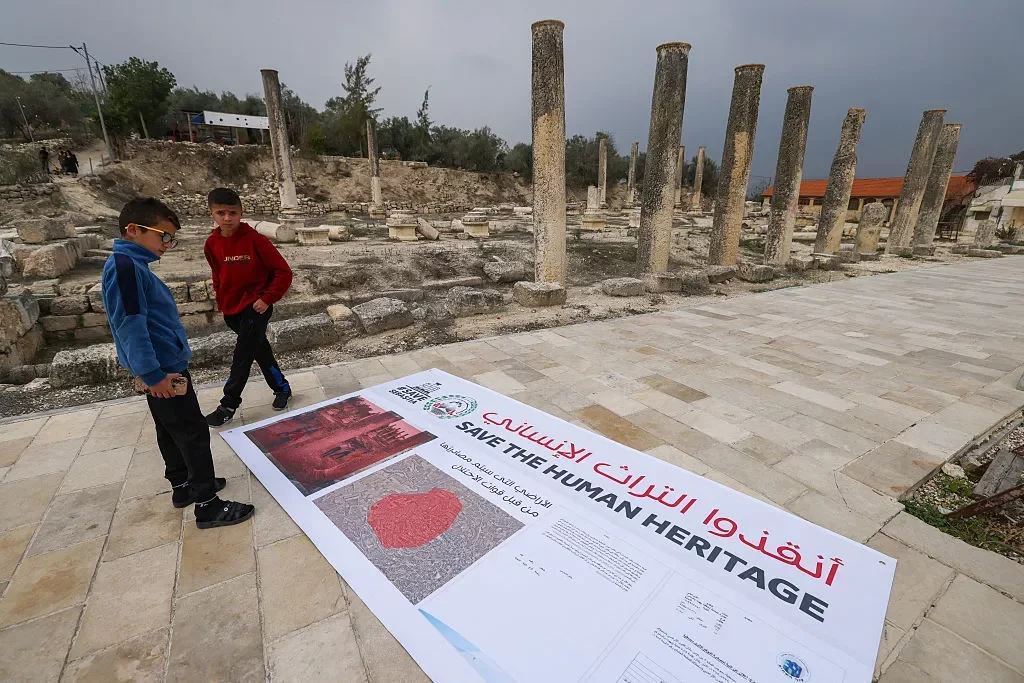
Critics argue that this new bill is part of a broader strategy to erode Palestinian land rights in the West Bank and facilitate the growth of Israeli settlements. Recently, Israeli authorities announced intentions to take control of an archaeological site near the town of Sebastia, which local leaders described as an "aggression" against the approximately 3,500 Palestinians who depend on tourism and agriculture for their livelihoods.
Recognized as a cultural crossroads with a rich history, Sebastia has been on the tentative UNESCO World Heritage list for Palestine since 2012. Its historical significance spans various eras, making it a focal point in the ongoing dispute over control.
Israeli authorities have sought to reclassify the site as part of Israel, citing biblical references and its historical role as the capital of the ancient Israelite kingdom of Samaria. Plans for the area include renaming it Shomron National Park, covering around 450 acres, which would mark the largest land appropriation for an archaeological project in the West Bank since 1967.
Binyamin Har-Even, an official in the Civil Administration, stated that this action aims to protect and rehabilitate the site for future generations. However, Alon Arad from Emek Shaveh criticized the move, asserting that archaeology should serve all communities and not be used as a political tool.
International and local opposition to the proposed legislation has intensified since November, with Palestinian Authority President Mahmoud Abbas condemning it as a "dangerous" attempt to legitimize settlement expansion and land confiscation. A coalition of foreign ministers from several countries also expressed their concern, warning that such actions exacerbate tensions and conflict in the region.