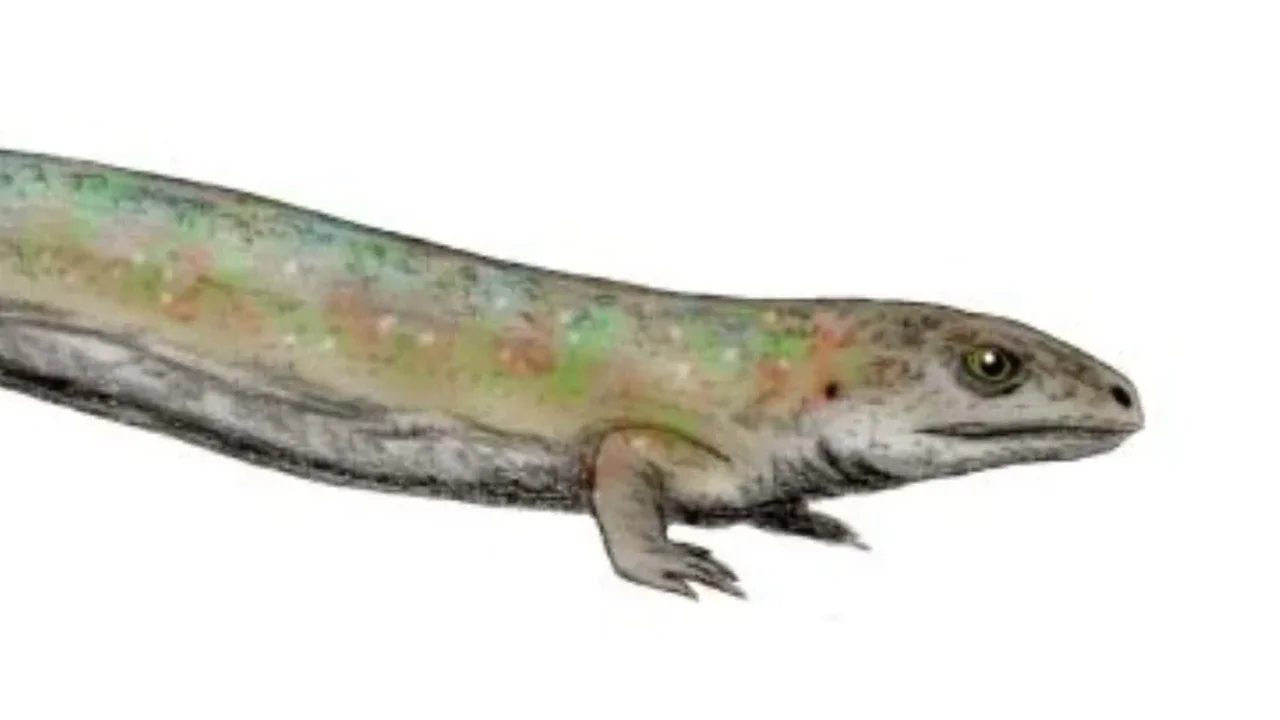
A fossil long regarded as one of the earliest reptiles has revealed a more surprising identity. Westlothiana lizziae, nicknamed "Lizzie," lived around 345 million years ago and was once placed close to the origin of reptiles, birds and mammals.
New high-energy X-ray analysis has now shown that Lizzie was not an early reptile relative. Instead, it belonged to a deeper branch of the tetrapod family tree--the broad evolutionary group that includes all four-limbed vertebrates.
Hidden anatomy changes the picture
The specimen was discovered at East Kirkton in Scotland in 1984 and formally named in 1990. Its five-toed feet, sturdy limbs and pointed digits had made it appear well adapted to moving on land.
Researchers used advanced scanning technology at the European Synchrotron Radiation Facility to examine structures concealed inside the flattened fossil. The scans uncovered bony supports for internal gills, including channels that likely carried blood to these organs. Lizzie's jaws and palate also contained dense fields of tiny tooth-like structures suited to feeding underwater.
These features suggest that the animal spent much of its life in water or along wetland margins, while already possessing some skeletal traits associated with terrestrial movement. Its pointed fingers and toes looked claw-like, but lacked the structural signs expected of fully developed keratin-covered claws.
Evolution was not a straight path
The revised classification shows that characteristics linked with land life emerged earlier and more gradually than once assumed. Animals with functional gills could already have developed limbs and digits capable of supporting movement beyond water.
The finding also encourages caution when interpreting ancient fossil tracks. Claw-shaped impressions alone may not be enough to identify an early amniote--the lineage that later produced reptiles, birds and mammals--because similar features could have appeared in more primitive aquatic tetrapods.
Published in Nature, the study reinforces Lizzie's scientific importance: not as the world's oldest reptile, but as a rare window into a complex evolutionary transition. As imaging tools continue to reveal hidden fossil anatomy, they may reshape how science maps the origins of life on land.