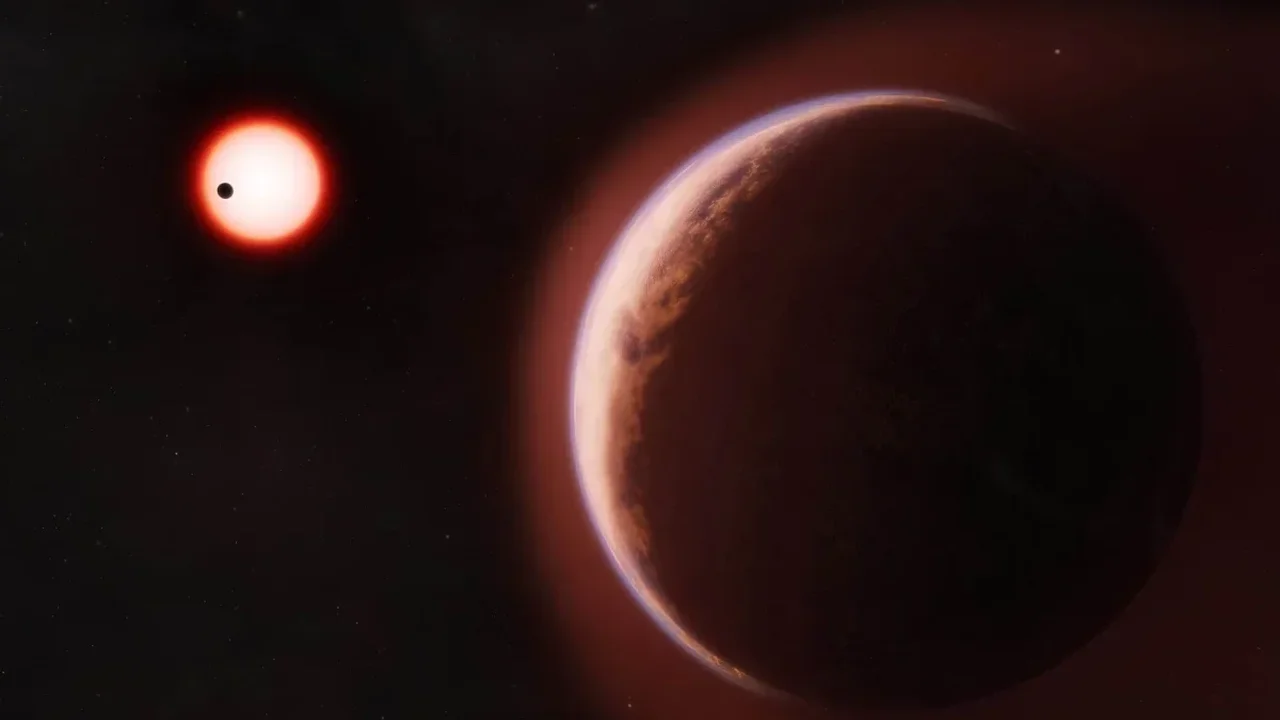
Astronomers have reached a major milestone in the search for habitable worlds: they have identified an atmosphere around a rocky exoplanet in the temperate zone of a nearby star. The planet, LHS 1140 b, is located about 48 light-years from Earth and circles a cool red dwarf every 24.7 days.
According to a study published in Science, the planet is about 5.6 times more massive than Earth and receives roughly 42% of the sunlight our planet gets. That combination makes it one of the most compelling rocky worlds yet found for studying conditions that could support liquid water.
A new method for a difficult search
Detecting atmospheres on small rocky planets is notoriously challenging because the signal is faint and easily lost in the glare of the host star. In this case, researchers focused not on water vapor or carbon dioxide near the surface, but on helium escaping from the upper atmosphere, where it is easier to observe.
The team used models to predict that stellar radiation would strip helium from the planet's atmosphere at a measurable rate. Observations with the WINERED spectrograph on the Magellan Clay telescope in Chile then supported that prediction.
What made the result especially striking was its timing. During one observing night, both LHS 1140 b and its inner sibling crossed the star, but only LHS 1140 b showed the helium signature. When the system was observed again in 2025, that signal had faded, suggesting the atmosphere may be dynamic and layered.
Why it matters
Researchers say the most likely explanation is that the planet has a real atmosphere, with lighter helium high above and heavier gases closer to the surface. That raises the possibility of deeper layers where water could exist, though the planet is not yet confirmed to host oceans or life.
LHS 1140 b is now a priority target for future observations with JWST and Hubble-based programs. Over the next few years, astronomers hope to determine whether water is present and how stable the atmosphere may be.
This discovery marks an important step toward identifying rocky planets with genuine atmospheric systems, and it may help reshape how scientists search for Earth-like worlds in the years ahead.