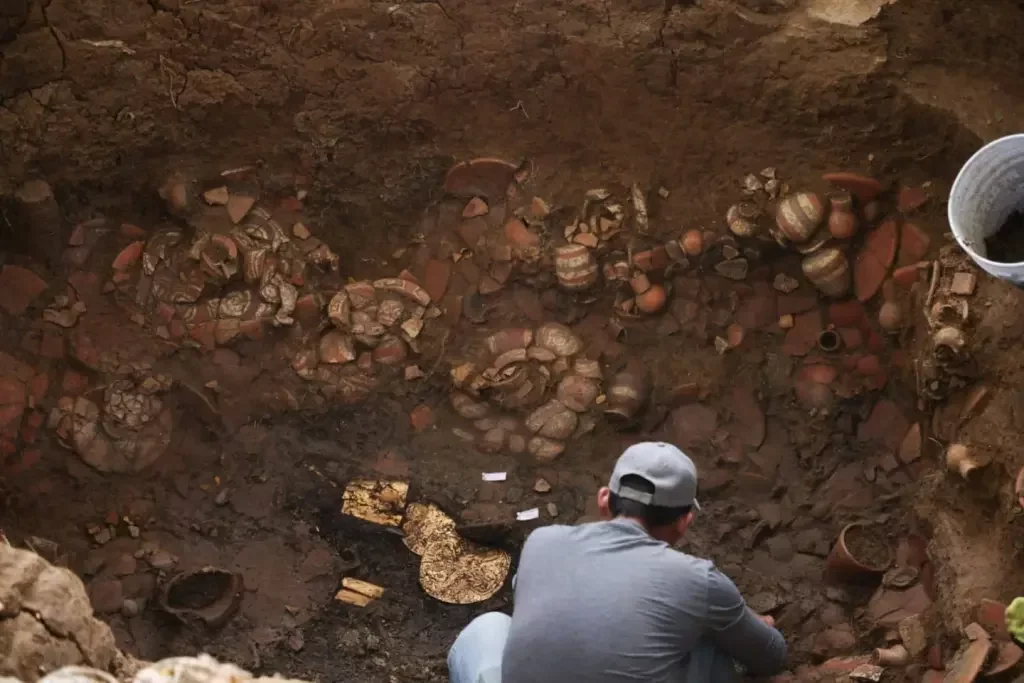
A recently excavated tomb in central Panama has unveiled a treasure trove of artifacts alongside evidence of ritual sacrifice. This 1,000-year-old burial site, known as Tomb 3, is situated within the El Caño Archaeological Park and has captivated archaeologists with its findings.
As detailed by researchers, the tomb is the final resting place of a prominent figure referred to as the 'Lord of Tomb 3.' This individual was interred with an impressive array of gold items, including large pectorals, earrings, and delicately crafted ornaments resembling crocodile teeth and bat wings. Surrounding the central figure were the remains of others, believed to have been sacrificed to accompany him in the afterlife.
Insights into the Gran Coclé Culture
Located approximately 120 miles southwest of Panama City, the site served as a necropolis for the Gran Coclé civilization, which was characterized by a well-organized society led by powerful elites. This culture flourished through trade and elaborate ceremonies, establishing centralized political systems by the 8th century.
According to the Panama Ministry of Culture, the El Caño site functioned as a funerary enclosure, constructed around 700 AD and abandoned approximately 300 years later. It featured not only the notable monoliths but also a cemetery and ceremonial areas with wooden structures. The tomb, believed to have been built around 750 AD, signifies the burial of a significant lord alongside others who were likely sacrificed for his journey into the afterlife, as highlighted by Julia Mayo, director of the El Caño Foundation.
This remarkable discovery sheds light on the complex social structures and rituals of the Gran Coclé culture, often compared to Egypt's Valley of the Kings due to its historical significance. Such findings not only enrich our understanding of ancient civilizations but also inspire future archaeological endeavors that may continue to reveal the intricacies of human history.