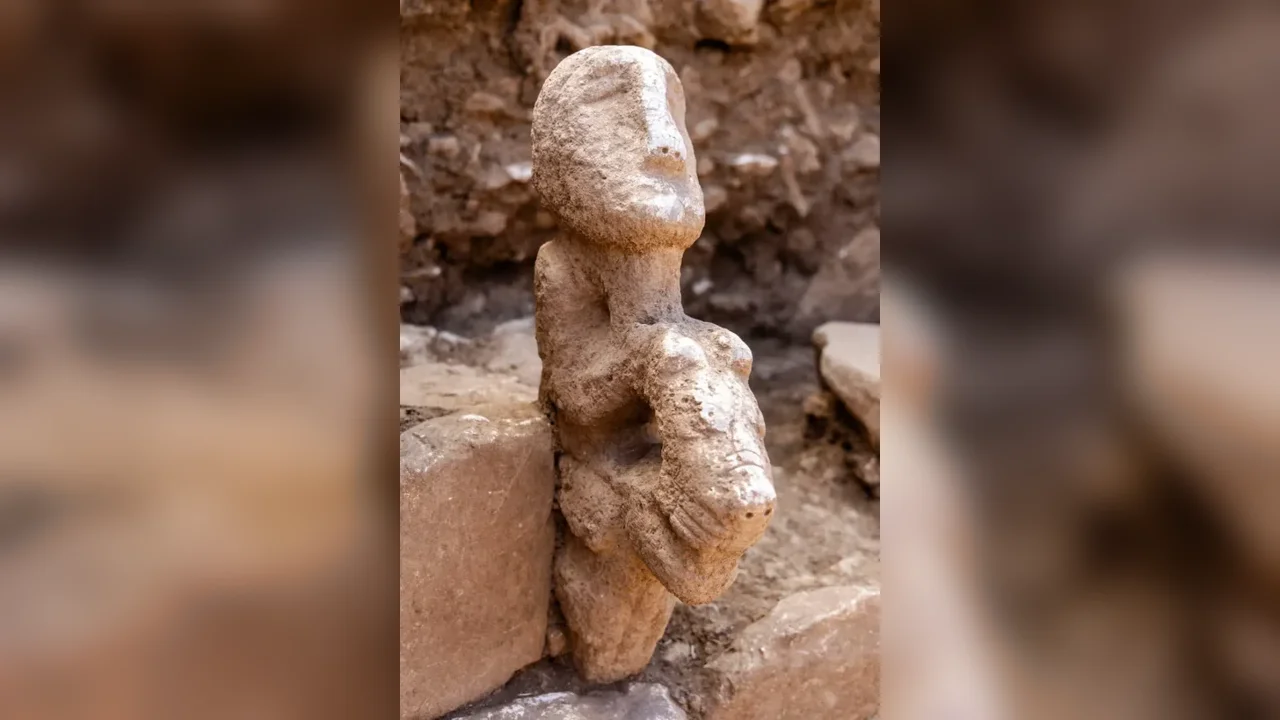
In a remarkable discovery in southwestern Germany, a tiny mammoth figurine carved from tusk, dating back 40,000 years, showcases a sequence of crosses and dots meticulously etched into its surface. This artifact, part of the Aurignacian culture, is among the earliest known artistic creations by modern humans in Europe.
Researchers have long debated the significance of these markings. Were they mere decorations, or did they serve a deeper purpose? A recent study suggests that these symbols may represent an advanced system for storing information.
Unraveling the Ice Age's Symbolic Language
In their investigation, scientists analyzed over 3,000 geometric signs on 260 artifacts from the Swabian Jura region, dating between 34,000 and 45,000 years ago. Employing computational linguistics, they assessed the information density of these engravings.
Professor Christian Bentz from Saarland University stated, "Our research reveals the unique statistical properties of these sign systems, which may be an early precursor to writing." Instead of speculating on the meanings of the symbols, the team measured characteristics such as diversity and repetition rates, comparing them with modern languages and early writing forms like protocuneiform.
The findings were astonishing; the 40,000-year-old marks exhibited a statistical complexity comparable to early writing systems. "I was amazed by the data," Bentz remarked.
Defining Writing in the Ancient Context
So, can we classify these Ice Age markings as writing? The answer hinges on our definition of writing. Traditional definitions require symbols to represent spoken language, which is characterized by low repetition rates. In contrast, the Ice Age symbols frequently repeat, suggesting a different function.
However, if we broaden our definition to include any visible marks for communication, these artifacts certainly qualify. They comprise a distinct set of 22 symbols, including V-shaped notches, lines, crosses, and dots, applied according to cultural rules rather than random patterns.
Archaeologist Ewa Dutkiewicz noted that figurines exhibit a higher informational density than tools, indicating intentionality in the application of these symbols.
A Legacy of Symbolic Communication
What is particularly fascinating is the stability of this encoding system over a span of 10,000 years. Unlike the rapidly evolving Mesopotamian cuneiform, which adapted to represent spoken language, the Aurignacian system remained unchanged until it eventually disappeared.
This research underscores the importance of symbolic communication in early human societies, revealing that our ancestors were engaged in complex forms of information storage long before the advent of formal writing systems.
The study highlights the enduring human drive to convey information through symbols, a practice that has evolved but remains fundamental to our communication today.