When envisioning ancient crocodiles, one might picture them as low-slung aquatic predators. However, the evolutionary history of these reptiles unveils a fascinating and unexpected narrative.
Often referred to as "living fossils," crocodiles have a lineage that spans over 200 million years. Contrary to this label, they have undergone remarkable changes in metabolism, immune responses, and ecological roles. Recent research highlights that some members of the crocodilian family exhibit surprising adaptations.
A Unique Crocodile Ancestor
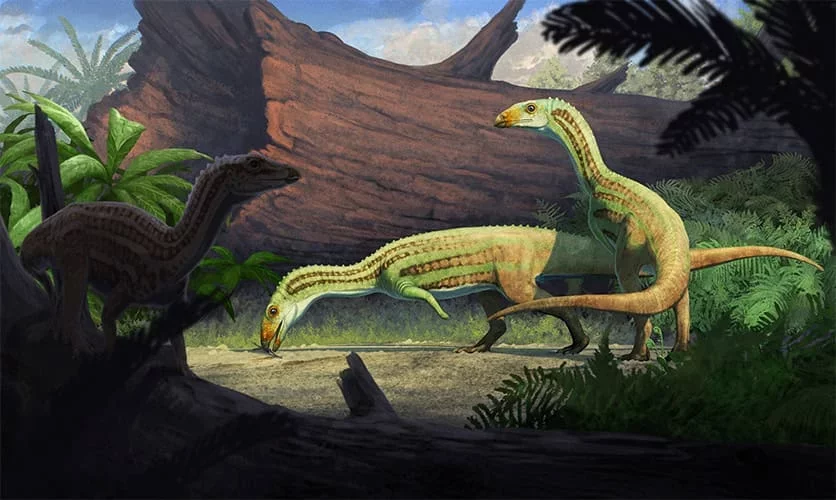
During the Late Triassic period, approximately 225 to 201 million years ago, the crocodilian lineage explored unconventional body structures. Paleontologists in the American Southwest have discovered a poodle-sized, toothless ancestor of crocodiles that transitioned to bipedalism as it matured. This species, named Sonselasuchus cedrus, thrived among evergreen trees.
"This creature is part of the Shuvosauridae family, which shares several convergent traits with dinosaurs, including a toothless beak and lightweight bones," explained lead author Elliott Armour Smith from the University of Washington.
As Armour Smith and colleague Professor Christian Sidor noted, this species' posture evolved with age. "We believe these animals began life on four legs and later adopted bipedalism," he stated.
A Fascinating Evolutionary Shift
Understanding how an extinct species altered its locomotion requires extensive fossil evidence. A decade-long excavation led by Professor Sidor at Arizona's Petrified Forest National Park yielded over 3,000 fossils, including those of Sonselasuchus.
With a large sample size, researchers observed significant changes in limb proportions, indicating that the juvenile Sonselasuchus primarily moved on four legs while transitioning to bipedalism in adulthood.
An Evolutionary Advantage
Such transitions between quadrupedalism and bipedalism are more common in nature than one might expect. Humans, for example, undergo this transformation during early development. Similar shifts can also be observed in modern lizards, which may switch to bipedalism for speed.
As these ancient reptiles grew, they likely relied more on their hind limbs for movement. "This hypothesis requires further testing to clarify how Sonselasuchus stood and moved," Armour Smith remarked.
Convergent Evolution in Action
Sonselasuchus is part of a unique group of reptiles known as shuvosaurids, which exhibit striking similarities to ostrich-like dinosaurs. This phenomenon illustrates convergent evolution, where different species independently develop similar traits due to comparable environmental pressures.
Despite diverging from a common ancestor over 250 million years ago, both crocodilian and dinosaur ancestors adapted to their ecosystems in similar ways, leading to the evolution of traits like bipedalism.
Survival Strategies in a Competitive Environment
Standing upright could have provided Sonselasuchus with vital advantages, such as spotting predators or accessing higher vegetation for food. At around 25 inches tall, it likely occupied a mid-tier position in the food chain, feeding on soft plant matter and possibly small invertebrates.
Redefining "Living Fossils"
Modern crocodiles are often termed "living fossils," suggesting they have remained unchanged over millions of years. Discoveries like Sonselasuchus challenge this notion, revealing a diverse and innovative evolutionary history.
"Today's crocodiles are as evolutionarily creative as their extinct relatives," Armour Smith concluded. The findings were published in the Journal of Vertebrate Paleontology, underscoring the dynamic nature of evolution.