Recent research featured in Nature Ecology and Evolution reveals a significant evolution in the dietary habits of early land vertebrates. Scientists have identified a 307 million-year-old fossil of one of the earliest known terrestrial vertebrates capable of consuming plants.
Arjan Mann, assistant curator of fossil fishes and early tetrapods at the Field Museum in Chicago and co-lead author of the study, states, "This is among the oldest four-legged animals known to eat vegetables. It indicates that the exploration of herbivory dates back to the earliest terrestrial tetrapods, the ancient ancestors of all land vertebrates, including humans."
Zifang Xiong, a PhD student at the University of Toronto and co-lead author, adds, "This specimen is the first of its kind to undergo a detailed 3D reconstruction, enabling us to investigate its skull and uncover its specialized teeth, which helps trace the origins of herbivory on land."
Tyrannoroter heberti: An Unexpected Diet
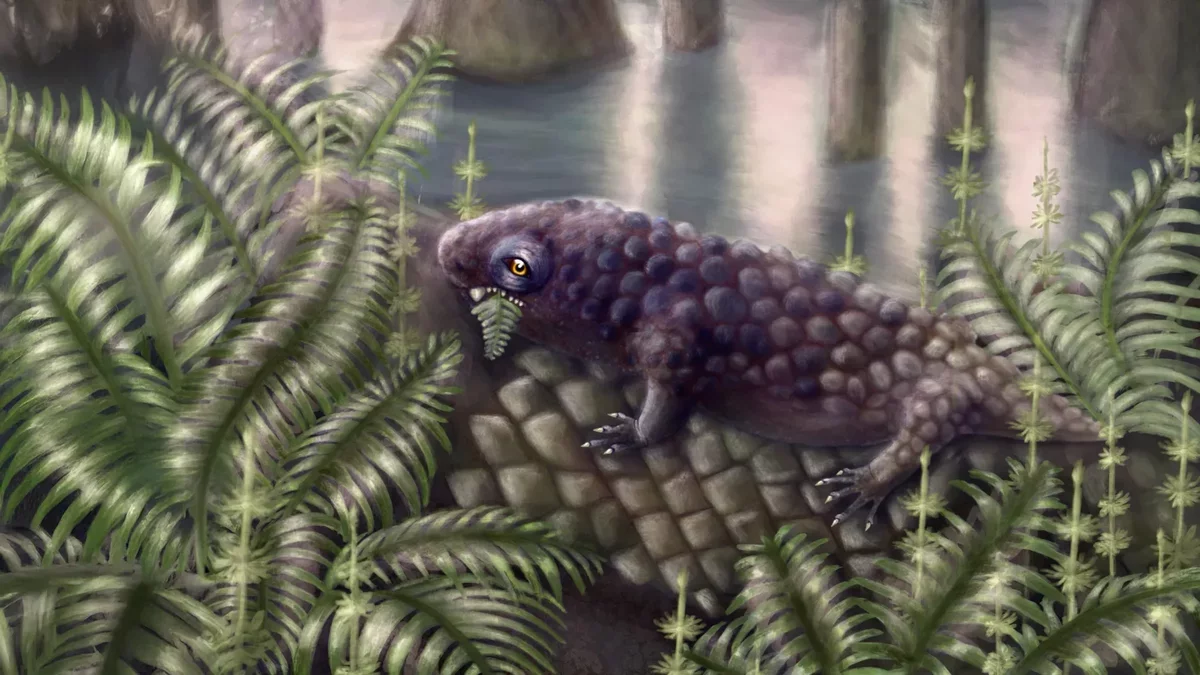
The newly discovered species has been named Tyrannoroter heberti, honoring its discoverer, Brian Hebert. Currently, only the skull has been found, and based on its size and comparisons with related fossils, researchers estimate this animal was a robust four-legged creature approximately one foot long.
"Its size and shape were comparable to that of an American football," Mann explains. While modest by today's standards, it was among the largest terrestrial animals of its time. Though it may have resembled a lizard, it predated the divergence of reptiles and mammals, meaning it was not classified as a reptile.
A Remarkable Fossil Discovery in Nova Scotia
The fossil was unearthed on Cape Breton Island in Nova Scotia, a region notorious for its challenging and sometimes perilous excavation conditions.
"Nova Scotia experiences the highest tides globally, making our work a race against the tide," Mann notes. "The terrain is rocky, and fossils are embedded in cliffs along the shore. Paleontologists generally dislike excavating cliffs due to the risk of collapse."
Brian Hebert, a passionate paleontologist from Nova Scotia, discovered the small skull within a fossilized tree stump during a field season led by Hillary Maddin, a paleontology professor at Carleton University.
Mann describes the skull as "wide and heart-shaped, narrow at the snout but broad at the back." Within moments of examining it, he recognized it as a pantylid microsaur.
Pantylids and Their Role in Vertebrate Evolution
Pantylids signify a crucial phase in the evolution of land vertebrates. The first lobe-finned fish that developed limbs for terrestrial movement still heavily depended on aquatic environments.
Mann explains, "Pantylids emerged in the second phase of terrestrial adaptation, when animals became permanently suited for life on dry land." They are regarded as stem amniotes, closely related to the tetrapod group that later evolved eggs capable of surviving outside aquatic settings. Over time, stem amniotes gave rise to reptiles and the early ancestors of mammals.
CT Scans Unveil Specialized Teeth for Plant Processing
To analyze the fossil, Mann meticulously removed the surrounding rock. However, the skull was fossilized with the mouth closed, concealing internal structures like the brain case. To explore these features, the team employed CT scanning technology, creating a detailed three-dimensional model from a series of X-ray images.
Maddin, the study's senior author, expresses excitement about the findings, stating, "We were eager to discover what lay hidden inside this animal's mouth once scanned -- a mouth filled with an additional set of teeth designed for crushing and grinding food, particularly plants."
Some of these teeth were located on the roof of the mouth, indicating the animal's capability to process vegetation. These findings suggest that stem amniote relatives began experimenting with plant consumption earlier than previously thought.
Hans Sues, senior research geologist and curator of vertebrate paleontology at the Smithsonian National Museum of Natural History and co-author of the study, emphasizes, "Tyrannoroter heberti is significant because it was traditionally believed that herbivory was exclusive to amniotes. As a stem amniote, it possesses specialized teeth that could facilitate plant processing."
A Varied Diet and Evolutionary Shifts
Nonetheless, Tyrannoroter was likely not a strict herbivore.
Mann recalls, "During my post-doctoral fellowship at the Smithsonian, Hans Sues often remarked that nearly all herbivores today consume some animal protein, viewing herbivory as a gradient."
This creature likely consumed insects and other small prey alongside plants. Crushing insect exoskeletons may have aided early tetrapods in developing the ability to process tougher plant materials. Consuming plant-fed insects could have also introduced beneficial gut microbes, enhancing their capacity to digest vegetation.
Understanding Climate Change at the End of the Carboniferous
In addition to shedding light on the origins of herbivory, this discovery may offer insights into how plant-eating animals adapt to environmental changes. Tyrannoroter existed towards the end of the Carboniferous Period, a time marked by significant climate shifts and the transition from an icehouse to a greenhouse world.
Mann explains, "At the end of the Carboniferous, rainforest ecosystems collapsed, leading to a period of global warming. The lineage of animals to which Tyrannoroter belongs struggled during this time. This finding could provide valuable data regarding the impact of rapid climate change on plant-eating animals and their ecosystems."
This fossil not only illuminates the early evolution of herbivory but also highlights the vulnerabilities of such diets amid swift environmental transformations.