A brief account of a total solar eclipse recorded in China more than 2,700 years ago is helping scientists refine estimates of how Earth rotated in the distant past. The event took place on July 17, 709 BCE, and was chronicled in the Spring and Autumn Annals.
A small location correction, a major difference
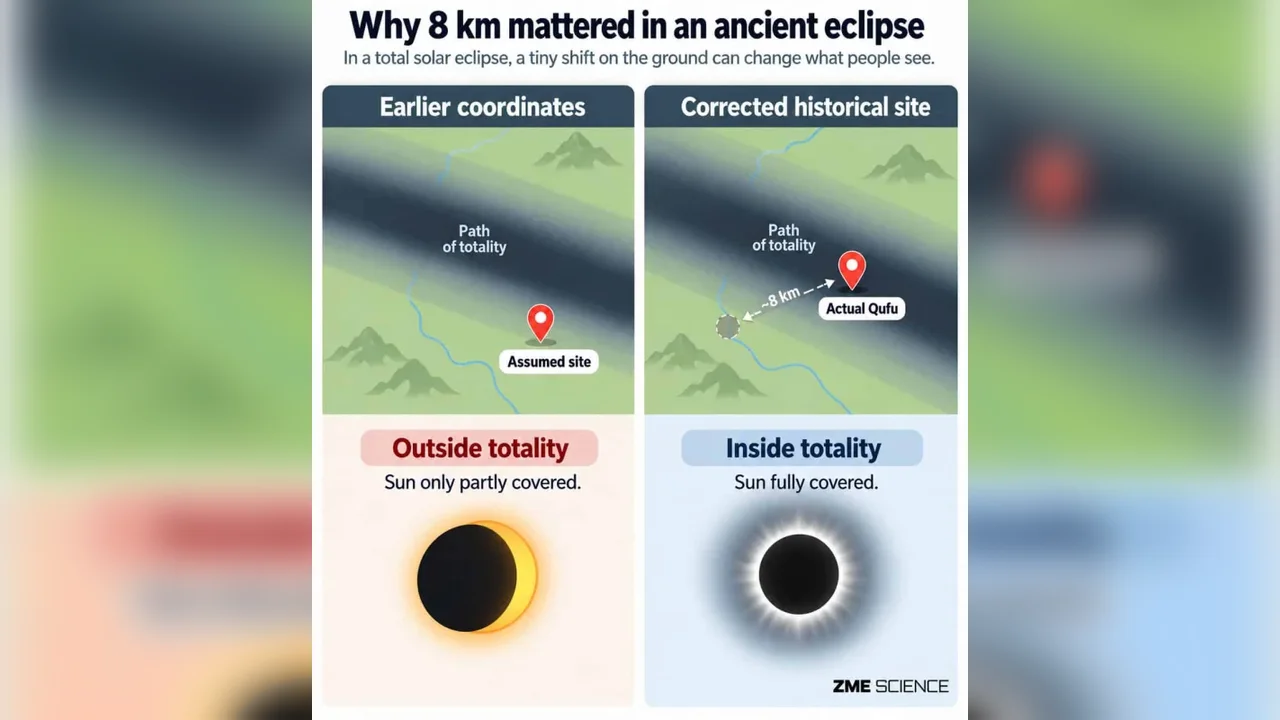
Modern calculations initially suggested that the eclipse's path of totality missed Qufu, the ancient capital of the state of Lu, where the observation was thought to have been made. Researchers led by Hisashi Hayakawa of Nagoya University revisited archaeological records and found that previous studies had placed the city about eight kilometres from its historical location.
That adjustment matters because the Moon's shadow during a total eclipse follows a narrow path. With the corrected coordinates, the ancient account becomes consistent with revised estimates of Earth's rotation at the time.
History meets astronomy
Earth's spin changes gradually under the influence of the Moon's tides and other processes. Though these shifts are tiny over a human lifetime, they accumulate across centuries. Historical eclipse observations give astronomers another way to test how the planet's rotation has varied.
The researchers also considered a later Chinese account describing the eclipsed Sun as yellow above and below--a possible reference to the solar corona. Their reconstruction, compared with evidence of solar activity preserved in tree rings, suggests such coronal features were plausible, though the interpretation cannot be confirmed conclusively.
The findings were published in The Astrophysical Journal Letters. By bringing archaeological precision together with astronomical modelling, this work shows how historical records can sharpen our understanding of Earth and the Sun--and help improve models of their changing behaviour.