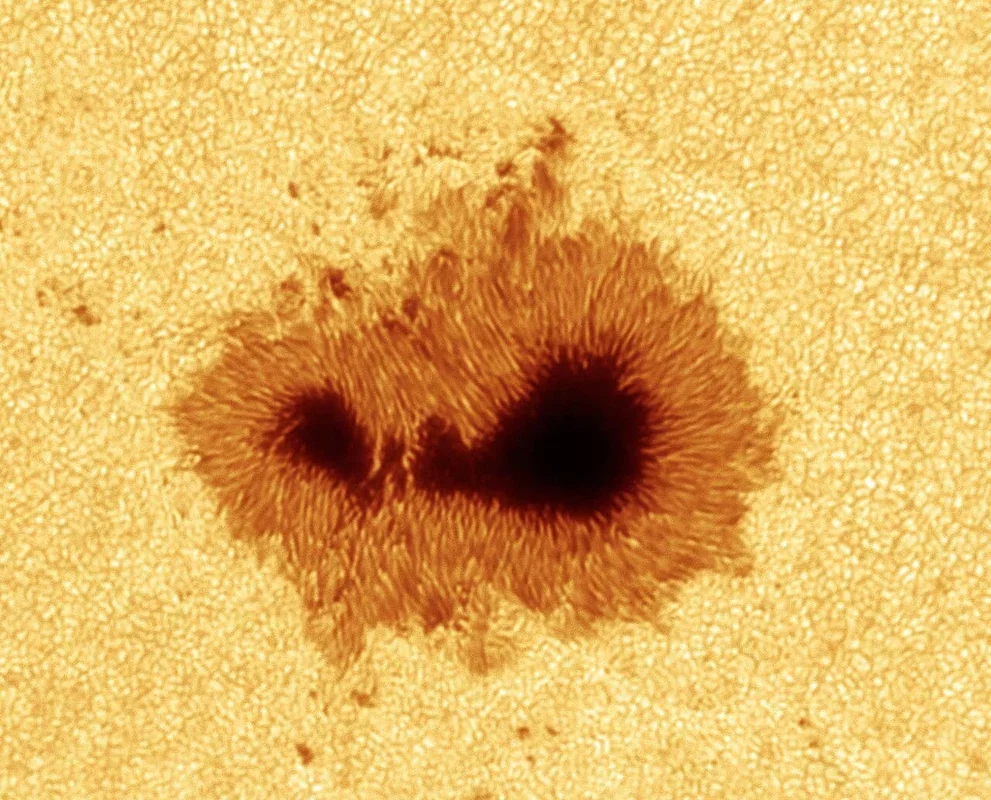
In 1607, renowned astronomer Johannes Kepler created a remarkable sketch by projecting sunlight onto paper, inadvertently capturing the first known image of a sunspot. Initially misidentified as Mercury, this drawing has now provided crucial insights into the Sun's magnetic behavior during a significant 70-year period of solar quietness.
Astrophysicists have recently analyzed Kepler's historic sketch to better understand the Sun's magnetic activity leading up to this mysterious phase. Their findings suggest that the Sun maintained a more consistent cycle than earlier theories proposed, shedding light on its behavior before entering a Grand Minimum.
Understanding Solar Dynamics
The Sun operates on an approximately 11-year cycle, characterized by fluctuations in magnetic activity. During solar minimum phases, the Sun appears calm, while solar maximum periods are marked by intense magnetic turmoil, resulting in phenomena like solar flares and sunspots. Current observations place us within Solar Cycle 25.
In the early 17th century, telescopes were still in development, and Kepler utilized a camera obscura to project the Sun's image. This innovative technique allowed him to observe the Sun's surface, revealing sunspots--cooler regions caused by magnetic disturbances that suppress heat.
Kepler's initial misinterpretation of his observation as Mercury was corrected a decade later, yet his sketches remained largely overlooked in solar cycle analyses. Hisashi Hayakawa, a researcher from Nagoya University, emphasized the significance of Kepler's work, stating that it represents the oldest sunspot sketch derived from instrumental observation.
The Maunder Minimum and Its Implications
The period from 1645 to 1715, known as the Maunder Minimum, was marked by a striking absence of sunspots. While telescopic records from this era are scarce, researchers have turned to tree-ring data to reconstruct solar activity. Cosmic rays, which increase during low solar activity, leave a distinct carbon-14 signature in tree rings, providing a historical record of solar behavior.
However, interpretations of this data have varied, leading to debates over the nature of solar cycles prior to the Maunder Minimum. Kepler's observations have now provided a pivotal reference point, confirming that the Sun transitioned smoothly into the Maunder Minimum rather than experiencing a sudden halt in activity.
Connecting Past and Future
By analyzing Kepler's drawings alongside modern solar models, researchers have positioned his observations at the end of Solar Cycle 14, affirming the existence of a regular 11-to-14-year cycle. This understanding enhances our grasp of solar dynamics and offers valuable context for interpreting solar behavior during this critical historical transition.
Kepler's unintentional contribution, stemming from his simple sketch, has proven to be a vital link in the historical narrative of solar activity, showcasing how past observations can inform our understanding of the Sun's future behavior.
The study is published in The Astrophysical Journal Letters, illustrating how historical data can illuminate contemporary scientific inquiries.