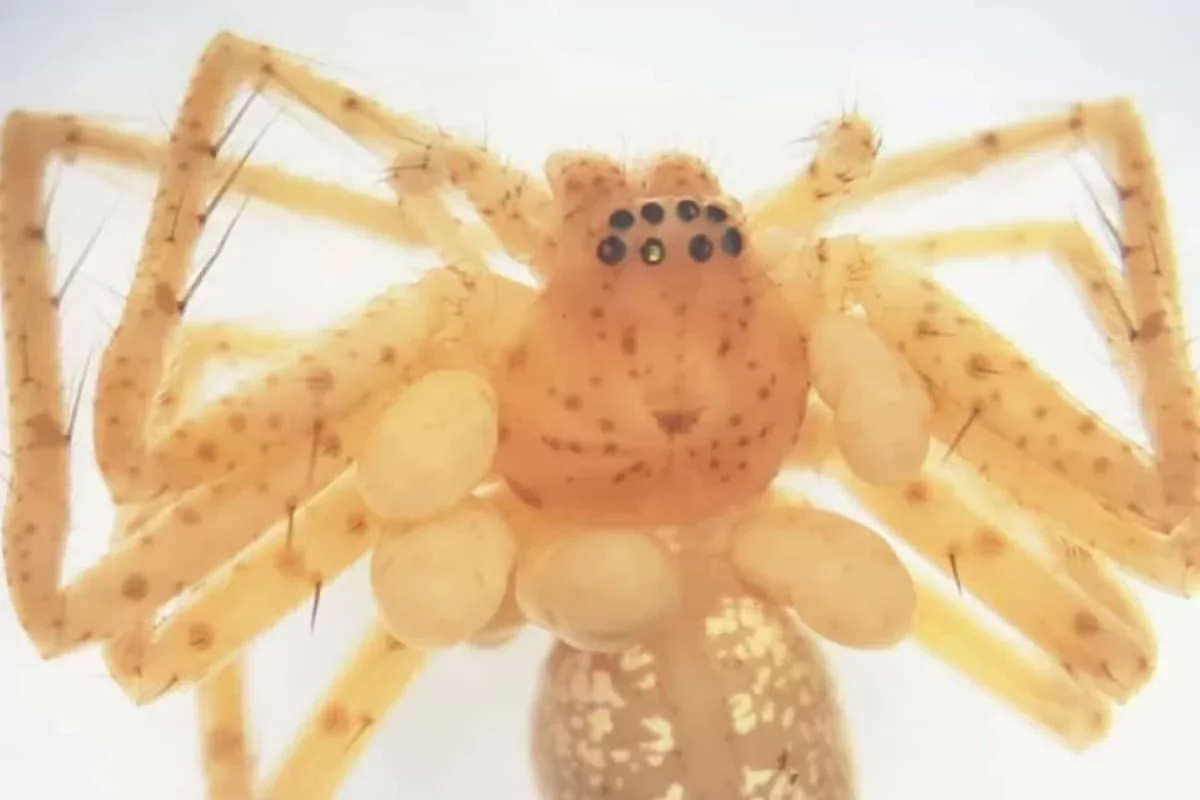
A recent study has unveiled a remarkable finding in Brazil's Atlantic Forest: a juvenile spider, initially appearing unremarkable, was discovered to have a peculiar adornment around its waist--a string of tiny, pearly spheres. Upon closer examination, researchers realized these weren't mere decorations; they were parasitic mites.
This intriguing discovery, published in the International Journal of Acarology, marks only the second documented instance of spider-parasitic mites in Brazil, highlighting the significance of a species first identified decades ago.
The Necklace of Mites
The research began at the Zoological Collections Laboratory in Pinheiral, Rio de Janeiro. While analyzing young spiders, scientists noticed an unusual beaded feature where the spider's body meets its abdomen. Expert acarologist Ricardo Bassini-Silva was called in for further investigation.
Bassini-Silva quickly identified the beads as mite larvae, each measuring just half a millimeter and swollen with the spider's hemolymph, akin to blood.
This finding is particularly significant given Brazil's immense spider diversity--over 3,000 species--yet only one spider-parasitic mite had been recorded before, belonging to a different family.
Employing light and scanning electron microscopy, the team described a new species, Araneothrombium brasiliensis, part of a genus first recognized in Costa Rica in 2017 and now documented for the first time in Brazil.
Weakness in Spider Armor
The mite larvae, measuring about half a millimeter, infest spiders that are only a few millimeters long, indicating a significant infestation. All examined larvae were engorged, having fed on the spider's hemolymph.
"For this group of mites, many parasitic species are known primarily through their larvae, as they become free-living predators in adulthood, making them elusive," explained Bassini-Silva.
Despite their tough chitinous exoskeletons, spiders have a vulnerable area--the pedicel, the slender tube linking the cephalothorax and abdomen--where mites can penetrate.
Understanding Ecosystem Dynamics
Parasites like these mites are often overlooked, yet they play crucial roles in ecosystems. The Araneothrombium genus, first identified in Costa Rica, being found in Brazil suggests these parasites may be more widespread than previously thought. They thrive in humid environments, waiting for juvenile spiders to latch onto.
The larvae cluster around the spider, forming the necklace-like appearance that drew researchers' attention. Their preference for juvenile spiders likely stems from their smaller size, making them easier targets.
Notably, the mites were found on spiders from three different families, including the formidable huntsman spider, indicating their adaptability as opportunistic feeders.
This discovery raises intriguing possibilities; Araneothrombium brasiliensis may not be limited to spiders. With Brazil's vast diversity of spider species, the potential for discovering new parasitic mites is immense.