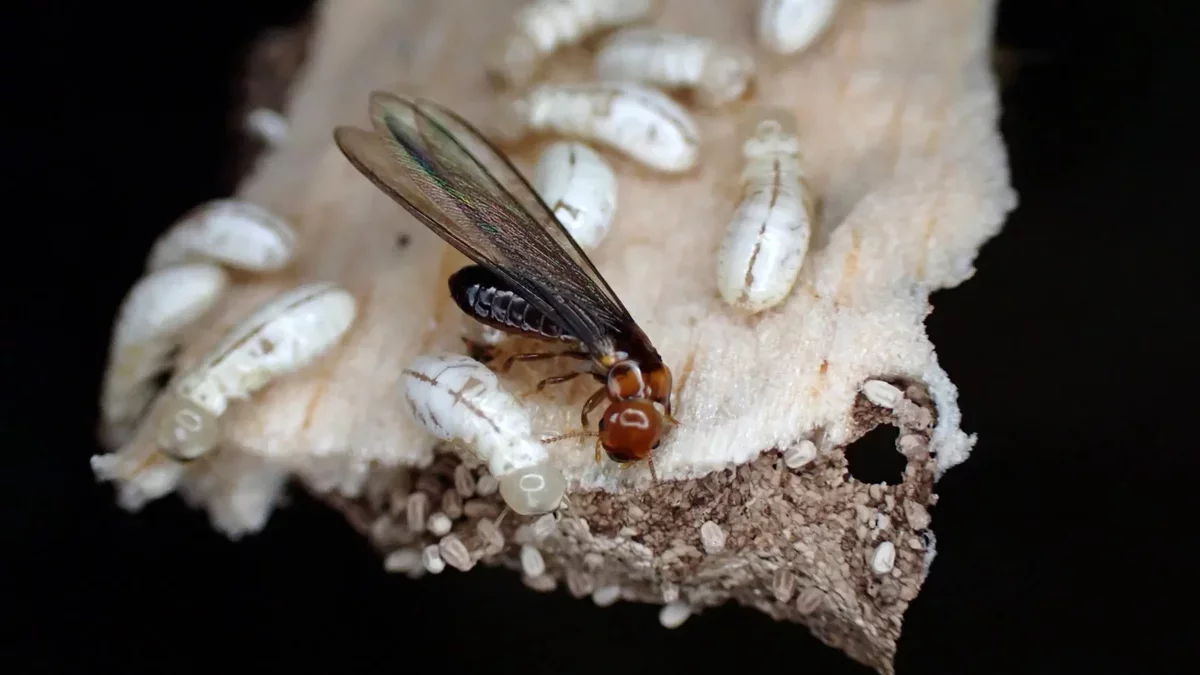
Researchers from the University of California, Riverside have discovered that bistrifluron, a chemical specifically designed to inhibit the formation of new exoskeletons in termites, can effectively eradicate drywood termite colonies. This groundbreaking research was published in the Journal of Economic Entomology. Laboratory tests revealed that the treatment successfully eliminated approximately 95% of a termite colony without the toxicity concerns commonly associated with traditional pest control methods.
A Safer Approach to Termite Control
"This chemical offers a more environmentally friendly alternative compared to conventional treatments for drywood termite infestations," explained Nicholas Poulos, the lead author of the study and a doctoral student in UCR's Department of Entomology. "It is designed to target insects specifically, posing no harm to humans."
The effectiveness of bistrifluron stems from its ability to target the unique biological structure of termites. Unlike humans, which have internal skeletons, termites possess an exoskeleton composed primarily of chitin--a robust natural material also found in fungi, fish scales, and cephalopod beaks.
Chitin is crucial for insects, providing structural support, protection, and muscle attachment points. As termites grow, they must molt their old exoskeleton and create a new one, a process they undergo about seven times throughout their lives.
Bistrifluron disrupts this molting process. Instead of rapidly poisoning the termites, it prevents them from synthesizing the chitin required for their new protective shell.
"Once termites reach a specific developmental stage, molting is unavoidable," noted Dong-Hwan Choe, a UCR entomology professor and senior author of the study. "With a lethal dose of this compound, they will attempt to shed their old exoskeleton but will lack the new one needed for protection."
Self-Distribution Among Termites
The action of bistrifluron is gradual. Initially, it reduces the activity and feeding of termites. Over time, it inhibits successful molting, leading to their demise.
The 2025 study tested three chitin synthesis inhibitors against the western drywood termite, Incisitermes minor. Bistrifluron outperformed chlorfluazuron and noviflumuron, achieving 99% mortality over 60 days in a no-choice test and 96% in a choice test with a 0.1% concentration.
Notably, after consuming treated wood, termites shared the compound with others in their colony. Even when only 5% of termites were initially exposed, 100% mortality was observed by day 90, demonstrating the chemical's effective distribution within the colony.
"This method of targeted treatment can effectively address larger colonies more efficiently than current practices," Choe stated. "Its lower toxicity and localized application could revolutionize termite control."
Future Implications
As climate change alters habitats, termites may expand into previously unsuitable regions. This innovative approach to termite management could pave the way for sustainable solutions, ensuring homes remain protected from infestations.