About 1.43 million years ago, a small group of upright hominins crossed a muddy lakeshore near what is now Lake Turkana in northern Kenya. Their steps were quickly covered by sand, preserving a rare snapshot of ancient movement that researchers have now reexamined in detail.
A new study in Proceedings of the National Academy of Sciences suggests the tracks may belong to Paranthropus boisei, a human relative long imagined as short and heavily built. Yet the footprints tell a different story: some are large enough to imply individuals nearly 1.83 meters tall and around 74.8 kilograms, closer to the size range associated with Homo erectus.
A rare window into ancient mobility
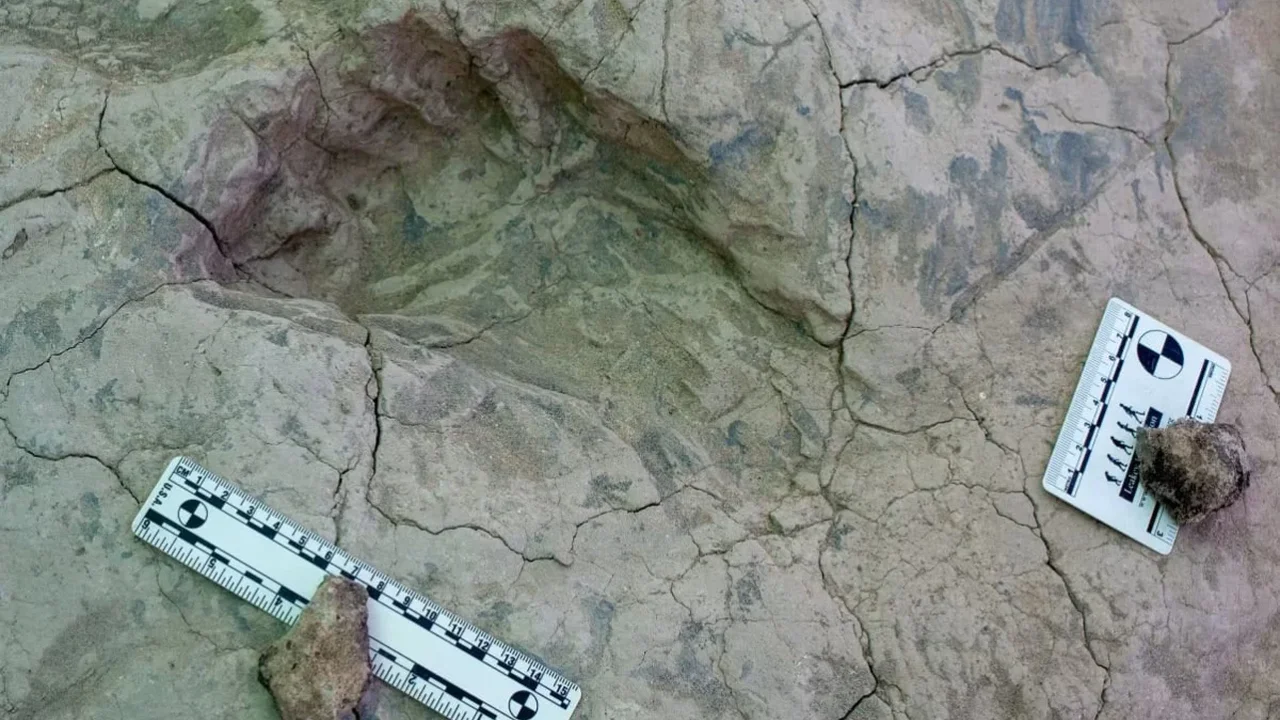
The site, known as GaJi10, was first noticed in 1978 by Smithsonian paleontologist Kay Behrensmeyer. After later excavations in 2016 and 2023, the team identified 21 hominin footprints from eight individuals. Volcanic ash in the surrounding layers helped date the surface to roughly 1.43 million years ago.
Footprints are especially valuable because they capture behavior in motion. Unlike isolated bones, they reveal how ancient humans and their relatives moved across landscapes, how they distributed weight, and how they traveled in groups.
The new prints resemble earlier tracks linked to P. boisei, including flatter arches and a big toe angled more outward than in modern humans. Still, their unusually large size leaves room for debate. They may represent a larger-than-expected body size for the species, or they may instead belong to Homo erectus.
Most known P. boisei fossils come from skulls and jaws, so its body proportions have remained difficult to reconstruct. Recent fossil evidence, including a partial skeleton described in Nature in 2025, has already helped show that this hominin was more adaptable than older stereotypes suggested.
The trackway also hints at social behavior. The footprints appear to come from several mostly adult males moving together across a shoreline where water, food and large animals all converged. That pattern suggests cooperation may have offered an advantage in a demanding environment.
Whether the makers were Paranthropus boisei or Homo erectus, the discovery adds a new layer to the story of human evolution. It shows that ancient hominins were not simply small, static figures from the past, but varied, mobile and capable of sharing the same landscapes in complex ways. In the future, finds like this may reshape how we picture the diversity of early human relatives.