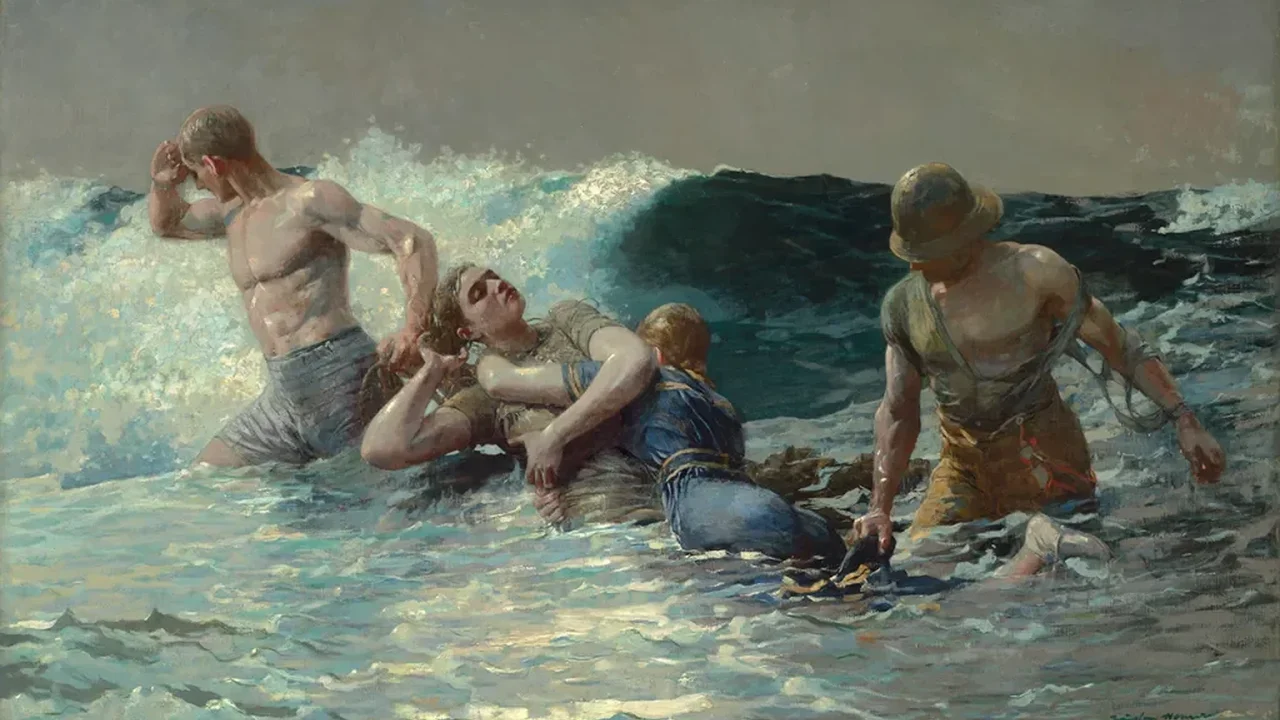
Portland Museum of Art in Maine is presenting a focused look at Winslow Homer through the exhibition "Winslow Homer: Painter, Etcher," which highlights a brief but pivotal phase in his printmaking career. The show brings together oils, watercolors, studies, proofs, and the full range of his etchings to trace how Homer transformed familiar subjects into sharper, more distilled compositions.
One key work, Saved (1889), reimagines the earlier painting The Life Line by stripping the scene to its most dramatic elements: a rope, a rescue device, and the force of the sea. The result shows how Homer used etching not as a copy of painting, but as a medium with its own visual language. The exhibition also places his work within the broader revival of etching in the late 19th century, when artists were rethinking the value of hand-made prints in an age of mechanical reproduction.
Homer, who began as a newspaper illustrator and later became known for painting, returned to printmaking in the 1880s with a renewed sense of experimentation. Working from his studio in Prouts Neck, Maine, he explored the possibilities of line, texture, and tone with remarkable precision. The show follows that process closely, revealing how copper plates, ink, acid, and paper shaped the final image.
Among the standout works is Two Heads (Study after Undertow), a rare example of Homer developing ideas directly in print. Another highlight, Fly Fishing, Saranac Lake (1889), shows him adapting a watercolor study into an etching that preserves the balance of reflection, transparency, and tension. Together, these works underline Homer's ability to move fluidly between media while keeping his artistic identity intact.
By opening a window onto Homer's methods, the exhibition offers viewers a vivid lesson in artistic reinvention. It suggests that the future of art appreciation may lie not only in finished masterpieces, but also in understanding the creative decisions that bring them to life.