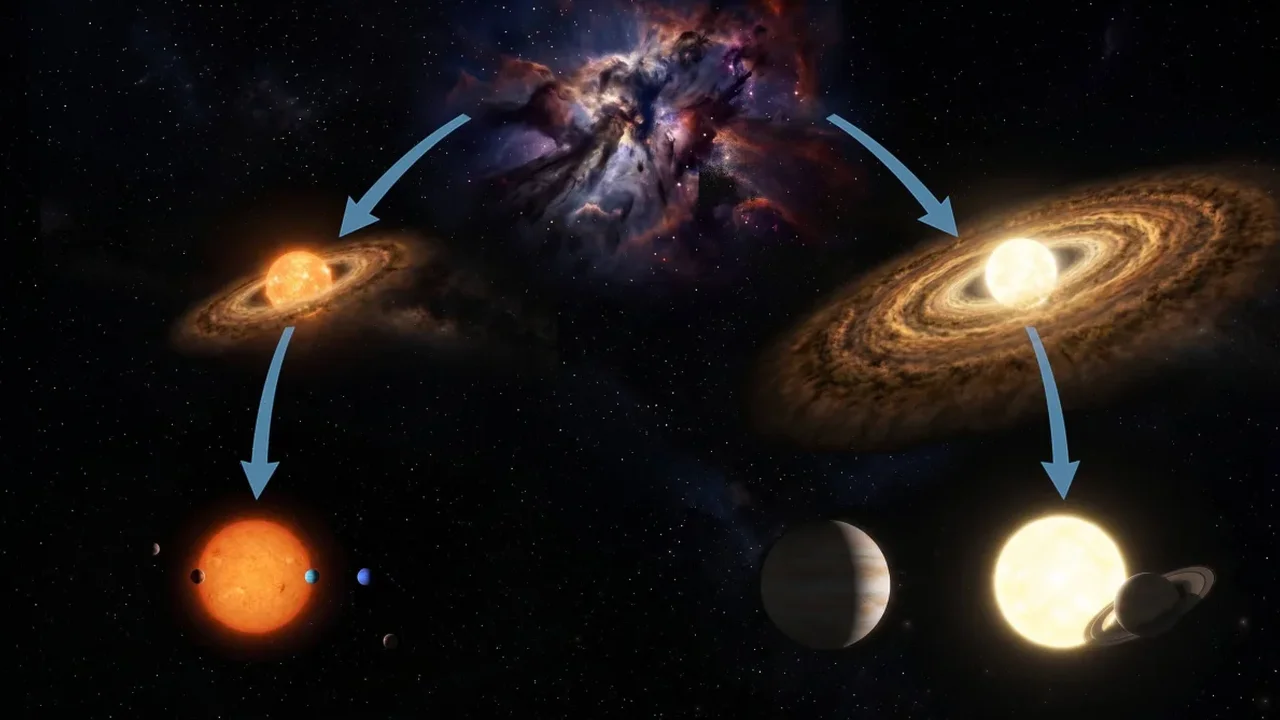
An analysis of around 300 well-characterized multi-planet systems suggests that a star's traits may help shape the planets around it--and influence how those systems evolve. The findings point to two broad families of planetary systems, each with distinct characteristics.
One family is made up of wide, massive systems, whose planets together can weigh two to 10 times as much as the planets in our Solar System. These systems are more often found around stars that are more massive and contain more elements heavier than hydrogen and helium than the Sun.
The second family is more compact and lower in mass. Its planets tend to be similar in size, a pattern astronomers call "peas in a pod," and often orbit close to stars with mass and composition similar to--or lower than--the Sun's.
How stars shape planetary systems
Researchers compared orbital patterns and other features, including dynamical temperature--a measure of how far a system's orbits depart from orderly, circular paths in a shared plane. The term does not describe planetary surface heat. The more massive systems showed stronger signs of gravitational disruption and orbital upheaval.
Computer simulations suggest that both a system's starting conditions and its later evolution matter. Around massive, element-rich stars, more material may be available to build planets. If planets grow large early, the system can become unstable, and some worlds may be lost over time.
The international team, including researchers from Italy's National Institute for Astrophysics (INAF) and the University of Valencia, also assessed whether differences in planet-detection capabilities could explain the two groups. Their analysis indicates that observational biases are not the whole story, though future discoveries may change how some systems are classified.
The results could help astronomers decide where to look for planetary systems resembling our own. A system's layout alone, however, cannot determine whether a planet is habitable. As observations improve, linking stars to planetary architecture may sharpen the search for worlds with conditions worth exploring.