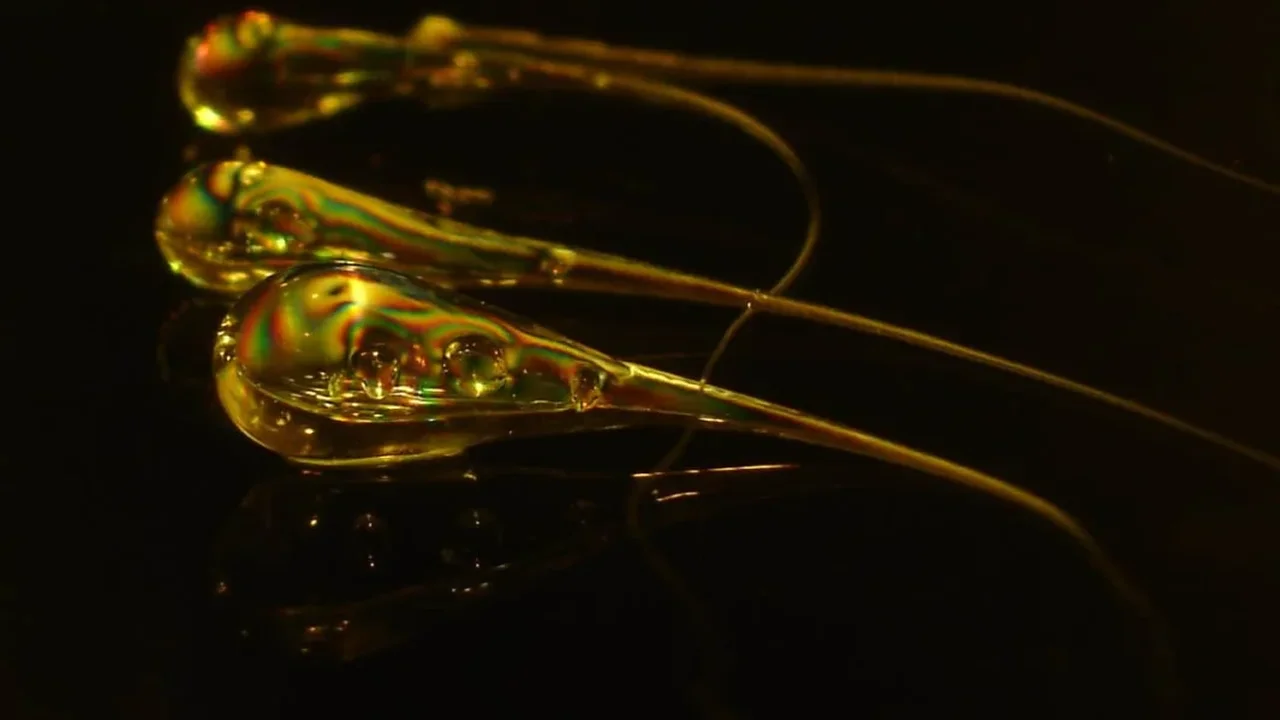
A small, tadpole-shaped glass drop can endure a heavy blow to its rounded head, yet a crack reaching its narrow tail may trigger its rapid disintegration. The contrast comes from forces trapped inside the glass as it cools.
Stress locked inside the glass
These drops form when molten glass falls into cool water. The outside hardens first, while the warmer interior cools and contracts later. The rigid outer layer restrains that contraction, leaving the surface under compression and the core under tension.
Surface compression makes cracks harder to start, helping the rounded head withstand substantial force. Measurements have found compressive stresses of about 400 to 700 megapascals near the surface, and some small drops have survived loads exceeding 10,000 newtons.
But if a crack penetrates the outer layer and reaches the tense interior, the stored energy drives it forward. The crack branches repeatedly, creating a cascade that can travel from tail to head at roughly 1,450 to 1,900 metres per second. The resulting network of fractures breaks the drop into thousands of fragments.
Centuries of questions, new details
The drops fascinated researchers in the 17th century. Specimens reached England in 1660, and the Royal Society investigated them soon after. Modern tools have since made it possible to map their internal stresses and examine the fragments in detail. One three-dimensional analysis counted at least 21,847 pieces from a shattered drop.
Recent chemical analysis has added another dimension to the explanation. Researchers found that the potassium-to-sodium ratio was higher near the exterior than in the interior. Their calculations suggest this difference may add to surface compression, though rapid cooling remains the established source of the drop's distinctive stress pattern.
The same basic strategy--compressing a glass surface to make cracks harder to initiate--is used in tempered glass. Prince Rupert's drops provide an especially vivid example of how internal stress can make a material both more resistant and more prone to sudden failure.
Further insights into these glass structures may help researchers better understand fracture and design materials with more predictable performance.