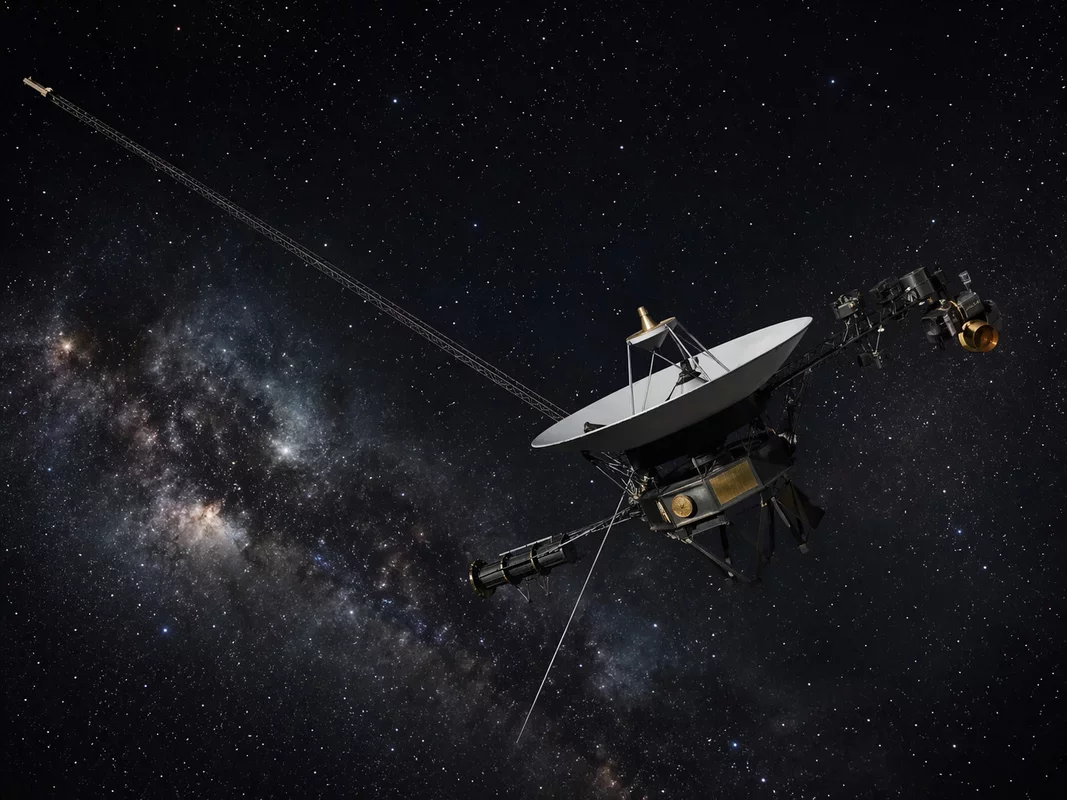
After nearly five decades in space, Voyager 1 is on the brink of achieving a remarkable milestone: it will soon be one full light-day away from Earth. This significant event is projected to occur in November 2026, with November 13 being the likely date. At this distance, light emitted from Earth will take a full day to reach the spacecraft.
This accomplishment marks a pivotal moment in human exploration. Voyager 1, powered by a diminishing nuclear energy source, is transitioning into an interstellar object. However, this advancement poses challenges for NASA, as commands sent to the probe will take approximately 24 hours to arrive, followed by another 24 hours for a response.
The Longest Voyage
Light travels at an astonishing speed of 299,792 kilometers per second, reaching the Moon almost instantly and covering the distance to Mars in mere minutes. However, at approximately 16.1 billion miles, Voyager 1 will be out of reach for less than a day, making communication increasingly complex.
Launched in 1977, Voyager 1 began its journey as a planetary explorer, gathering invaluable data as it flew past Jupiter and Saturn. It continued its trajectory beyond the solar system, officially leaving in 2013, although debates persist regarding the exact boundary of our solar neighborhood. By 2019, Voyager 1 was recognized as the first human-made object to enter interstellar space, a feat achieved by both Voyager probes.
Overcoming Challenges in the Solar System
The Voyager mission capitalized on a rare alignment of the outer planets, allowing for gravity assists that propelled the spacecraft from one giant planet to the next. Voyager 2 was launched first on August 20, 1977, followed by Voyager 1 on September 5, 1977, which took a faster route.
Today, Voyager 1 operates on the last remnants of its nuclear power source. Its Radioisotope Thermoelectric Generators (RTGs), which initially produced 470 watts, now generate around 220-225 watts, just enough to maintain a few instruments.
Despite dwindling power, the probe continues to function, thanks to the ingenuity of engineers who have made critical decisions to extend its operational life. In April 2026, NASA turned off the Low-Energy Charged Particles (LECP) instrument to conserve energy, a necessary measure to keep the spacecraft operational.
The Communication Delay Challenge
Reaching the one-light-day milestone introduces a significant operational hurdle. Any communication will require a minimum of 48 hours for a round trip. This delay complicates responses to telemetry anomalies, as engineers will be alerted only after a day has passed.
Nevertheless, NASA remains committed to the mission. In the coming months, a major reconfiguration known as the "Big Bang" will be implemented to enhance the spacecraft's power management. This ambitious project aims to replace aging components with more efficient alternatives, although it carries risks of potential failures.
Voyager 2 will be the first to undergo this upgrade in May 2026, with Voyager 1 following in July if successful. The continued operation of these probes remains vital, as they provide unprecedented data on the interstellar medium, including insights into solar activity.
Even after their power sources are depleted, Voyager probes will drift through the Oort Cloud, carrying the Golden Record--a testament to humanity's existence and achievements in space exploration.