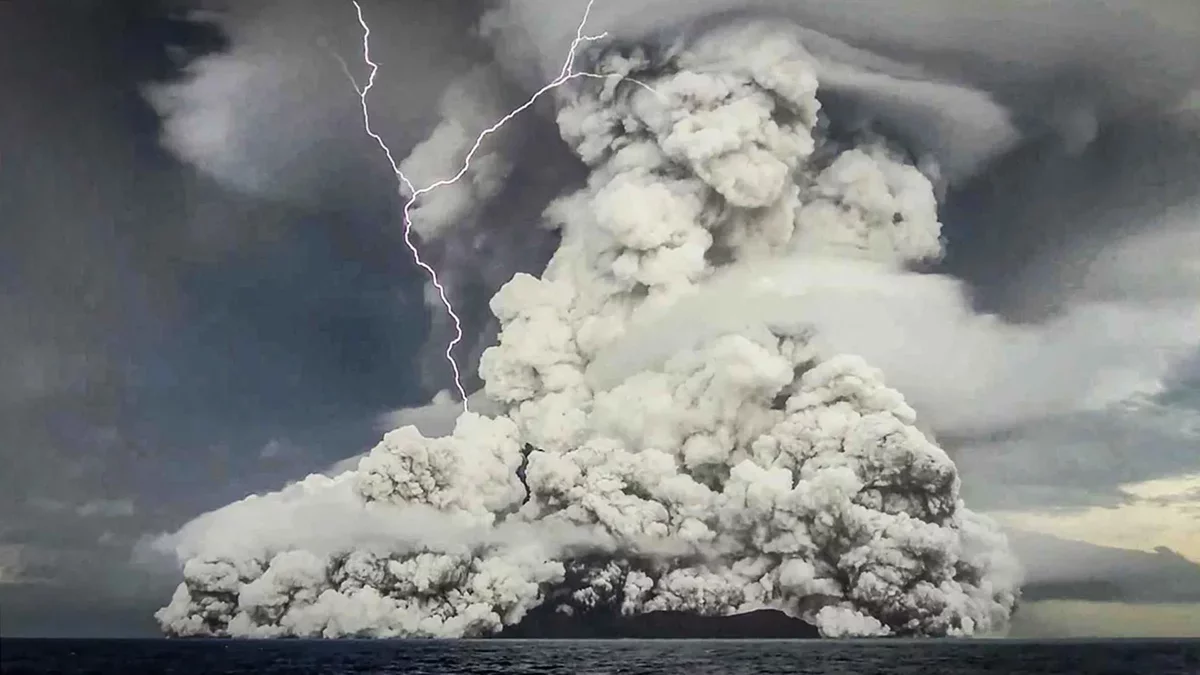
Recent satellite observations have unveiled an astonishing phenomenon: the eruption of a volcano has led to significantly elevated levels of formaldehyde within its expansive plume. This finding is particularly intriguing because formaldehyde is a byproduct of methane degradation in the atmosphere.
Dr. Maarten van Herpen from Acacia Impact Innovation BV, the lead author of a study published in Nature Communications, remarked, "The satellite imagery revealed an unprecedented concentration of formaldehyde. Tracking the cloud for ten days, all the way to South America, indicated that it was persistently eliminating methane for over a week." This discovery is groundbreaking, as it was previously understood that while volcanoes emit methane during eruptions, the potential of volcanic ash to mitigate this pollution was unknown.
Chemical Reactions in Volcanic Ash
The research team posits that the eruption triggered a unique chemical reaction, akin to one they had identified in different environmental contexts. Earlier studies in 2023 revealed that dust from the Sahara Desert, when carried across the Atlantic and combined with sea salt, forms tiny iron salt aerosols. Sunlight interacting with these aerosols releases chlorine atoms that react with methane, facilitating its breakdown in the atmosphere. This revelation has transformed our understanding of atmospheric chemistry.
Professor Matthew Johnson from the University of Copenhagen, who contributed to both studies, noted, "The unexpected aspect is that this mechanism also appears in volcanic plumes high in the stratosphere, where conditions differ significantly." During the Tonga eruption, vast quantities of salty seawater were propelled into the stratosphere alongside volcanic ash. Researchers believe that sunlight interacting with this mixture created reactive chlorine, which subsequently contributed to the destruction of methane released during the eruption. The elevated formaldehyde levels detected by satellites serve as proof of this methane breakdown.
Implications for Global Methane Estimates
This discovery prompts a reevaluation of the global methane budget, which tracks methane's entry and exit from Earth's atmosphere. "We now recognize that atmospheric dust, such as that from volcanic eruptions, influences the methane budget. This means we need to revise the data informing these estimates," stated Johnson.
The Importance of Methane in Climate Change
Methane is a significant contributor to global warming, accounting for about one-third of current temperature increases. Over a two-decade span, it can trap approximately 80 times more heat than carbon dioxide, although it typically dissipates within a decade. Reducing methane emissions could yield rapid climate benefits, potentially acting as an "emergency brake" on climate change, while long-term stability still hinges on lowering carbon dioxide emissions.
Future Climate Solutions
The findings may pave the way for innovative approaches to enhance methane removal from the atmosphere. Accurately measuring this removal has posed challenges, but the study demonstrates that satellite technology can effectively track methane breakdown. "Our satellite method could provide insights into how humanity might mitigate global warming," concluded Johnson.
The research team estimates that the Tonga eruption released 300 gigagrams of methane, equivalent to the annual emissions of over two million cows, while simultaneously removing about 900 megagrams of methane daily, showcasing the eruption's dual impact.