Researchers have taken a closer look at two of the most talked-about electric vehicle batteries on the market: Tesla's 4680 cell and BYD's Blade Battery. The comparison, published in Cell Reports Physical Science, highlights how each company is pursuing a different path in the race to improve EV performance.
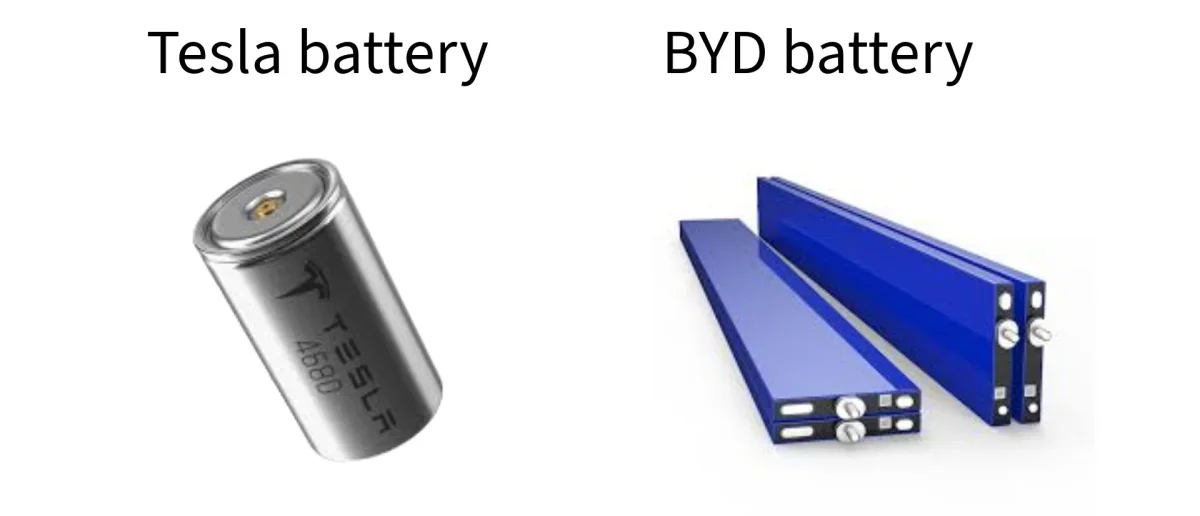
Tesla's 4680 uses a cylindrical design built for high energy output and compact packaging. BYD's Blade Battery follows a long, prismatic format based on lithium iron phosphate, or LFP, a chemistry known for stability, durability, and lower cost. In the teardown, Tesla came out ahead in energy density, with the 4680 delivering 241 Wh/kg and 643 Wh/l, compared with BYD's 160 Wh/kg and 355 Wh/l.
The study also found that the Tesla cell relies on a nickel-rich cathode, which raises material costs, while BYD's LFP approach benefits from more abundant and affordable ingredients. That gives the Blade Battery an advantage in price and thermal stability, making it especially attractive for mass-market electric vehicles.
Beyond chemistry, the two batteries reflect distinct engineering philosophies. Tesla uses a streamlined "jelly roll" structure and tabless manufacturing, while BYD's Z-folded stack is designed to improve mechanical strength and thermal management. Researchers also noted that neither cell contained silicon in the anode, a reminder that real-world battery design often differs from laboratory expectations.
The takeaway is not that one battery is universally superior, but that each serves a different purpose. Tesla's design fits premium and performance-focused models, while BYD's Blade is well suited to vehicles that prioritize safety, cost efficiency, and long service life. As battery innovation accelerates, the future may belong to multiple chemistries tailored to different mobility needs.