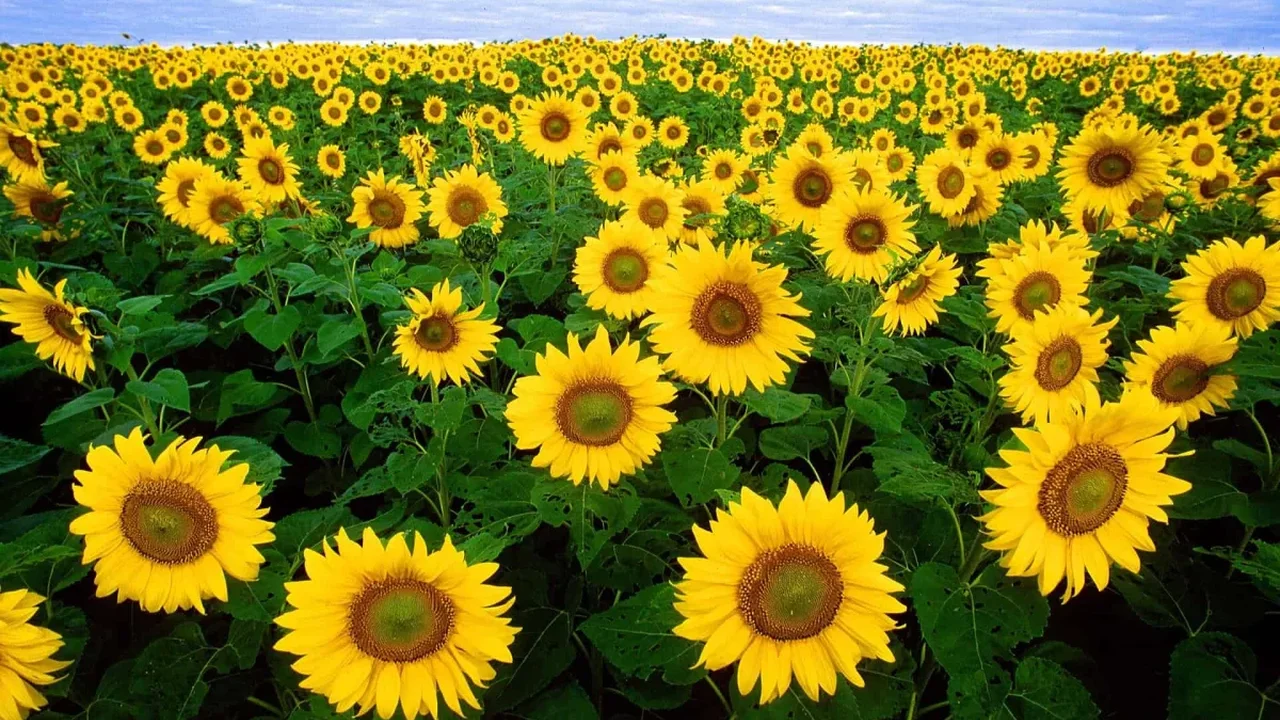
When young sunflowers were surrounded by three lights, they grew toward the weakest one--not the brightest. A study published in Proceedings of the National Academy of Sciences offers an explanation: two equally strong lights from opposite directions can counterbalance each other, leaving a dimmer light from the side to steer growth.
How the experiment worked
Researchers exposed week-old seedlings to blue LED lights and tracked how their stems curved over at least 21 hours. With one light, seedlings leaned toward it, although their response did not increase in direct proportion to its brightness. With two opposing lights, they turned toward the brighter source.
In the three-light test, two equally bright lamps faced each other while a third, less than half as intense, shone from another direction. Across 34 seedlings, the average growth direction pointed almost directly toward the dimmer lamp. The stronger signals had effectively balanced one another.
Plants process light without a brain
Sunflowers sense light through proteins called phototropins in their stems. Differences in light exposure trigger uneven growth on opposite sides, causing a shoot to bend. The researchers' model suggests these local signals are processed in a way that compresses differences in brightness before they are combined.
The model also predicts that light from multiple directions could sometimes make a plant grow slightly away from the direction receiving the most light. This possible effect has not yet been observed, and the predicted shift--up to six degrees--may be difficult to distinguish from the natural movement of growing stems.
Co-author Yasmine Meroz of Tel Aviv University described the response as a computation that emerges from how light is sensed and processed across the stem. Further research into these mechanisms could deepen understanding of how plants adapt their growth to complex environments, and inspire new approaches to responsive, brain-free systems.