MADRID -- One of the most iconic images of Maruja Mallo shows her enveloped in seaweed, crowned and adorned with long strands of kelp, her arms raised in a pose reminiscent of a powerful marine deity. This striking photograph, taken by poet Pablo Neruda in 1945 on a Chilean beach, was likely meticulously arranged by Mallo herself, who perceived her identity as intertwined with her art, where feminine energy serves as a conduit for both nature and cosmic forces.
The exhibition Maruja Mallo: Mask and Compass at the Museo Nacional Centro de Arte Reina Sofía stands as the largest retrospective of her work to date. Showcasing 100 paintings, approximately 70 drawings, and 100 archival documents--including the aforementioned photograph--the exhibition offers a comprehensive look at her artistic journey. Curator Patricia Molins has thoughtfully crafted a broad perspective on Mallo's remarkably diverse body of work, which encompasses not only her prominent two-dimensional pieces but also her published writings, photographic self-portraits, and detailed notebooks, alongside reconstructions of her lost set designs and ceramic creations.
Born Ana María Gómez González in Viveiro, Galicia in 1902, Mallo pursued her artistic education at the esteemed Real Academia de Bellas Artes de San Fernando in Madrid. There, she formed friendships with notable figures in art and literature, such as Luis Buñuel, Salvador Dalí, and Federico García Lorca, becoming a member of the avant-garde Generación del '27 group, which flourished in the 1920s and '30s.
In the early stages of her career, Mallo was associated with various influential art movements and collectives, including the Surrealists and the Escuela de Vallecas. However, her unique vision and distinctive style eventually set her apart from her contemporaries, which may explain her relative obscurity outside of Spain.
Decades after her passing, this exhibition elevates Mallo as one of the most innovative and individualistic artists of the 20th century, positioning her as a significant figure representing women in art and modern life. Her bold early works often depicted nude or nearly nude athletic women engaged in activities like swimming and cycling, which were considered inappropriate by the societal standards of her time. A photograph of Mallo's portrait of a friend in a bathing suit--destroyed by the model's outraged father--serves as a poignant reminder of the era's restrictive norms.
Mallo's vibrant Verbenas (Street Fairs) series, reunited for the first time since their original exhibition in Madrid in 1928, celebrates the dynamic spirit of urban life with a focus on active, modern women. In her piece La verbena (1927), two smiling women in stylish, form-fitting dresses boldly step out of a vivid scene of celebration, their outstretched arms inviting viewers into the lively parade of existence.
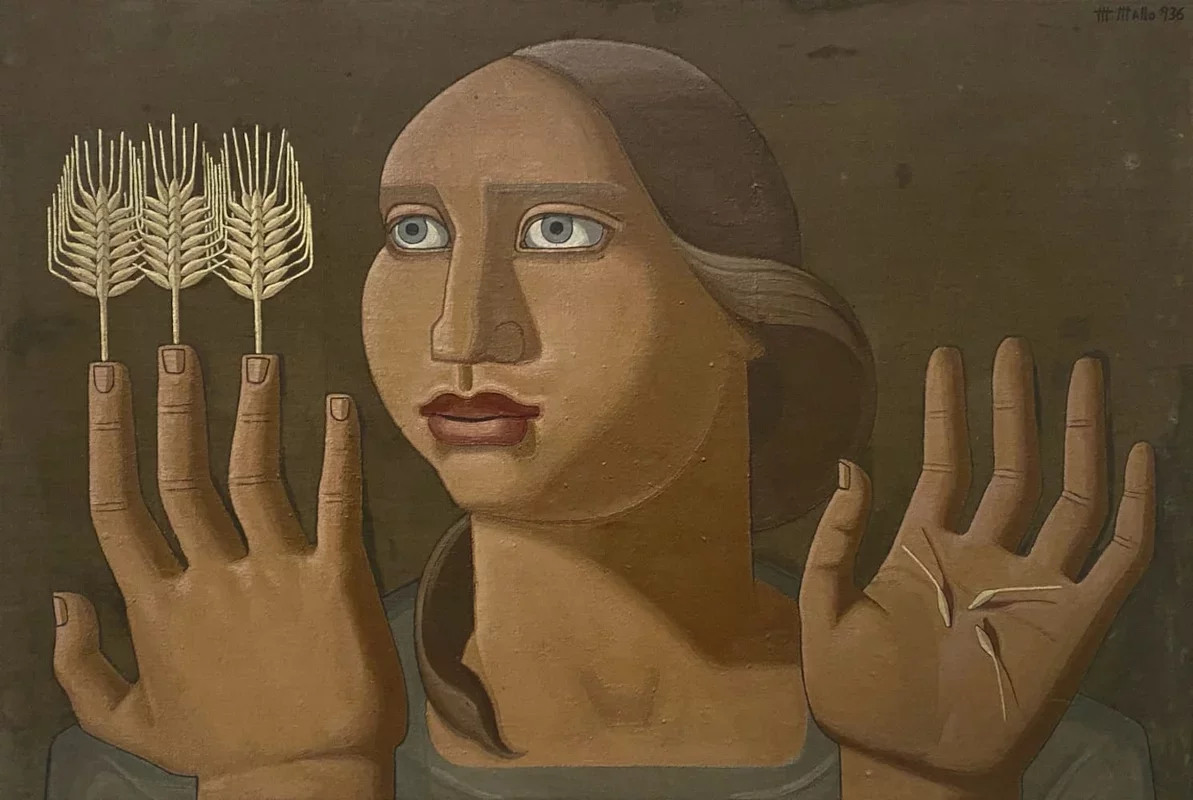
These works, inspired by popular culture, cinematic techniques, and theatrical elements, transition into her Cloacas y Campanarios (Sewers and Bell Towers) series. Created following her breakup with poet Rafael Alberti, these striking images--featuring bleak landscapes littered with refuse and skeletons--eerily foreshadow the devastation of the Spanish Civil War. During this tumultuous time, Mallo was sketching local fishermen in the coastal town of Bueu before fleeing to Portugal and later Argentina in 1937. Her Galician sketches ultimately laid the groundwork for her significant series La religión del trabajo (The Religion of Work), where heroic female figures wield agricultural tools, embodying a profound connection to nature.
In Argentina, Mallo connected with fellow exiled artists like Jorge de Oteiza and Luis Seoane, yet it was the rich biodiversity and cultural tapestry of South America that truly inspired her. Her series Las naturalezas vivas (Living Nature Works) features shells and flowers that evoke themes of reproduction and sensuality, while her portraits reflect a belief in universal connections beyond societal divisions. Mallo incorporated mathematical concepts into her artwork, expressing her vision of a harmonious and orderly universe.
The most enigmatic pieces in the exhibition include paintings of masks hovering above beaches and acrobats, created during the 1940s and '50s, which resonate with themes of transformation and alienation--echoing Mallo's complex identity as an exile and a nonconformist.
By the 1970s, Mallo had entirely transcended earthly themes in her art. Her final works, Moradores del vacío (Dwellers of the Void) and Viajeros del éter (Ether Travelers), present ethereal entities that are both microscopic and mystical. It seems fitting that an artist whose work transcended the earthly realm would turn to space for inspiration. This exhibition may finally secure her rightful place among the modernist greats.
Maruja Mallo: Mask and Compass continues at the Museo Nacional Centro de Arte Reina Sofía in Madrid until March 16. The exhibition is curated by Patricia Molins.