A groundbreaking study published in the Journal of Cosmology and Astroparticle Physics (JCAP) showcases the innovative efforts of undergraduate students from the University of Hamburg. This team has designed and constructed a cavity detector aimed at identifying axions, which are considered prime candidates for dark matter. Despite operating with limited resources, they successfully established new experimental limits on the properties of axions, proving that smaller-scale experiments can significantly contribute to solving one of physics' most profound mysteries.
Funding and Institutional Backing
The project received financial support through a student research grant from the University of Hamburg, facilitated by the Hub for Crossdisciplinary Learning, which promotes independent student-led research initiatives.
Nabil Salama, one of the authors and a current M.Sc. student in Physics, reflects on their collaboration: "We were integrated into the MADMAX dark matter experiment research group, which operates on a larger scale. Their expertise and support were invaluable to our project."
Salama expresses gratitude towards the university and the Quantum Universe Cluster of Excellence for providing essential funding, access to critical equipment like magnets, and support from experienced researchers.
Developing a Compact Axion Detector
"The appeal of researching dark matter or axions lies in their expected omnipresence throughout our galaxy," says Agit Akgümüs, the lead author and an M.Sc. student in Mathematical Physics. "This means that any experiment conducted is likely to encounter some form of dark matter."
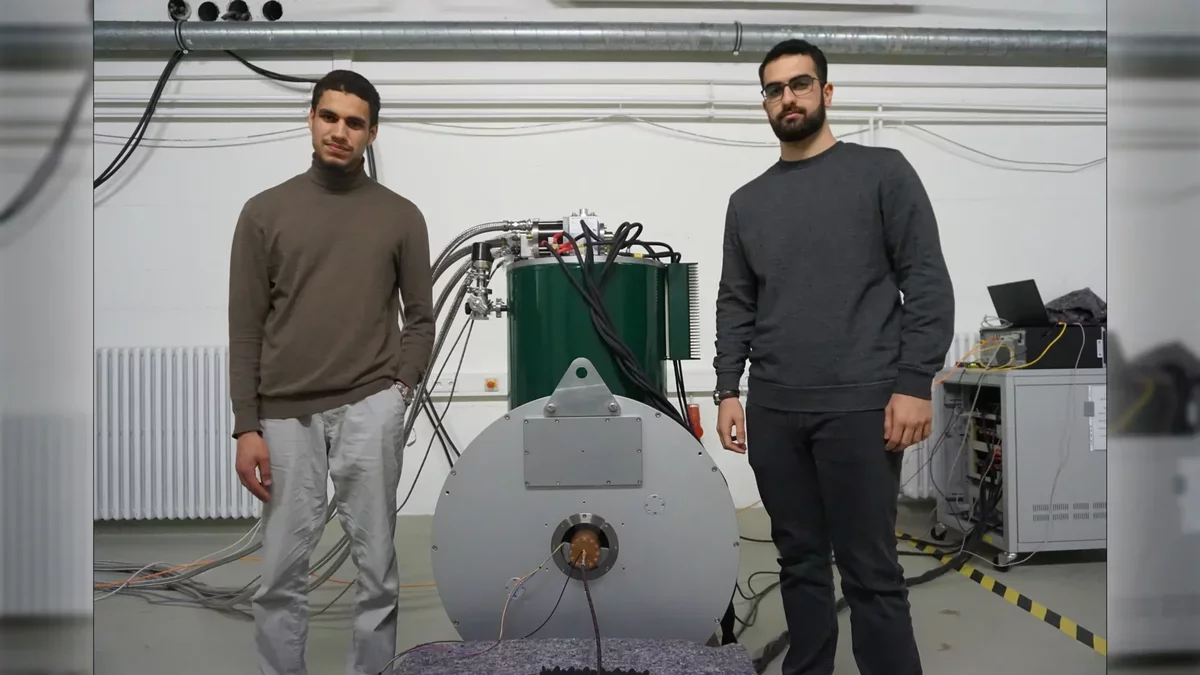
Using their grant, the team crafted a compact experimental setup centered on a resonant cavity constructed from highly conductive materials, complemented by necessary electronics, cabling, and measurement tools.
"Our detector represents a simplified version of a cavity detector for dark matter," Salama notes.
The students built upon existing facilities, utilizing equipment and guidance from the university and collaborative research groups. Following construction, the system underwent rigorous testing, calibration, and data collection.
"We distilled complex experiments to their fundamental elements," Salama explains. "The result is a less sensitive setup, limited in its search capabilities, yet still capable of yielding new scientific insights."
Valuable Insights Despite No Detection
Akgümüs elaborates, "The axion search entails examining a broad spectrum of potential parameters. While our experiment only probes a small area with limited sensitivity, it narrows down possibilities. Discovering the particle will require either significantly larger experiments or various smaller ones targeting specific regions."
Although the team did not detect any signals attributable to axions, their findings hold scientific merit. They have effectively ruled out certain axion characteristics within the tested mass range, particularly those that would interact more strongly with photons, thus refining the search for future experiments.
A Blueprint for Scalable Dark Matter Research
Salama emphasizes the importance of their experiment: "It demonstrates that research can be conducted on a smaller scale." Akgümüs adds, "While our results are naturally more constrained than those from larger experiments, we've proven that smaller setups can still yield valuable scientific data."
During the peer review process, one referee noted that once axions are discovered and their properties understood, experiments like theirs could become more accessible and potentially serve as student laboratory projects in the future.
"We were informed that setups like ours might one day become standard in educational labs," Salama concludes, hinting at a future where small-scale experiments could inspire the next generation of physicists.