The experience of identifying scents, whether it's the aroma of coffee or the odor of spoiled milk, relies on a complex biological system within our noses. While it was known that our sense of smell depends on diverse receptors, the organization of these receptors remained a mystery.
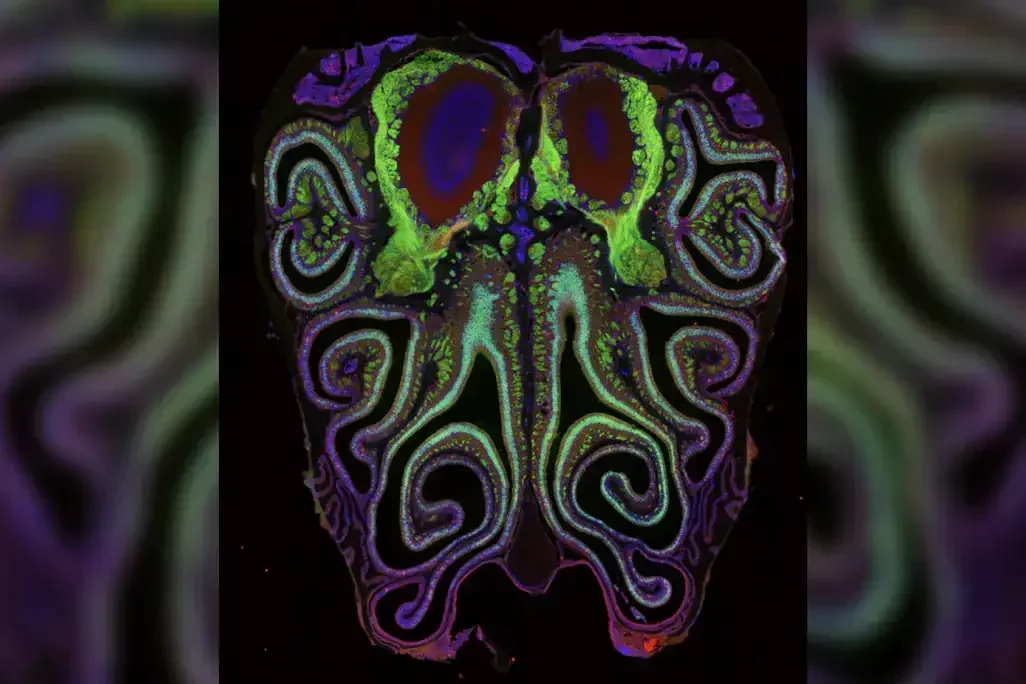
Recent research published in Cell has illuminated this enigma. Scientists meticulously mapped the olfactory receptors in mouse noses and discovered that approximately 1,100 receptor types are not randomly dispersed but instead occupy specific, predictable positions. This structured arrangement creates overlapping stripes extending from the top to the bottom of the nose, a pattern mirrored in the olfactory bulb of the brain, which is the initial processing center for smell.
Sandeep Robert Datta, a neurobiologist at Harvard University and co-author of the study, remarked, "The organization of information in space is a major organizing principle for all sensory systems, and that is what has, until now, made olfaction super weird. We have, to some extent, unveiled this long-lost map for smell."
The Previously Uncharted Sense
Traditionally, the organization of senses like vision and hearing has been well understood, with adjacent cells processing nearby stimuli. However, the olfactory system has long been perceived as chaotic. Mice possess around 20 million olfactory neurons and over 1,000 odor receptor types, while humans have several hundred. Each receptor can detect different odor molecules, and the sense of smell operates on a combinatorial code, allowing for the identification of an astonishing array of scents.
Previous models suggested that these receptors were grouped into a few broad zones, with receptor selection appearing random. The new findings challenge this outdated view, revealing a much more intricate and organized structure.
A Thousand Overlapping Stripes
Using advanced techniques such as single-cell sequencing and spatial transcriptomics, researchers analyzed data from over 300 mice, resulting in a comprehensive receptor map. Each receptor type was found to occupy a distinct average position along the nose's vertical axis, creating a consistent pattern across individual mice.
Datta explained, "Each receptor adopts a particular position in the nose... in a thousand overlapping stripes." This discovery aligns the olfactory system more closely with other sensory systems, suggesting that spatial organization is crucial for smell just as it is for sight and hearing.
Building the Map
The research also identified a potential mechanism driving this spatial organization: retinoic acid, a molecule related to vitamin A. This substance creates a gradient across the nose, guiding the development of olfactory neurons and influencing their receptor selection based on their location.
When retinoic acid signaling was manipulated, the spatial organization of receptors shifted, indicating that this gradient plays a critical role in forming the olfactory map. This precision is vital since olfactory neurons are continuously regenerated throughout an individual's life.
Implications for the Future
The alignment of the receptor map in the nose with the corresponding map in the brain suggests a unified developmental logic governing both systems. While this research was conducted on mice, it opens up exciting possibilities for understanding the human olfactory system. If humans possess a similar organizational structure, it could revolutionize approaches to treating conditions related to smell loss, which can arise from various medical issues.
As we deepen our understanding of this sensory map, we may not only improve therapeutic strategies but also enhance our appreciation of the profound role smell plays in our lives, influencing health, safety, and emotional well-being.