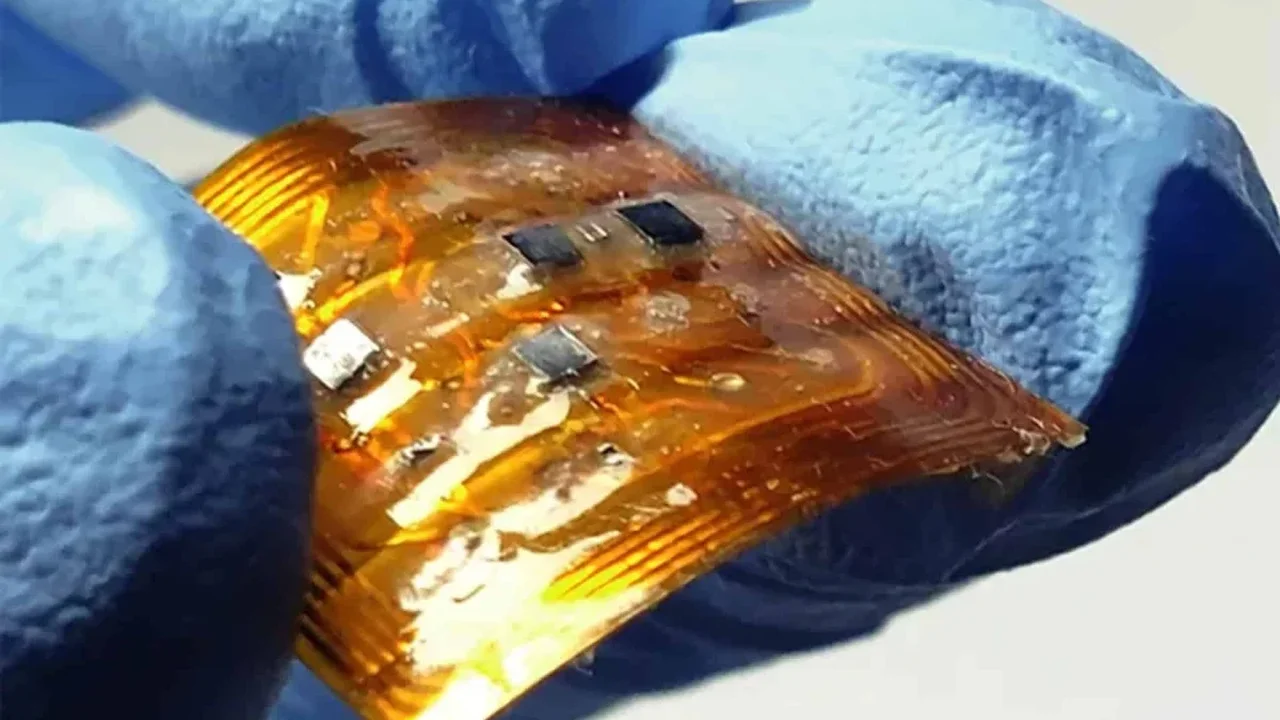
Researchers have introduced a foldable implant that could reshape how health data is collected from inside the body. Named MiFi, the device was developed by teams at Imperial College London and the University of Southern California and is designed to enter through a tiny incision before expanding into its full working form beneath the skin.
A compact design with more room to work
Instead of shrinking every component to fit a small opening, the implant uses an origami-style structure that folds tightly for insertion and then unfolds once in place. In its active form, it measures about 2.1 centimeters by 2.1 centimeters and only 0.3 millimeters thick, creating space for antennas, sensors and circuitry without requiring a larger procedure.
This approach separates implantation size from operating size, allowing the device to keep a small entry point while still supporting multiple functions. The researchers say the folded format can reduce the insertion footprint by up to six times.
Wireless power, multiple readings
MiFi runs without a battery. It draws energy through NFC, the same short-range wireless technology used in contactless payments, while also sending data back to an external reader. In animal tests, the implant captured signals linked to heart rate, breathing, temperature, tissue pH and lithium levels.
One version used a miniature accelerometer to detect movement from heartbeat and respiration, while another included electrodes for cardiac electrical activity. The chemical sensing is especially notable because the implant sits in contact with interstitial fluid, opening the door to measuring markers that are harder to capture reliably from sweat or skin-based wearables.
Early results in rats
To test the concept, the team placed the device under the skin of rats and compared its readings with external monitoring tools. The implant closely followed heart rate, respiratory rate and temperature measurements, and it also detected rising lithium levels after the animals received lithium chloride.
The study, published in Advanced Materials, is still an early proof of concept. The experiments were short and performed in anesthetized rats, so longer-term safety, durability and human use still need to be explored. Even so, MiFi points to a future where implants may combine minimal intervention with richer real-time monitoring. This kind of design could help define a new era of personalized, less invasive health technology.