Minerals, each with distinct crystal structures and characteristics, play a crucial role in understanding planetary environments. Recent investigations have shed light on the Martian surface, revealing the presence of layered iron sulfates that have puzzled researchers for nearly two decades. Led by Dr. Janice Bishop, a senior research scientist at the SETI Institute and NASA's Ames Research Center, a new study has identified a rare ferric hydroxysulfate phase, enhancing our understanding of Martian geology.
"Our research focused on two sulfate-rich sites near the expansive Valles Marineris canyon system, which exhibited unique spectral signals from orbital data," noted Bishop.
Exploring Valles Marineris
The study concentrated on two significant locations adjacent to Valles Marineris, one of the solar system's largest canyon networks. The first site, Aram Chaos, is located northeast of the canyon, where ancient waterways are believed to have flowed. The second site is positioned on the plateau above Juventae Chasma, a deep canyon just north of Valles Marineris.
Signs of a Wet Past
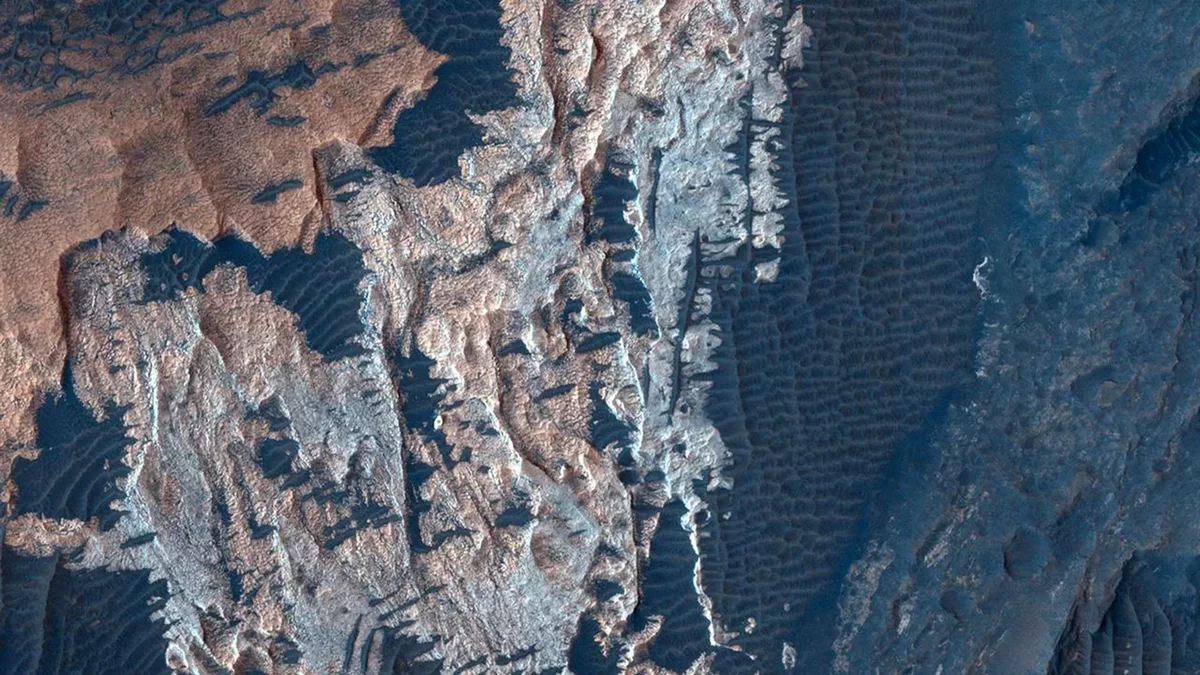
This plateau region showcases evidence of a once-wet environment, with ancient channels indicative of flowing water. Researchers discovered sulfate minerals concentrated in depressions likely formed from evaporating sulfate-rich waters, leaving behind hydrated ferrous sulfates.
These minerals, including ferric hydroxysulfate, are found in thin layers interspersed with basaltic materials, suggesting they were subjected to geothermal heat from volcanic activity after their formation.
Insights from Aram Chaos
Sulfate minerals are prevalent in the Valles Marineris area, particularly within chaotic terrains shaped by historical flooding. As water receded, it left behind layered deposits of iron and magnesium sulfates, hinting at a wetter Martian climate in the past. In one chaotic terrain formed by an ancient impact, layers of polyhydrated sulfates lie above monohydrated sulfates and ferric hydroxysulfate.
Heat's Role in Mineral Transformation
The unique spectral signatures of these sulfates can be detected from orbit using the CRISM instrument. Initial observations of the mineral arrangement posed challenges, but laboratory experiments revealed that heating polyhydrated sulfates leads to the formation of monohydrated forms and eventually ferric hydroxysulfate. This suggests that geothermal heating significantly influenced mineral transformations post-deposition.
While polyhydrated and monohydrated sulfates are widespread, ferric hydroxysulfate is rare, indicating potential geothermal activity beneath these areas, which may host undiscovered deposits.
Laboratory Discoveries
SETI Institute and NASA Ames researchers conducted experiments to trace the evolution of these minerals. They found that heating rozenite, a hydrated ferrous sulfate, produces ferric hydroxysulfate, demonstrating the influence of oxygen in this transformation.
"The new mineral's unique crystal structure and thermal stability could redefine our understanding of Martian geology," Bishop stated. However, confirmation of its status as a new mineral requires identification on Earth.
Implications for Martian Geology
The identified ferric hydroxysulfate may have formed under conditions that suggest Mars has experienced significant geological activity more recently than previously thought. This discovery opens new avenues for understanding the planet's surface evolution and its potential to support life.
The findings are documented in the paper titled "Characterization of Ferric Hydroxysulfate on Mars and Implications of the Geochemical Environment Supporting its Formation," published in Nature Communications.