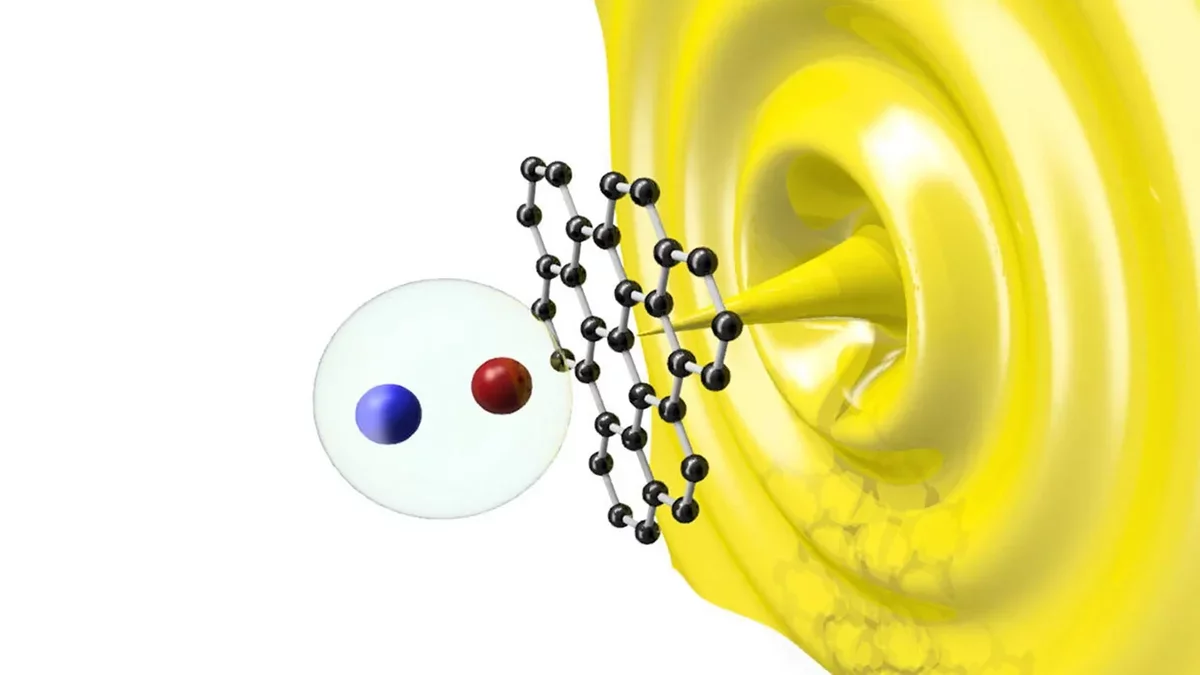
Familiar through the double-slit experiment, the phenomenon of wave-particle duality has intrigued scientists for decades. In this classic experiment, electrons passed through two narrow slits, creating a pattern of alternating light and dark bands on a detector. This outcome illustrated that electrons behave like waves, with their quantum wave-functions interfering with themselves. Despite significant advancements, direct observation of this effect in positronium--a fleeting two-body system formed by an electron and its antiparticle, the positron--had remained elusive.
Breakthrough in Observing Positronium Wave Behavior
A team from Tokyo University of Science, led by Professor Yasuyuki Nagashima, alongside Associate Professor Yugo Nagata and Dr. Riki Mikami, has successfully demonstrated matter-wave diffraction in a positronium beam. Their findings, published in Nature Communications, provide compelling evidence of wave-particle duality within this unique system.
"Positronium, being the simplest atom with equal-mass components, behaves as a neutral atom until it self-annihilates. Our observation of quantum interference in a positronium beam opens new avenues for fundamental physics research," states Prof. Nagashima.
Innovative Production of a High-Quality Positronium Beam
The research hinged on the creation of a precisely controlled positronium beam. Initially, the team produced negatively charged positronium ions. A carefully timed laser pulse then removed an extra electron, resulting in a swift, neutral, and coherent stream of positronium atoms.
This beam was directed towards a graphene sheet, where the atomic spacing closely matched the de Broglie wavelength of the positronium at the experimental energy levels. As the positronium atoms traversed the graphene, some passed through and were detected, revealing a distinct diffraction pattern that confirmed their wave-like behavior.
Significant Findings on Quantum Behavior
This innovative method achieved higher energy positronium beams, reaching up to 3.3 keV, with a narrower energy spread and a more focused trajectory. Conducting the experiment in an ultra-high vacuum ensured the graphene surface remained pristine, allowing for clearer observation of the diffraction pattern.
The results indicated that positronium, despite being composed of two particles, acts as a single quantum entity. The electron and positron diffract collectively, behaving as a unified wave.
"This pivotal experimental achievement marks a significant advancement in fundamental physics, demonstrating the wave nature of positronium as a bound lepton-antilepton system and paving the way for precision measurements," adds Dr. Nagata.
Looking Ahead: Applications in Science and Antimatter Research
The implications of positronium diffraction extend beyond theoretical physics. As positronium carries no electric charge, it holds potential for analyzing material surfaces without causing damage, making it particularly valuable for studying insulators and magnetic materials.
Future experiments involving positronium interference may also provide insights into how antimatter interacts with gravity, a question that has yet to be directly measured even for electrons.
About the Researchers
Dr. Yasuyuki Nagashima and Dr. Yugo Nagata are prominent figures in the field of positronium physics at Tokyo University of Science, focusing on the properties and applications of this exotic atom.
This research was supported by JSPS KAKENHI (Grants Nos. JP25H00620, JP21H04457, and JP17H01074).