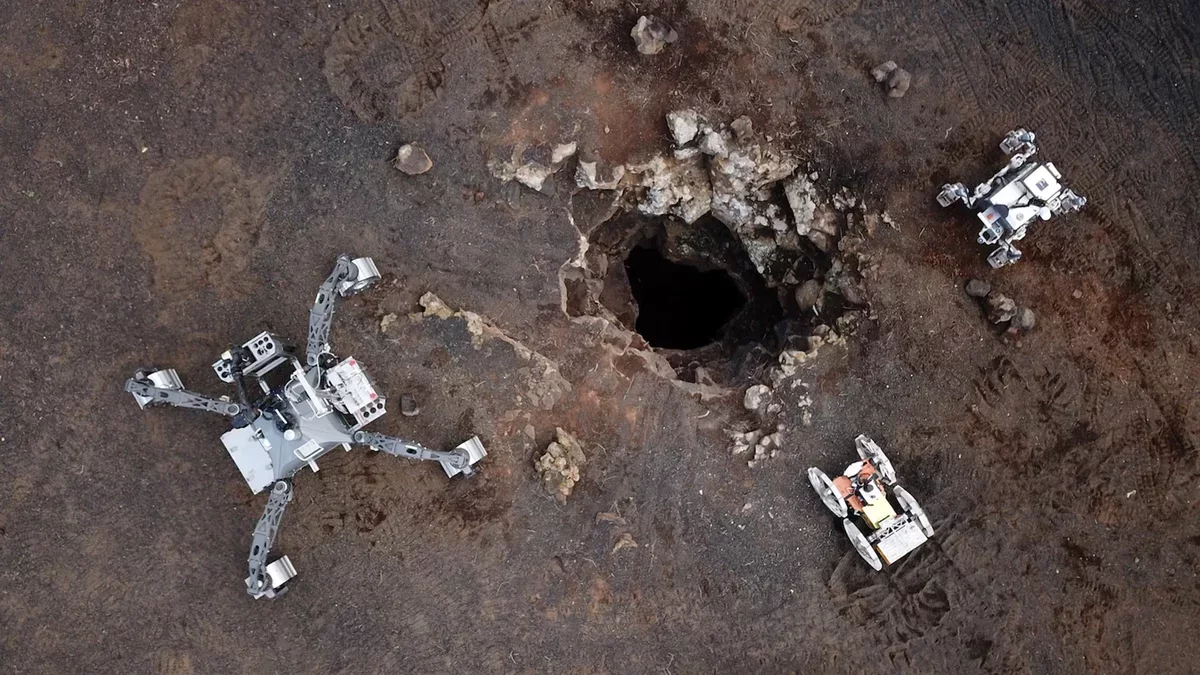
In response to the challenges of extraterrestrial exploration, a European research consortium, which includes the Space Robotics Laboratory at the University of Malaga, has initiated an innovative mission aimed at investigating lava tubes. This groundbreaking work was recently detailed in the journal Science Robotics. The mission focuses on three distinct types of robots that can autonomously collaborate to navigate and chart these extreme subterranean environments. Currently, the system is undergoing tests in volcanic caves located in Lanzarote, Spain, with aspirations for future missions to the Moon.
Four Stages of Autonomous Exploration
The proposed mission is structured into four meticulously designed phases. Initially, the robots work together to map the vicinity surrounding the lava tunnel entrance (phase 1). Following this, a sensor-equipped payload cube is deployed into the cave to collect preliminary data (phase 2). Subsequently, a scout rover descends through the entrance to access the interior (phase 3). In the final stage, the robotic team conducts an in-depth exploration of the tunnel and generates detailed three-dimensional maps of its structure (phase 4).
A practical field test carried out in Lanzarote in February 2023 demonstrated that the approach functions as intended. The trial underscored the technical prowess of the consortium, which is spearheaded by the German Research Center for Artificial Intelligence (DFKI), alongside contributions from the University of Malaga and the Spanish firm GMV.
Preparing for Lunar and Martian Exploration
The outcomes affirmed the technical viability of the mission concept and showcased the extensive potential of collaborative robotic systems. These insights indicate that teams of autonomous robots could significantly contribute to future exploration endeavors on the Moon or Mars. Furthermore, the study advocates for the ongoing advancement of sophisticated robotic technologies tailored for planetary exploration.
The Contribution of the Space Robotics Laboratory at UMA
The Space Robotics Laboratory at the UMA is dedicated to developing innovative methods and technologies that enhance autonomy in space robotics, applicable to both planetary and orbital missions. In recent years, the laboratory has collaborated closely with the European Space Agency, creating algorithms that enable planetary exploration vehicles (rovers) to plan their routes and operate with greater independence.
Beyond research, the laboratory is committed to nurturing the next generation of space robotics engineers. Students from the School of Industrial Engineering at UMA engage in internships and thesis projects related to this field. Most initiatives are conducted in partnership with national and international research institutions through collaborative research efforts or technology transfer agreements with companies and research organizations.