A researcher from The University of Osaka has explored a groundbreaking concept called the gyroscopic wave energy converter (GWEC). This innovative study assessed the feasibility of this design for large-scale electricity generation, with findings published recently in the Journal of Fluid Mechanics.
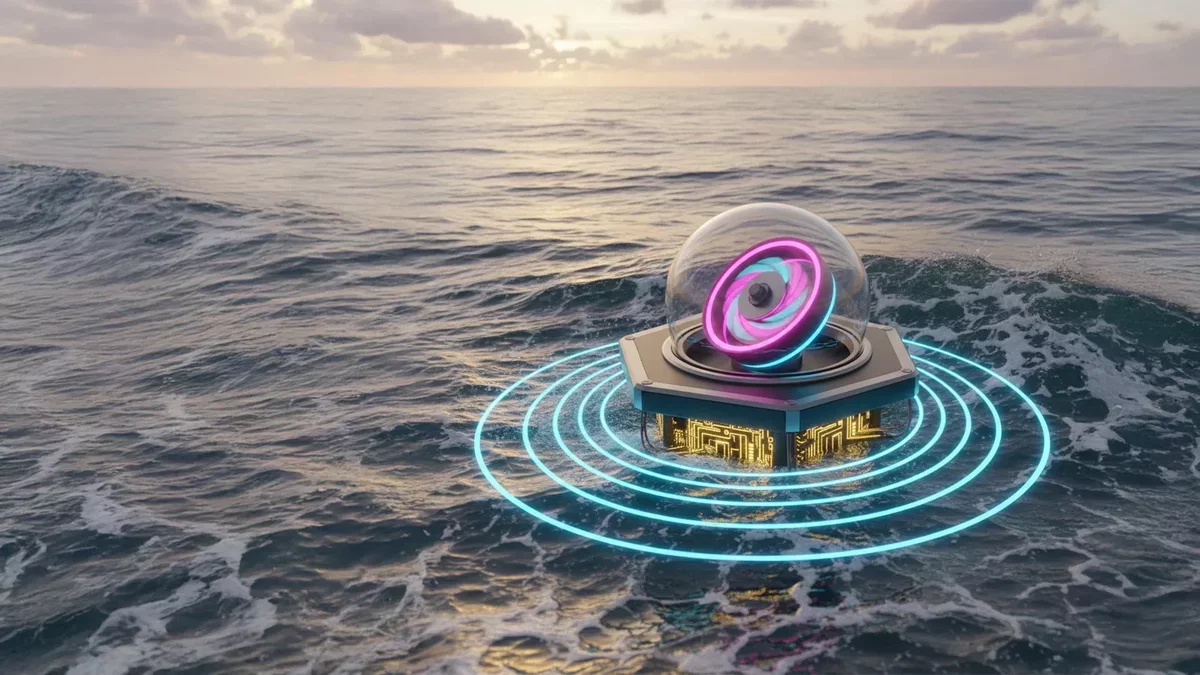
In contrast to conventional systems, the GWEC utilizes a spinning flywheel contained within a floating platform. As the platform moves with the ocean waves, the rotating flywheel transforms this motion into electrical energy. The unique aspect of this system lies in its gyroscopic functionality, which allows it to efficiently capture energy across a broad spectrum of wave frequencies, rather than being restricted to a limited range.
Understanding Gyroscopic Precession for Energy Generation
This innovative mechanism leverages gyroscopic precession, which occurs when a spinning object responds to external forces. When ocean waves cause the floating platform to pitch, the spinning flywheel alters its orientation through precession, effectively changing its rotational direction. This movement is linked to a generator, enabling the device to produce electricity.
"Wave energy technologies often face challenges due to the ever-changing conditions of the ocean," explains Takahito Iida, the study's author. "However, a gyroscopic system can be adjusted to maintain high energy absorption, even when wave frequencies fluctuate."
Maximizing Wave Energy Efficiency through Modeling
To gain deeper insights into the system's performance, the researcher applied linear wave theory to model the interactions between ocean waves, the floating structure, and the gyroscope. This analysis revealed optimal settings for both the flywheel's rotational speed and the generator's controls. The results indicated that, when finely tuned, the GWEC can achieve a theoretical maximum energy absorption efficiency of 50% across all wave frequencies.
"This efficiency threshold is a core principle in wave energy theory," Iida notes. "What's particularly exciting is our discovery that it can be achieved over a wide range of frequencies, rather than just at a single resonant point."
Simulations Validate Real-World Performance
The research findings were further validated through numerical simulations conducted in both frequency and time domains. Additional simulations included nonlinear gyroscopic behaviors to examine potential performance limits. The outcomes confirmed that the device retains high efficiency close to its resonance frequency, indicating optimal performance when its movement aligns with the natural wave patterns.
By elucidating how to fine-tune the gyroscope's operational parameters, this research provides valuable insights for developing more adaptable and efficient wave energy systems. As the global community seeks reliable renewable energy solutions to meet climate targets, innovations like the GWEC could play a crucial role in harnessing the vast, largely untapped energy reserves of the oceans.