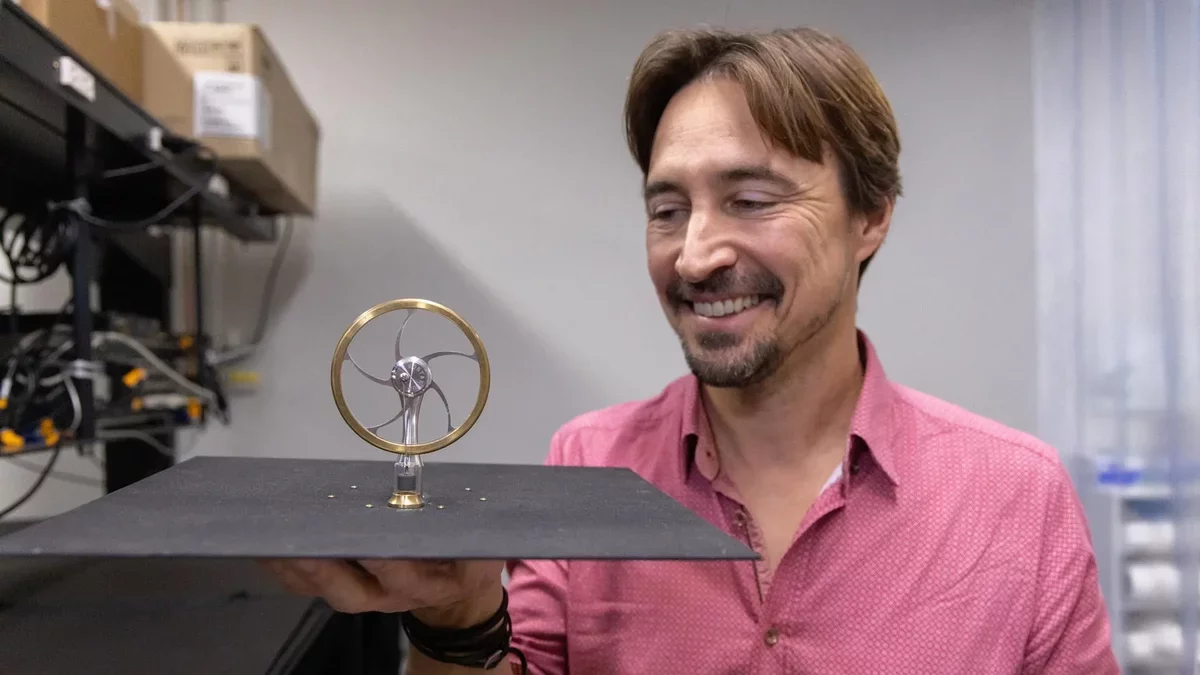
A groundbreaking device utilizing a Stirling engine has been developed to convert the frigid temperatures of space into energy during the night. Unlike traditional internal combustion engines, which require significant temperature differentials to function effectively, Stirling engines operate efficiently even with minimal heat variations. Jeremy Munday, a professor of electrical and computer engineering at UC Davis and co-author of the study, noted that the temperature difference can be as slight as that between a warm cup of coffee and the cooler surrounding air.
Munday explained, "These engines excel when faced with small temperature contrasts, while other engine types thrive on larger differences, yielding greater power." In a standard Stirling engine setup, one side is heated, and the opposite side is cooled, creating a temperature gradient that drives a piston to generate mechanical energy.
However, Munday emphasized that simply placing the engine on a flat surface won't generate power, as it would lack the necessary temperature difference.
Utilizing Deep Space as a Cold Source
Traditionally, a temperature differential is achieved by heating one side of the engine with a fuel source. Munday and graduate student Tristan Deppe investigated whether the cold side could be linked to the extreme cold of deep space, rather than relying on combustion.
"The engine doesn't need to physically touch space; it can interact with it radiatively," Munday remarked. On clear, cool nights, heat naturally radiates from the body into the sky, creating a chilling effect. The team aimed to replicate this phenomenon.
Their innovative design positions a Stirling engine atop a panel that functions as a heat-radiating antenna. This setup is placed outdoors at night, where the ground provides warmth to one side while the panel releases heat upwards, effectively connecting the other side to the cold of space.
Promising Results from Nighttime Testing
After a year of nighttime experiments, the researchers discovered that their compact device could generate a minimum of 400 milliwatts of mechanical power per square meter. In practical demonstrations, the engine successfully powered a small fan and was linked to a small electric motor to produce electrical current.
These findings highlight the potential for harvesting substantial energy from the night sky. Munday noted that this technology is particularly effective in areas with low humidity and consistently clear skies. Looking ahead, it could play a vital role in ventilating greenhouses or homes without traditional energy sources.
UC Davis has filed a provisional patent for this innovative invention.