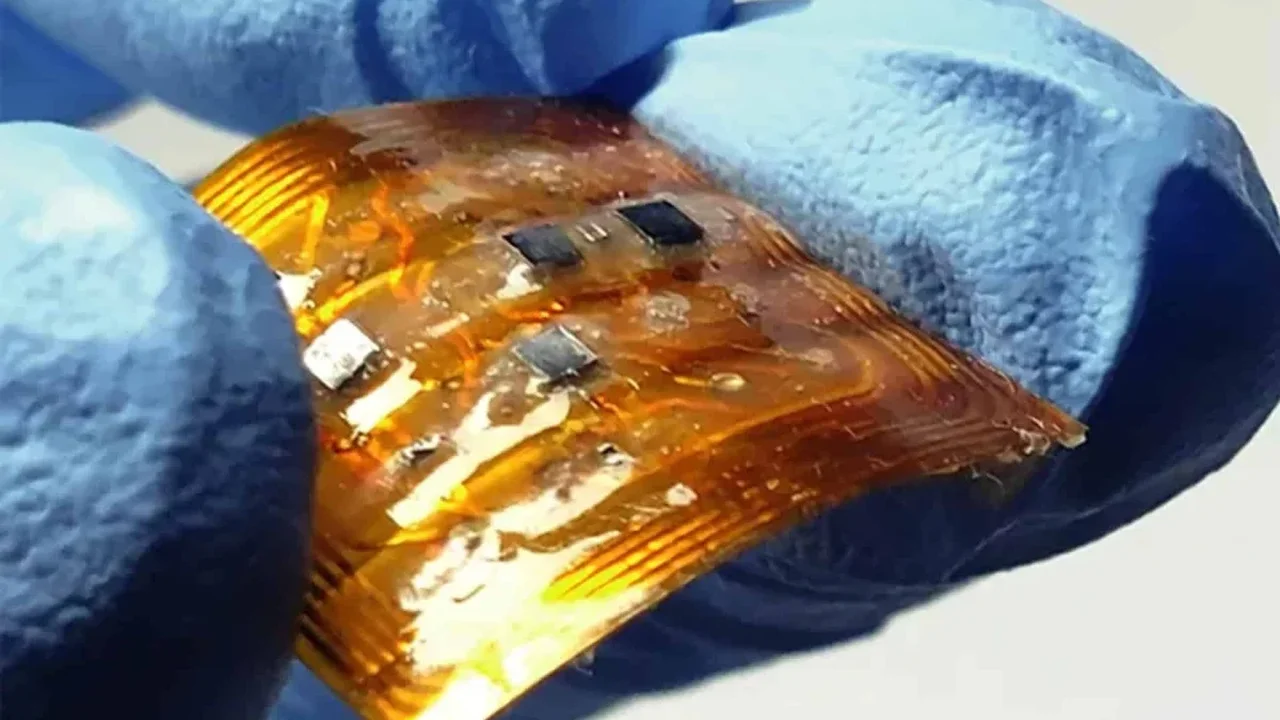
Researchers from the University of Southern California (USC) have made a groundbreaking discovery in high-temperature electronics. In a study published in Science, a team led by Joshua Yang, the Arthur B. Freeman Chair Professor at the Ming Hsieh Department of Electrical and Computer Engineering, revealed a new memory device capable of operating at a staggering 700 degrees Celsius (approximately 1300 degrees Fahrenheit). This temperature surpasses that of molten lava and represents a significant leap in technology.
Yang described the innovation as "a revolution," noting it as the most effective high-temperature memory ever demonstrated. The device, known as a memristor, is a nanoscale component that not only stores data but also performs computations. Its structure consists of two electrodes with a thin ceramic layer sandwiched in between.
The first author of the study, Jian Zhao, constructed the memristor using tungsten for the top electrode, hafnium oxide ceramic in the middle, and graphene for the bottom layer. Tungsten boasts the highest melting point of any element, while graphene is recognized for its outstanding strength and thermal resistance.
This unique combination resulted in exceptional performance, allowing the device to retain data for over 50 hours at 700 degrees without requiring a refresh. It also endured more than one billion switching cycles at that temperature, operating at just 1.5 volts with speeds in the tens of nanoseconds.
The breakthrough was unexpected; the researchers initially aimed to create a different graphene-based device. Yang remarked, "It was by accident, as most discoveries are," highlighting the serendipitous nature of scientific exploration.
Conventional electronics face challenges at high temperatures, as metal atoms tend to migrate and create short circuits. However, the interaction between tungsten and graphene prevents this failure, allowing the device to maintain functionality even under extreme heat. Advanced microscopy and simulations confirmed this mechanism, opening avenues for future designs using similar materials.
The implications of this technology extend far beyond laboratory environments. Electronics capable of withstanding temperatures above 500 degrees Celsius have long been sought for space exploration, particularly for missions to planets like Venus. Current silicon-based chips fail under such conditions, but this new memristor technology could revolutionize electronics in extreme environments, including geothermal energy systems and nuclear applications.
Moreover, the memristor's design holds promise for enhancing artificial intelligence (AI). Traditional AI systems rely heavily on matrix multiplication, a process that consumes significant energy. Memristors can perform these calculations more efficiently by leveraging Ohm's Law, yielding instantaneous results as electricity flows through them. Yang noted that over 92 percent of computing in AI systems involves matrix multiplication, making this technology a game-changer.
Yang and his colleagues have co-founded TetraMem to commercialize these AI chips, with ongoing developments in their lab already utilizing working chips for machine learning tasks. The high-temperature version of the device could enable real-time data processing in environments where conventional electronics fail.
While the results are promising, Yang cautioned that practical applications are still evolving. High-temperature logic circuits need to be developed, and scaling up production will take time. However, the materials used in the device are already prevalent in semiconductor manufacturing, suggesting a pathway to future advancements.
This research was conducted through the CONCRETE Center, supported by the Air Force Office of Scientific Research and the Air Force Research Laboratory. Yang views the publication in Science as a significant milestone in the journey toward exploring new frontiers in technology.
As Yang aptly stated, "This paper represents a critical leap into a much larger, more exciting frontier," signaling a transformative era for high-temperature electronics and AI.