In the realms of physics, chemistry, biology, and materials science, numerous significant phenomena occur at astonishing speeds. According to Yunhua Yao, the research team leader from East China Normal University, their innovative technique allows for the comprehensive observation of both brightness and internal structure of materials in a single measurement. This advancement represents a pivotal leap forward in understanding the fundamental characteristics of matter, designing novel materials, and revealing the intricacies of biological processes.
The research, published in Optica, the journal of the Optica Publishing Group, introduces a method termed compressed spectral-temporal coherent modulation femtosecond imaging (CST-CMFI). This cutting-edge system enables scientists to monitor ultrafast activities, such as plasma formation in water following a femtosecond laser pulse and the dynamics of excited charge carriers in ZnSe.
Yao elaborated, "This technique not only aids researchers in examining materials that react instantaneously to laser light and chemical reactions that rapidly rearrange atoms but also enhances the dynamic study of biomolecules. CST-CMFI holds potential for refining high-power laser technologies pivotal for clean energy research, advanced manufacturing, and scientific instrumentation. Furthermore, it could pave the way for more efficient electronics and improved solar cells, leading to faster devices through a deeper understanding of material behavior at extremely rapid timescales."
Beyond Brightness: A New Era in Ultrafast Imaging
This research is part of ongoing initiatives at the Extreme Optical Imaging Laboratory at East China Normal University, aiming to push the boundaries of ultrafast camera technology. A primary focus is on single-shot ultrafast optical imaging, which captures irreplaceable events in one exposure, akin to taking a single frame that encapsulates an entire sequence.
Previously, such techniques primarily recorded changes in light intensity. However, light also conveys phase information, indicating how it bends or varies in speed when traversing materials. The researchers aimed to capture both intensity and phase simultaneously, offering a more comprehensive view of ultrafast processes.
To achieve this, they integrated time-spectrum mapping, compressive spectral imaging, and coherent modulation imaging, each contributing unique advantages such as tracking rapid changes, gathering extensive data in one measurement, and maintaining fine image details.
Mechanics of the CST-CMFI Technique
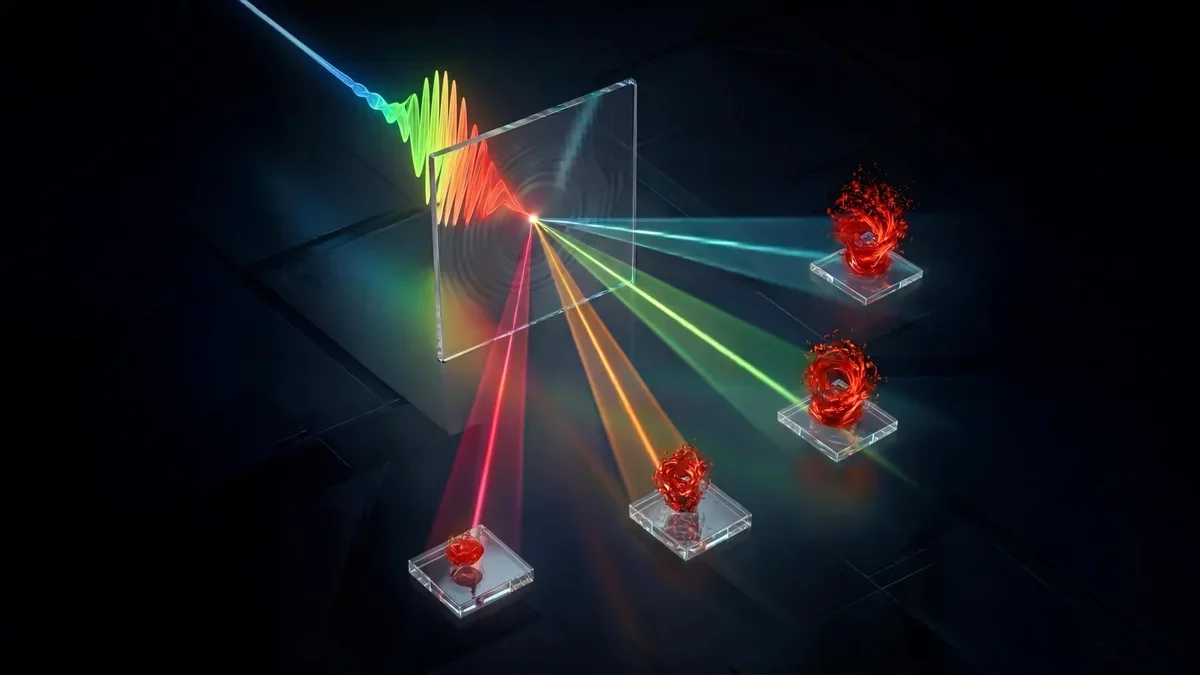
The system employs a chirped laser pulse with multiple wavelengths arriving at staggered times, effectively linking time with wavelength. When this pulse interacts with a rapidly changing event, the scattered light carries intricate spatial, spectral, and phase information, which is subsequently compressed into a single image through dispersion-encoded coherent modulation imaging.
A physics-informed neural network processes this data, separating wavelengths and reconstructing both intensity and phase over time. Each wavelength corresponds to a specific moment, culminating in a sequence of frames that forms an ultrafast movie captured in one shot.
Real-Time Insights into Plasma and Electron Dynamics
The researchers tested their technique by investigating two ultrafast phenomena. One experiment focused on plasma generated in water by a femtosecond laser, with findings revealing both brightness and phase changes within the plasma channel. Understanding plasma formation and evolution is crucial for applications such as laser-based medical procedures.
Additionally, the team explored carrier dynamics in ZnSe to gain insights into the movement of electrical charges post-excitation by light. Such knowledge is vital for enhancing optical and electronic devices made from this material, potentially leading to faster and more efficient technologies.
"CST-CMFI allowed us to observe phase variations linked to carrier dynamics, even without significant intensity changes," Yao noted, emphasizing the technique's sensitivity in detecting subtle ultrafast processes.
Future Applications and Innovations
Looking to the future, the researchers plan to utilize this method for studying further phenomena, including interface dynamics and ultrafast phase transitions. These areas necessitate detecting minuscule changes in light phase, underscoring the technique's value.
Currently, CST-CMFI translates spectral information into temporal data, which limits its application to processes sensitive to spectral changes. The team aims to enhance this by merging CST-CMFI with compressive ultrafast photography, allowing for separate capture of spectral and temporal information, thereby broadening the technology's applicability and versatility.