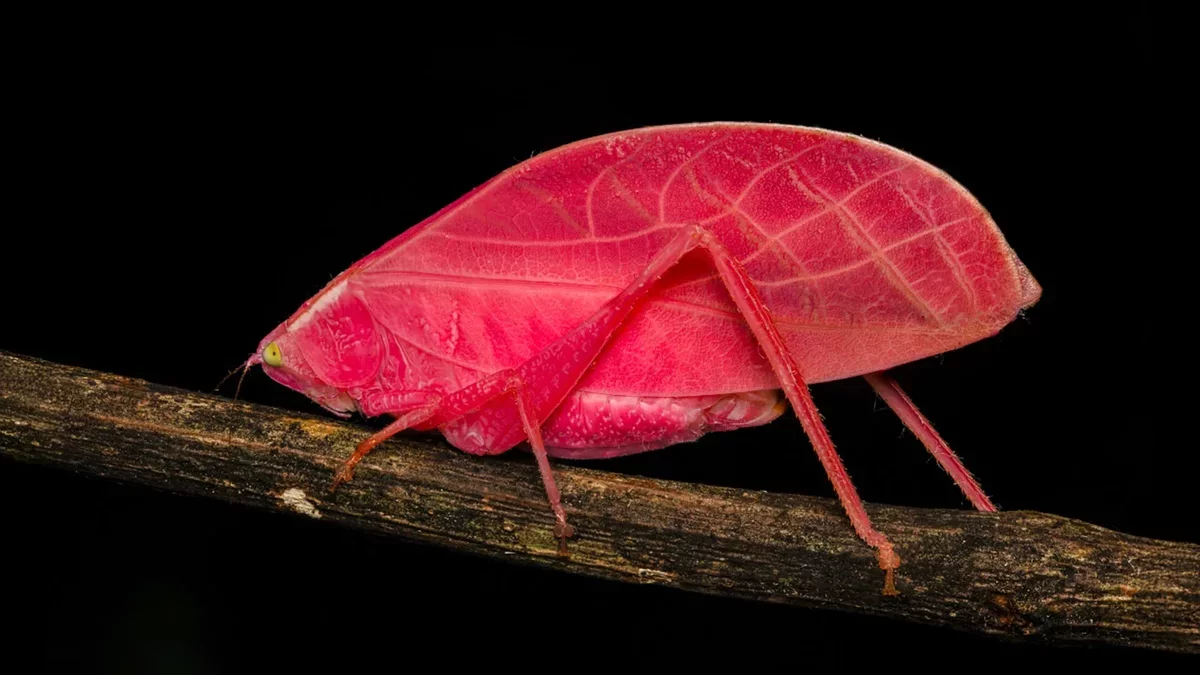
This week, researchers made an astonishing discovery detailed in the journal Ecology, focusing on the leaf-mimicking katydid, arota festae, commonly referred to as a "bush cricket." This fascinating species inhabits regions across Central and South America, including Panama, Colombia, and Suriname.
Surprising Observation in Panama
The striking color transformation was first recorded at the Smithsonian Tropical Research Institute's field station on Barro Colorado Island in Panama. An adult female was observed exhibiting a vibrant hot pink hue under light. Remarkably, just eleven days later, she had completely transitioned to a lush green.
Adapting to Rainforest Colors
A collaborative team from the University of St Andrews, University of Reading, Smithsonian Tropical Research Institute, and the University of Amsterdam proposes that this color change is linked to a natural phenomenon called "delayed greening." Many tropical plants initially showcase bright pink or red leaves, which gradually evolve into green as they mature. On Barro Colorado Island, approximately one-third of plant species display this color pattern throughout the year, providing a consistent pink backdrop that aids in predator evasion for insects with similar coloring.
A Strategic Survival Mechanism
Lead author Dr. Benito Wainwright from the University of St Andrews expressed his astonishment at discovering this rare individual. He noted that instead of being a genetic anomaly, this color change could represent a sophisticated survival tactic that aligns with the lifecycle of the rainforest foliage it mimics.
To explore this phenomenon further, the researchers observed the katydid in captivity for 30 days, documenting its daily color changes. After four days, the vivid pink began to soften, eventually resembling the typical green form by day eleven.
A Unique Color Transition
This katydid lived long enough to reproduce before passing away naturally the following month. Although pink katydids have been documented since 1878, they have typically been perceived as rare mutations. This observation marks the first known instance of a katydid undergoing a complete color transition within a single life stage.
Camouflage in a Complex Habitat
Co-author Dr. Matt Greenwell from the University of Reading commented on the complexity of tropical forests, highlighting how this discovery illustrates the remarkable adaptability of certain species. He noted that a bright pink insect would typically draw attention in a predominantly green environment, making this gradual color shift an extraordinary example of evolutionary camouflage.