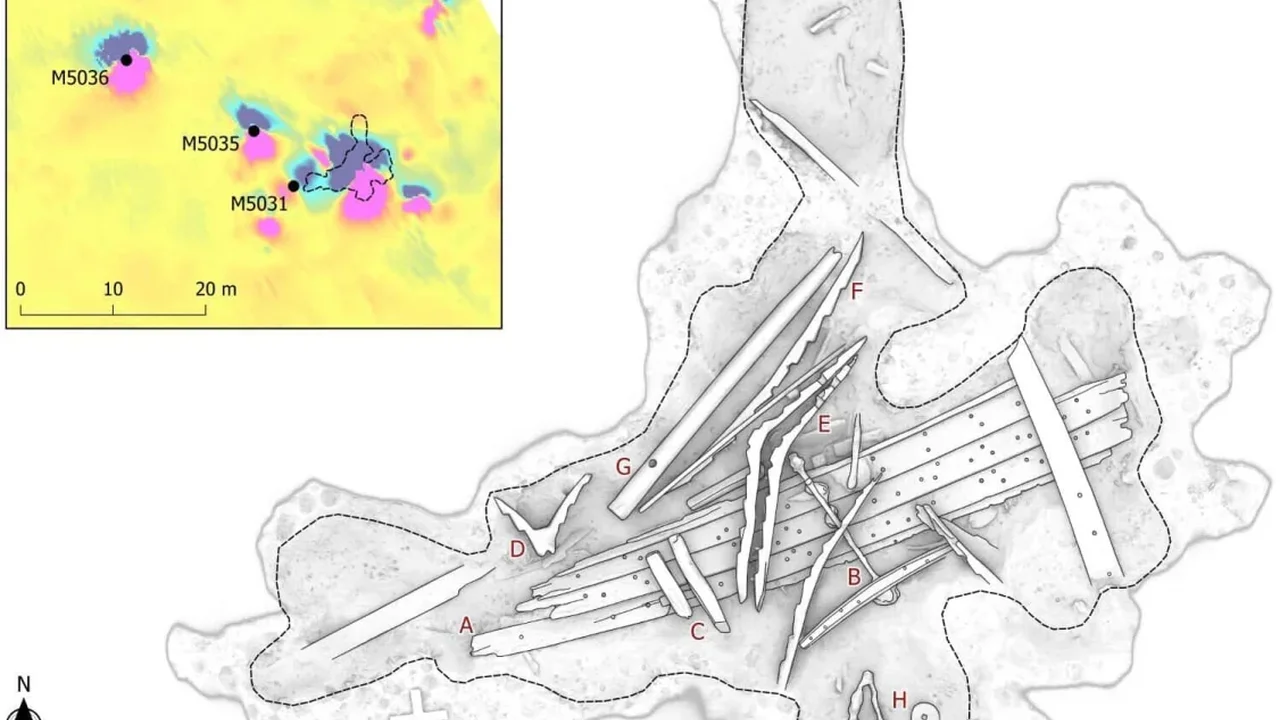
A seabed survey for an offshore gas pipeline in Germany's Bay of Greifswald has led to the discovery of a previously unknown shipwreck dating back around 400 years.
Archaeologists identified wooden hull remains, an anchor, rope, tools, barrel fragments and personal objects on the shallow Baltic seabed. With construction activity approaching the site, a five-person team completed 22 dives in 12 days to document and secure the remains.
A Snapshot of 17th-Century Baltic Life
The vessel rested about 7.5 metres below the surface in soft sediment, where limited visibility made the underwater investigation especially demanding. Researchers recorded more than 60 artefacts, including shoe soles, a leather strap, carpentry equipment and a possible bilge pump carved from an oak trunk.
Although only parts of the ship's outer hull and scattered timber frames survived, its construction offered important clues. The vessel was built using clinker construction, a traditional method in which overlapping planks were fastened with iron nails and sealed with tar and animal hair.
Tree-ring analysis dated one of the timbers to a tree felled between 1626 and 1639, placing the vessel within the active maritime networks of the 17th-century Baltic. Its name, route and the circumstances of its sinking remain unknown.
Infrastructure Meets Heritage Protection
Following the survey, the pipeline route was adjusted and the surviving wreckage was covered with sandbags for protection. The case illustrates how modern seabed mapping can support both infrastructure planning and the preservation of hidden cultural heritage.
This discovery shows that future engineering projects may increasingly become opportunities to map, protect and better understand the cultural stories preserved beneath the world's waters.