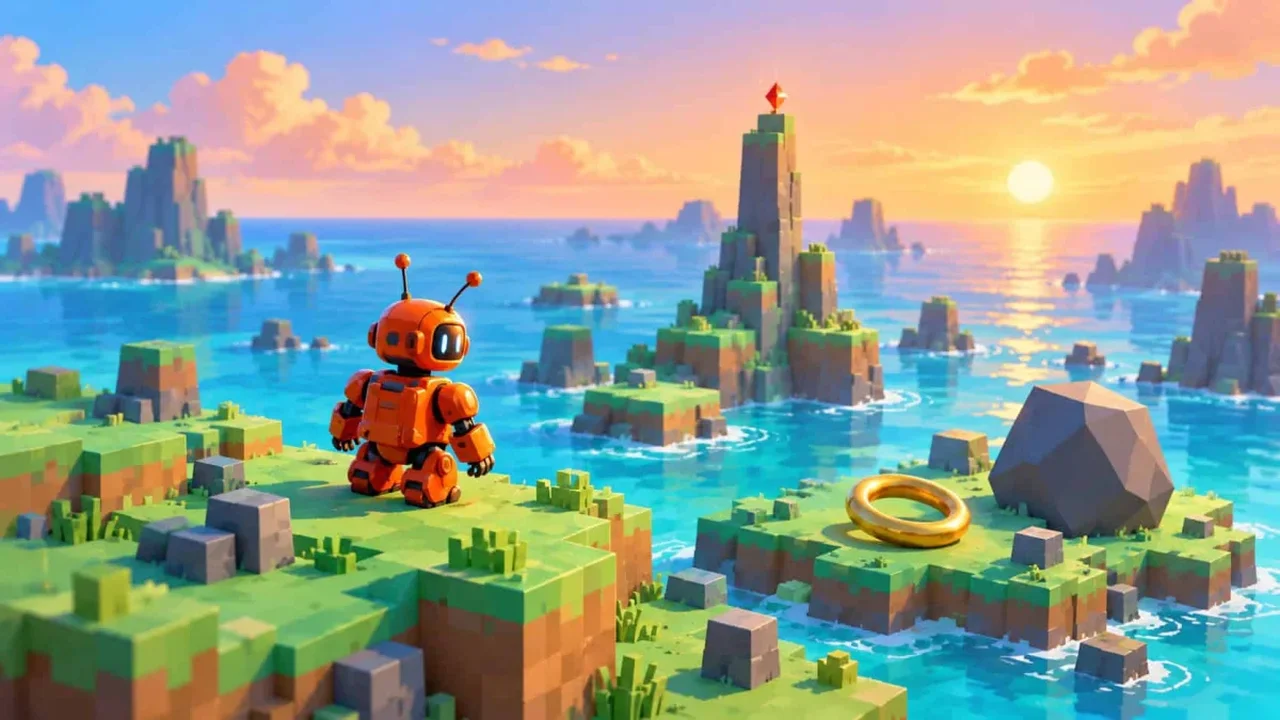
Give an AI agent a virtual island, a handful of objects and no specific task, and it may find its own way to learn. In an experiment, MIT researchers observed agents inventing games and testing how their simulated world worked.
One agent, Eko, balanced a ring on a ridge and used a block to take shots at it. Others arranged cubes like bowling pins, built sculptures and experimented with object-throwing. After discovering that hurling a particular rock generated extra blocks, Eko used the feature to create increasingly elaborate designs.
Exploration that carried over to new tasks
The researchers gave 13 agents 30 hours each to explore the island, without assigning goals or offering scores and rewards. The agents recorded their discoveries in notes, which remained available after the simulation reset.
When later asked to move objects to the island's highest peak, the experienced agents placed an average of 10.3 objects there, compared with 3.5 for agents that had not explored. They also generally performed better at other challenges, including building towers.
The notes helped explain the improvement: agents could draw on techniques they had discovered, such as jumping before throwing to send blocks higher. But exploration could also leave them with mistaken assumptions, which sometimes hindered later performance.
What counts as play?
The agents devised activities, repeated them with variations and sometimes treated objects as if they served a different purpose. The researchers see parallels with play, while noting that it remains uncertain whether the systems were genuinely playing or reproducing patterns learned from human examples. Their initial instructions encouraged curiosity, although some agents showed similar behavior without that persona.
The experiment suggests that open-ended exploration can build practical skills, while also showing why autonomous learning needs carefully controlled environments. In the future, this approach could help robots adapt to unfamiliar settings by learning through structured experimentation.