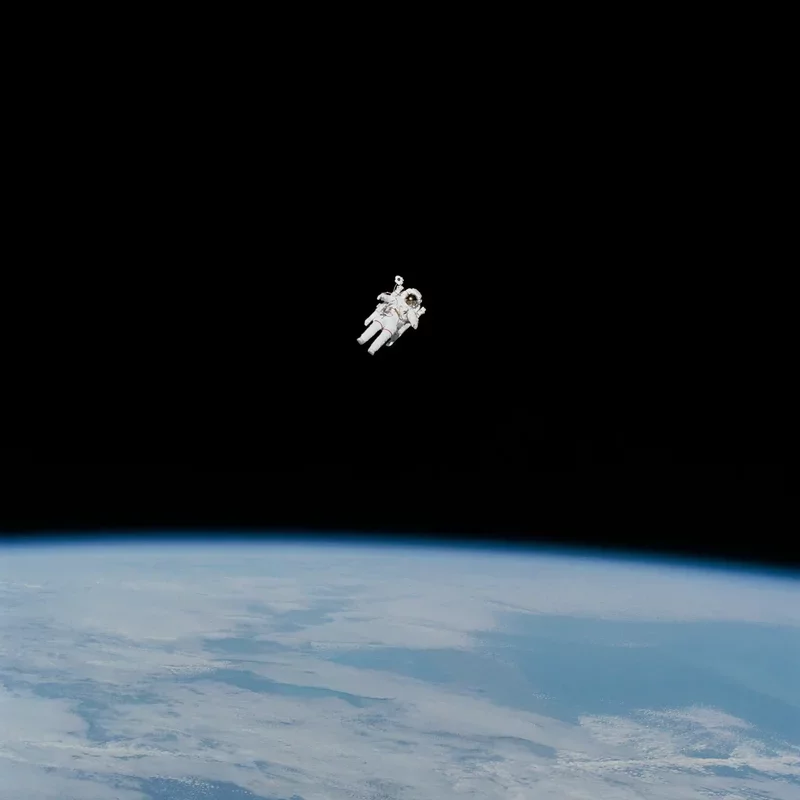
On February 7, 1984, astronaut Bruce McCandless II made history by becoming the first person to fly untethered in space. Exiting the space shuttle Challenger, he transformed into a true biological spacecraft, relying solely on a nitrogen-powered backpack and his white pressure suit.
Prior to this momentous event, astronauts had always been tethered to their spacecraft during spacewalks. McCandless, however, ventured an astonishing 98 meters (322 feet) away from Challenger, with the Earth spinning silently beneath him. This breathtaking image, captured by NASA, became iconic, symbolizing the potential for astronaut independence in orbit while highlighting the inherent risks of such freedom.
Why Pursue Untethered Flight?
The vision of untethered astronaut flight had been a goal for NASA since the dawn of the space age. The first American spacewalk in 1965 by Ed White utilized a tether, but the challenges of maneuvering outside a spacecraft were quickly evident. Early attempts to develop maneuvering devices faced significant obstacles, leading to a deeper understanding of the complexities involved in free flight.
NASA's Skylab program provided crucial insights, allowing astronauts to test maneuvering devices in a controlled environment. McCandless, selected by NASA in 1966, played a pivotal role in these trials, contributing to the development of the Manned Maneuvering Unit (MMU).
The Manned Maneuvering Unit
The MMU was designed to offer astronauts stability and control while navigating in space. Equipped with gyroscopic sensors, it could detect unwanted rotations and adjust accordingly, allowing astronauts to focus on their tasks without the constant struggle against drift. This innovative technology was essential for the success of untethered missions.
The Historic Spacewalk
During NASA's STS-41B mission, McCandless opened the hatch and became a free flyer, humorously remarking, "It may have been one small step for Neil [Armstrong], but it's a heck of a big leap for me." He successfully maneuvered over 300 feet from the orbiter, demonstrating the MMU's capabilities under the watchful eyes of his fellow crew members.
Despite initial setbacks, including the malfunction of communication satellites deployed during the mission, the untethered flight went off without a hitch. The successful test of the MMU solidified NASA's confidence in the potential for astronauts to operate independently in space.
A Lasting Legacy
Although the MMU was only used in three missions, its legacy endures today in the Simplified Aid for EVA Rescue (SAFER), a device designed to assist astronauts in emergencies. McCandless's contributions to spacewalking technology and procedures have had a lasting impact on future missions, emphasizing the importance of safety and innovation in space exploration.
As we look to the future, the untethered flight of Bruce McCandless II serves as a reminder of humanity's relentless pursuit of exploration and the boundless possibilities that lie ahead in the cosmos.