On February 24, engineers at NASA's Jet Propulsion Laboratory (JPL) in Southern California conducted a groundbreaking test of an experimental thruster, achieving unprecedented power levels for electric propulsion systems in the United States. This innovative engine, which utilizes lithium metal vapor, signifies a major leap in propulsion technology.
The prototype exceeded the capabilities of existing electric thrusters used in NASA missions, and the data gathered will inform future tests aimed at enhancing and scaling this technology. "At NASA, we are actively pursuing multiple projects, and our focus on Mars remains steadfast. The successful operation of our thruster marks significant progress toward sending astronauts to the Red Planet," stated NASA Administrator Jared Isaacman. He highlighted that this was the first instance in U.S. history where an electric propulsion system operated at such high power levels, reaching up to 120 kilowatts. "We will continue to invest strategically to facilitate our next monumental leap forward."
Extreme Conditions Inside JPL's Test Chamber
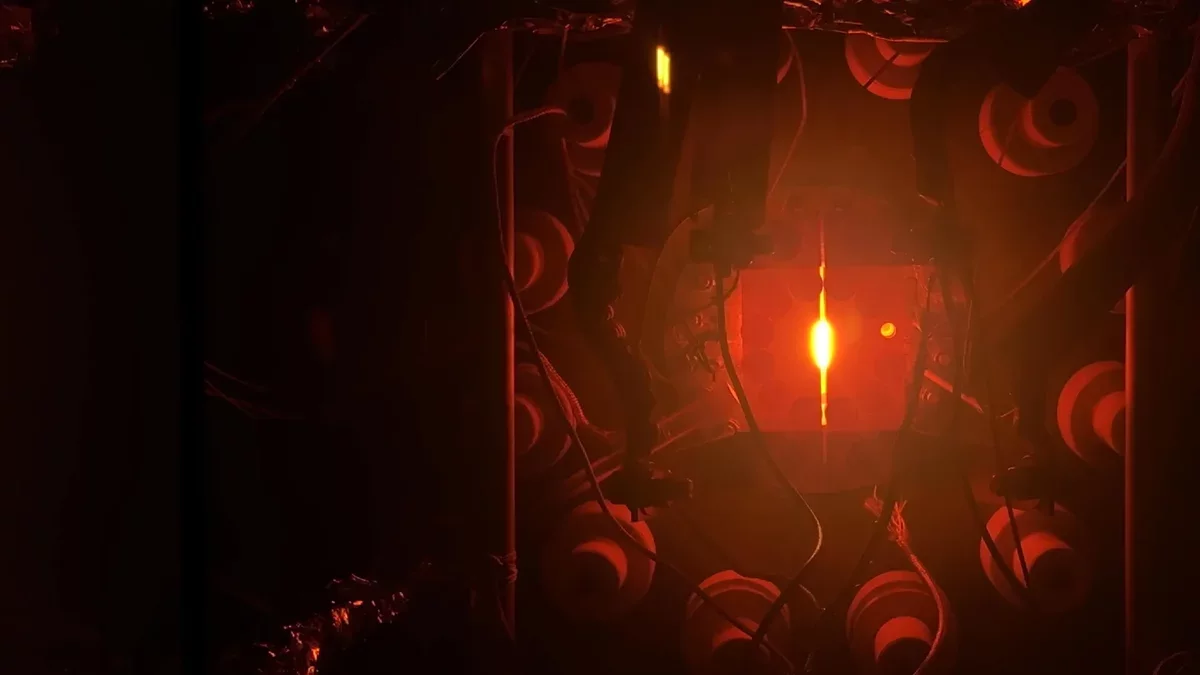
During the test, the central tungsten electrode of the thruster experienced extreme heating, glowing brightly at temperatures surpassing 5,000 degrees Fahrenheit (2,800 degrees Celsius). The experiment took place in JPL's Electric Propulsion Lab, equipped with a specialized vacuum chamber designed for safely evaluating high-power engines using metal vapor propellants.
Understanding Electric Propulsion
Electric propulsion systems are known for their efficiency, utilizing up to 90% less propellant compared to traditional chemical rockets. Instead of delivering a powerful thrust in short bursts, these systems provide a steady push over extended periods, allowing spacecraft to gradually achieve high speeds.
NASA's current missions, such as the Psyche spacecraft, already employ this technology, with solar-powered electric thrusters enabling speeds of up to 124,000 mph.
The tested engine is a lithium-fed magnetoplasmadynamic (MPD) thruster. Although the concept has been around since the 1960s, it has yet to be operationally utilized. This innovative design harnesses strong electrical currents and magnetic fields to accelerate lithium plasma, resulting in greater thrust at elevated power levels.
Record Power Achieved
In this initial test, the thruster achieved an impressive 120 kilowatts, more than 25 times the power of the thrusters currently deployed on the Psyche mission, making it the highest-power electric propulsion system tested in the U.S. to date. "The journey to this first test has been extensive, and we have not only confirmed the thruster's functionality but also achieved our targeted power levels," remarked James Polk, a senior research scientist at JPL. "This moment is significant as it sets the stage for addressing the challenges of scaling up."
Future of Mars Missions
The next objective is to further increase the engine's power, targeting levels between 500 kilowatts and 1 megawatt in the coming years. A crewed mission to Mars could require a total power output of between 2 and 4 megawatts, necessitating multiple thrusters operating together for extended durations.
Advantages of Lithium Plasma Thrusters
Lithium-fed MPD thrusters present numerous benefits, including high power operation, efficient propellant use, and superior thrust compared to existing electric systems. When combined with nuclear power sources, they could minimize launch mass and enable heavier payloads for human exploration.
Collaborative Efforts and Future Prospects
The development of this thruster has been a collaborative effort over the past two and a half years, led by JPL in partnership with Princeton University and NASA's Glenn Research Center. This initiative is part of NASA's Space Nuclear Propulsion project, launched in 2020 to advance critical technologies for megawatt-class nuclear electric propulsion systems.
The advancements in electric propulsion technology not only pave the way for more efficient space travel but also enhance our capability to explore distant worlds, potentially transforming human presence beyond Earth.