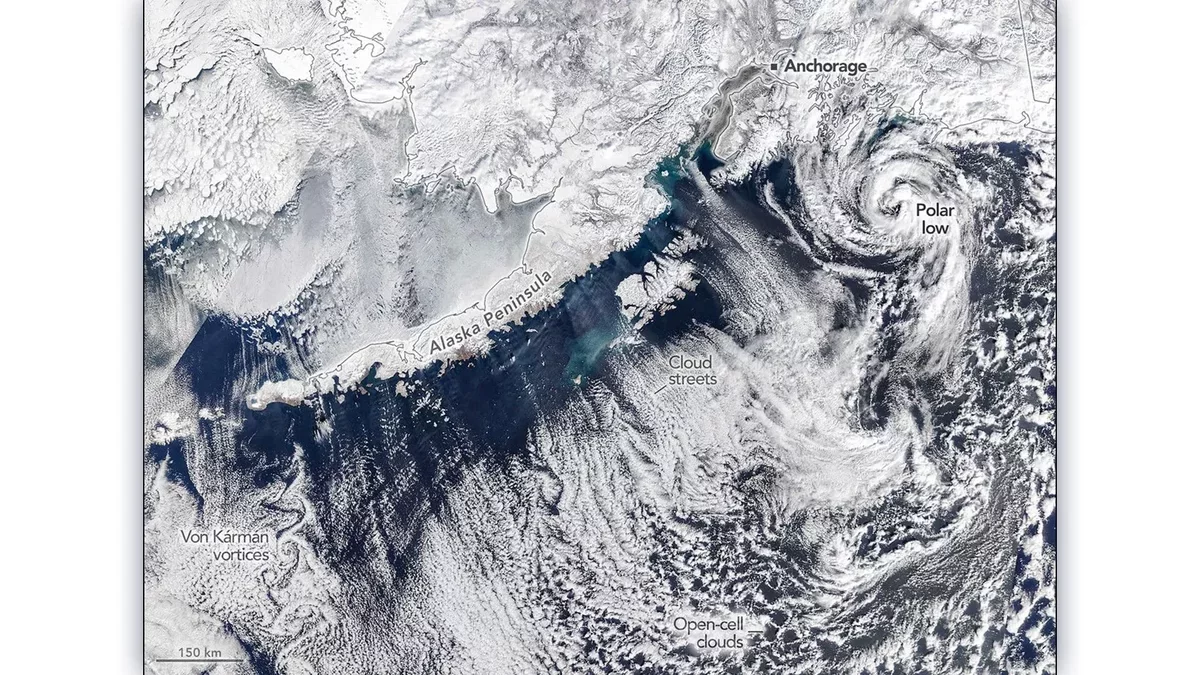
On March 19, 2026, the concluding day of astronomical winter, a NASA satellite captured an extraordinary scene over Alaska. A NOAA weather briefing elaborated on the atmospheric conditions: a low-pressure system over the Gulf of Alaska combined with high pressure from eastern Russia and northern Alaska, driving frigid Arctic air southeastward across the Alaska Peninsula.
The Formation of Cloud Streets
As the cold, dry air moved over the relatively warmer waters of the Gulf, it underwent significant transformation, leading to the creation of "cloud streets." These elongated, parallel bands of clouds align with the wind's direction, forming when the air absorbs heat and moisture from the ocean surface. The rising warm, moist air generates clouds, while cooler air descends, resulting in clear gaps in between.
Near the coastline, the sky remained predominantly clear, as the air had not absorbed sufficient heat and moisture to produce clouds. However, further offshore, the cloud streets became more pronounced and transitioned into open-cell clouds, characterized by thin cloud formations encircling empty, circular spaces.
Vortex Patterns and Geographic Influences
Another striking pattern emerged near Unimak Island, the easternmost of the Aleutian Islands. The satellite captured von Kármán vortex streets on the downwind side of the island, showcasing swirling patterns that rotate in opposing directions. These formations occur when strong winds navigate around elevated terrain, such as islands rising from the ocean.
A Dynamic Polar Low Offshore
Among the most dramatic elements in the captured imagery was a large swirling cloud system located approximately 180 miles (300 kilometers) southwest of Anchorage. Meteorologist Matthew Cappucci identified this as a polar low, a compact storm that arises when cold polar air moves over warmer water. This particular system exhibited tropical storm-force winds, producing snow and even thunderstorms in its vicinity.
Ongoing Cold and Stormy Conditions
The remarkable weather conditions observed on March 19 were part of a larger climatic trend. Throughout the month, Alaska experienced persistent cold and recurrent stormy weather. By late April, temperatures began to rise, yet reports indicated that unsettled, wet conditions were still anticipated for Southcentral and Southeast Alaska as an atmospheric river approached.