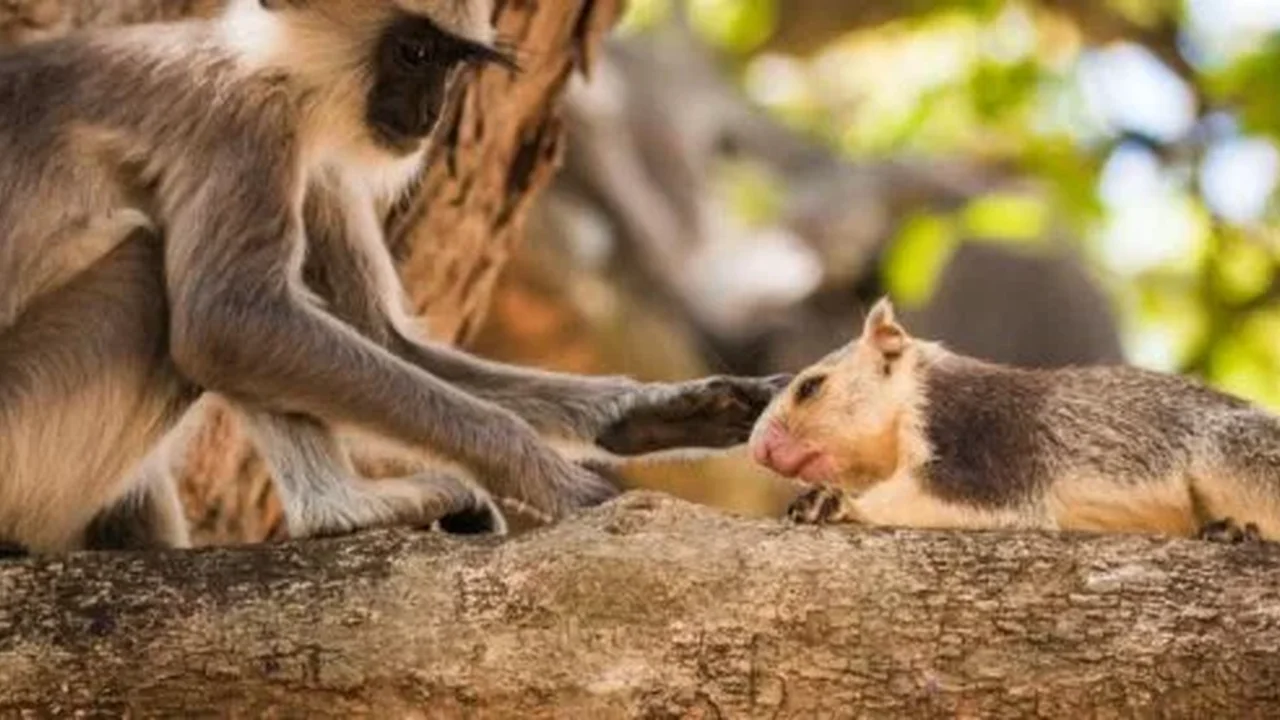
New research from the University of Oxford suggests that monkeys and apes may be far more socially flexible than previously assumed. Across wild and captive settings, primates were observed interacting with animals from other species through play, grooming, carrying, huddling and, in rare cases, long-term companionship.
The review brought together hundreds of documented examples from scientific publications, researcher surveys and screened records, revealing a wide range of cross-species pairings. The most common interactions involved closely related primates, but the pattern also extended to dogs, deer, pigs, cats, birds, squirrels and other animals.
Beyond Simple Curiosity
Lead author Cyril Grueter noted that humans are often seen as unique in forming close bonds with other species. The study challenges that idea by showing that primates can display curiosity, tolerance and even caregiving behaviors toward animals outside their own group.
Among the most striking examples was a case in Brazil, where wild capuchin monkeys accepted an infant marmoset into the group and tolerated its presence for months. Other records included macaques grooming dogs and Japanese macaques riding on deer, especially in settings where species live in close proximity.
The researchers also found that many of these encounters begin as play or grooming. In some cases, however, the behavior becomes more intense, showing that social interest does not always equal understanding. The team emphasizes that primates may engage with other animals without fully recognizing their needs or limits.
Even with its limitations, the study offers a fresh lens on animal social life. It suggests that the roots of human-style companionship may be older and more widespread in nature than once believed. In the future, such findings could reshape how science understands empathy, social learning and the evolution of interspecies relationships.