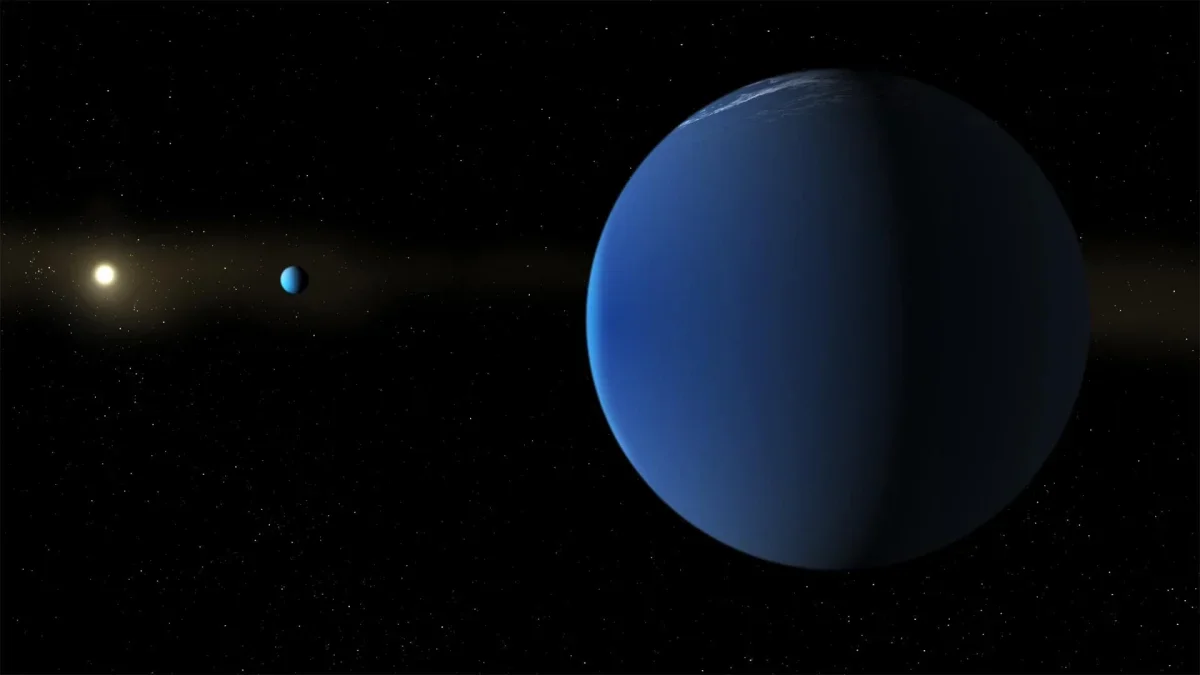
Researchers have identified two unusually low-density exoplanets, TOI-791 b and TOI-791 c, orbiting a star about 1,110 light-years away in the constellation Volans. Although both worlds are close to Jupiter in size, their masses are so modest that they belong to the rare class of super-puff planets.
The study, led by the University of Oxford and published in Monthly Notices of the Royal Astronomical Society, shows that TOI-791 b has a density of just 0.038 grams per cubic centimeter, while TOI-791 c measures 0.047. For comparison, those values are near the density of candy floss, making them among the lightest giant planets ever measured.
A rare planetary pair
What makes the system especially valuable is that both planets appear in the same star system. Astronomers say this offers a natural laboratory for studying how giant planets form, migrate, and evolve. The pair also seems to follow a 5:3 orbital resonance, meaning their paths around the star are closely synchronized.
The planets were first flagged through data from NASA's TESS mission, with early candidate identification supported by the Planet Hunters TESS citizen-science project. Follow-up observations from ground-based telescopes, including the Antarctic ASTEP instrument, helped confirm their unusual properties and measure long transits lasting more than 11 hours.
Why they matter
Scientists think super-puff planets may have thick hydrogen- and helium-rich atmospheres surrounding relatively small cores. Yet their exact origin remains uncertain. The TOI-791 system could help answer whether such planets formed close to their star or farther out before drifting inward.
Future observations with the James Webb Space Telescope may reveal atmospheric molecules and offer deeper clues about how these delicate giants came together. In the broader story of exoplanet science, TOI-791 b and c highlight how much more there is to learn about planetary architecture across the galaxy. Their discovery may shape the next generation of models for how worlds are built and transformed.