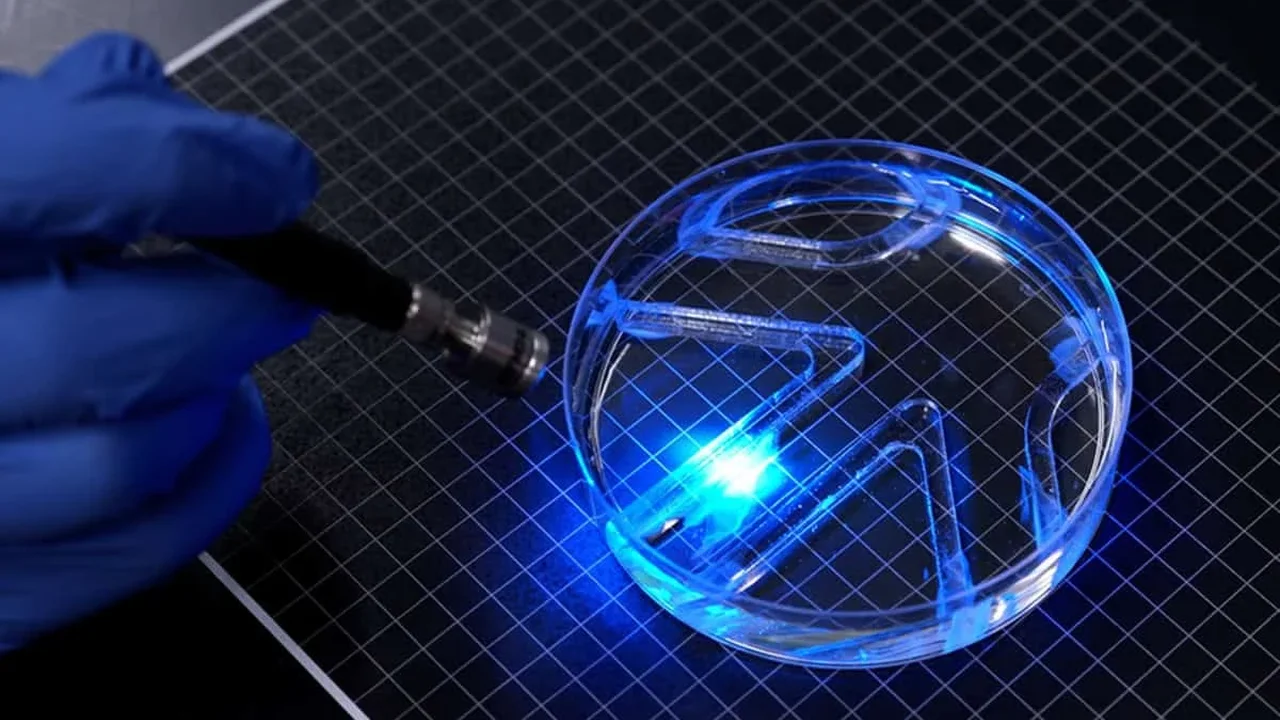
Researchers at MIT have made significant strides in the field of superconductivity by employing terahertz light to reveal previously undetected quantum vibrations within superconducting materials. This groundbreaking observation marks a pivotal moment in understanding the intricate behaviors of these materials.
Understanding Terahertz Light
Terahertz radiation occupies a unique position on the electromagnetic spectrum, nestled between microwaves and infrared light. Its rapid pulsing--more than a trillion times per second--aligns well with the natural vibrations of atoms and electrons, making it an ideal candidate for studying these movements. However, a challenge arises due to the long wavelength of terahertz radiation, which spans hundreds of microns, preventing it from focusing on tiny structures effectively.
Innovative Terahertz Microscope Development
In a study featured in Nature, MIT scientists introduced a novel terahertz microscope capable of compressing this long-wavelength light into a remarkably small area. This advancement enables the detection of quantum-scale features that were previously inaccessible.
The team utilized this technology to investigate bismuth strontium calcium copper oxide (BSCCO), a material that exhibits superconductivity at relatively high temperatures. The microscope revealed a frictionless flow of electrons behaving like a "superfluid," oscillating at terahertz frequencies within the material. "This new microscope now allows us to see a new mode of superconducting electrons that nobody has ever seen before," stated Nuh Gedik, the Donner Professor of Physics at MIT.
Significance of the Discovery
Exploring BSCCO and similar materials with terahertz light could enhance our understanding of superconductivity, paving the way toward the development of room-temperature superconductors. This technology might also facilitate the identification of materials capable of emitting and detecting terahertz radiation, which could be instrumental in future wireless communication systems operating at terahertz frequencies, significantly improving data transmission speeds.
Alexander von Hoegen, a postdoctoral researcher at MIT, emphasized the potential of terahertz technology, stating, "There's a huge push to elevate Wi-Fi or telecommunications to the next level." The research team included a diverse group of MIT scientists and collaborators from prestigious institutions such as Harvard University and the Max Planck Institute.
Addressing the Diffraction Limit
Historically, terahertz light has shown promise for imaging due to its nonionizing nature and ability to penetrate various materials. However, its application in microscopy has been hindered by the diffraction limit, which restricts detail resolution based on wavelength. The researchers overcame this limitation by employing spintronic emitters, which generate brief bursts of terahertz radiation, allowing for a more focused analysis of microscopic features.
Exploring Quantum Motion
The team constructed their microscope by integrating spintronic emitters with a Bragg mirror to filter out unwanted wavelengths while safeguarding the sample. Testing the system on an ultrathin BSCCO sample revealed that the terahertz field exhibited distinct oscillations, indicating the presence of superconducting electrons in motion. "It's this superconducting gel that we're sort of seeing jiggle," von Hoegen remarked.
A New Era in Quantum Phenomena Research
While scientists had theorized about these motions, direct observation had eluded them until now. The team plans to apply this innovative microscope to other two-dimensional materials to further investigate terahertz-scale effects. This advancement not only enhances our understanding of fundamental physics but also opens new avenues for research in quantum phenomena.