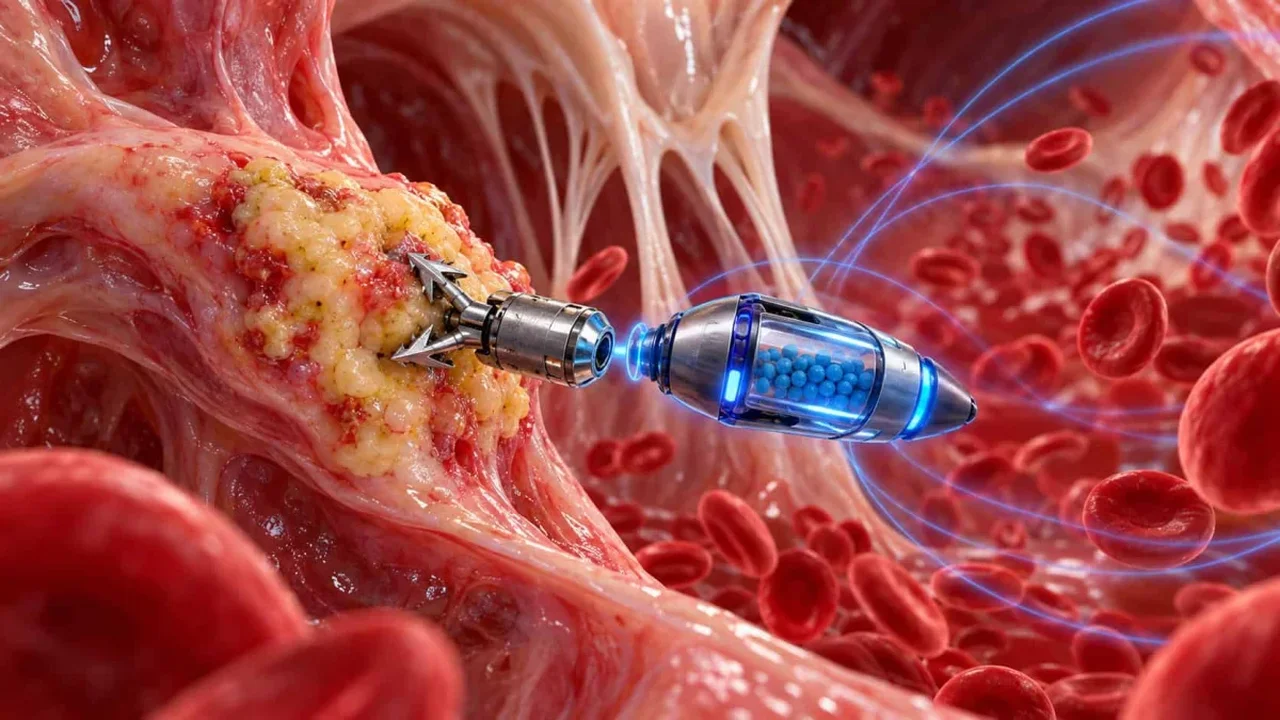
Researchers at Johns Hopkins University have developed a pair of miniature robots designed to deliver medicine directly to heart tissue. In early laboratory tests, the devices moved through a model heart and demonstrated how they could dock together on tissue.
One robot, the needle module, uses a tiny barbed tip to anchor itself to tissue. The second carries medication, navigates to the anchored device and connects to it magnetically, then releases its liquid payload. It can detach afterward, allowing another delivery unit to take its place if needed.
Both robots are smaller than a grain of rice and are guided by external electromagnetic fields, so they do not require onboard motors or batteries. Computer vision and automated navigation help track and steer them.
Early-stage testing
The team is exploring the system as a possible way to treat infective endocarditis, an infection of the heart's inner lining that can be difficult to manage. Current treatment commonly involves intravenous antibiotics over several weeks. Delivering medicine directly to an affected area could eventually help concentrate treatment where it is needed, though this potential has not yet been demonstrated in patients.
In experiments, magnetic docking worked in all reported trials, while the robots successfully undocked in 93%. The drug module released 22 microliters of liquid over three hours. Tests used an artificial heart model with simulated fluid flow, along with pig heart tissue--not a living, beating human heart.
The researchers say further testing in more realistic models is needed. The work, published in Advanced Materials Technologies, establishes an engineering proof of concept; it does not show that the robots can cure an infection or that they are ready for human trials.
If future studies confirm their safety and effectiveness, targeted microrobots could expand the ways clinicians deliver treatments inside the body.