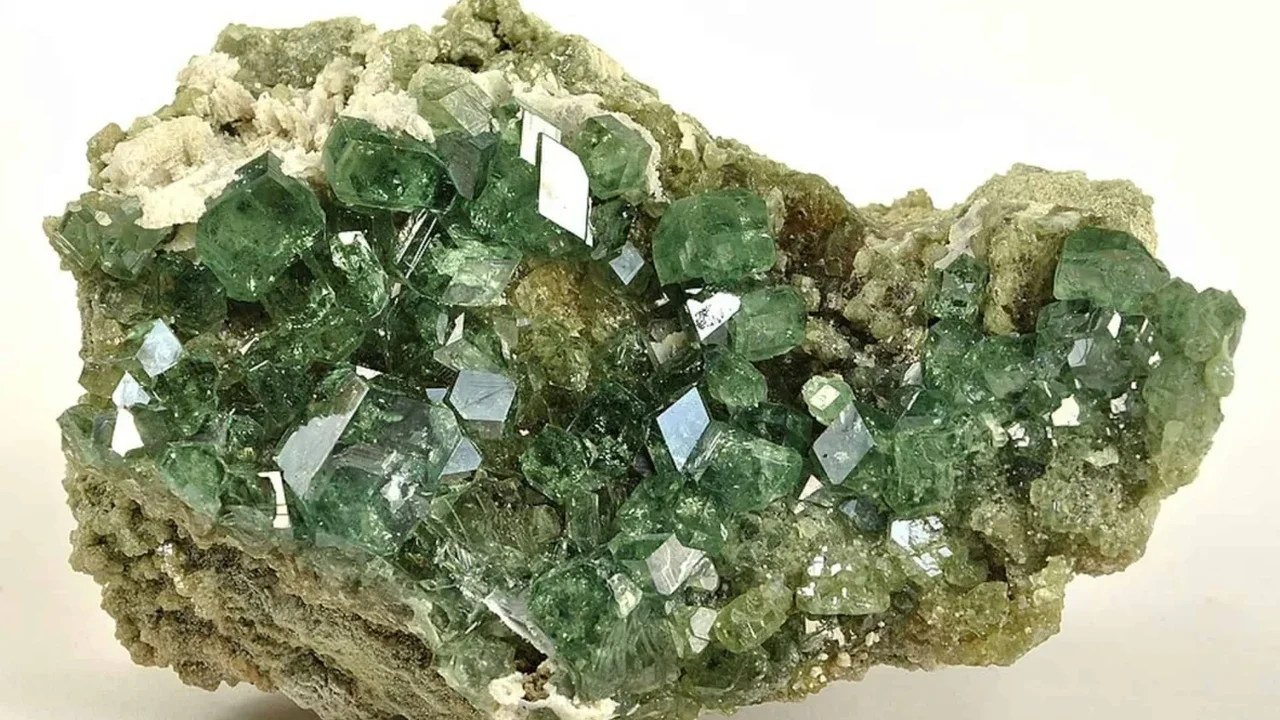
Researchers have identified a previously unknown rock type inside a Martian meteorite fragment, revealing garnet in a setting that may have formed on Mars itself. The mineral, specifically the andradite variety, is common in Earth geology but had never before been confirmed in this form within a rock linked to the Martian crust.
A new clue from an old meteorite
The sample comes from meteorite NWA 8171, found in Northwest Africa and classified as a Martian polymict regolith breccia. These meteorites are made of mixed rock fragments that were broken apart and reassembled by ancient impacts on Mars. The newly studied fragment adds a fresh layer to that story.
On Earth, andradite garnet often appears in metamorphic rocks formed under intense heat and fluid activity. That makes the discovery especially intriguing, because Mars does not have plate tectonics like Earth. As a result, the rock may point to a geological process on Mars that scientists have not yet fully recognized.
The fragment's mineral chemistry, texture, and association with other Martian material support a strong Martian connection, though researchers say further testing is still needed to confirm exactly how and where it formed. Oxygen isotope analysis could provide the clearest answer, but that step would require careful destructive sampling.
Beyond its mineral appeal, the finding helps scientists refine their understanding of how Mars evolved over billions of years. Each unusual rock recovered from a meteorite can act like a time capsule, preserving details about planetary impacts, crustal processes, and the early inner Solar System.
This discovery shows how a single mineral can open a wider window onto planetary history, and it may guide future studies of Mars as scientists continue mapping the planet's deep geological past.