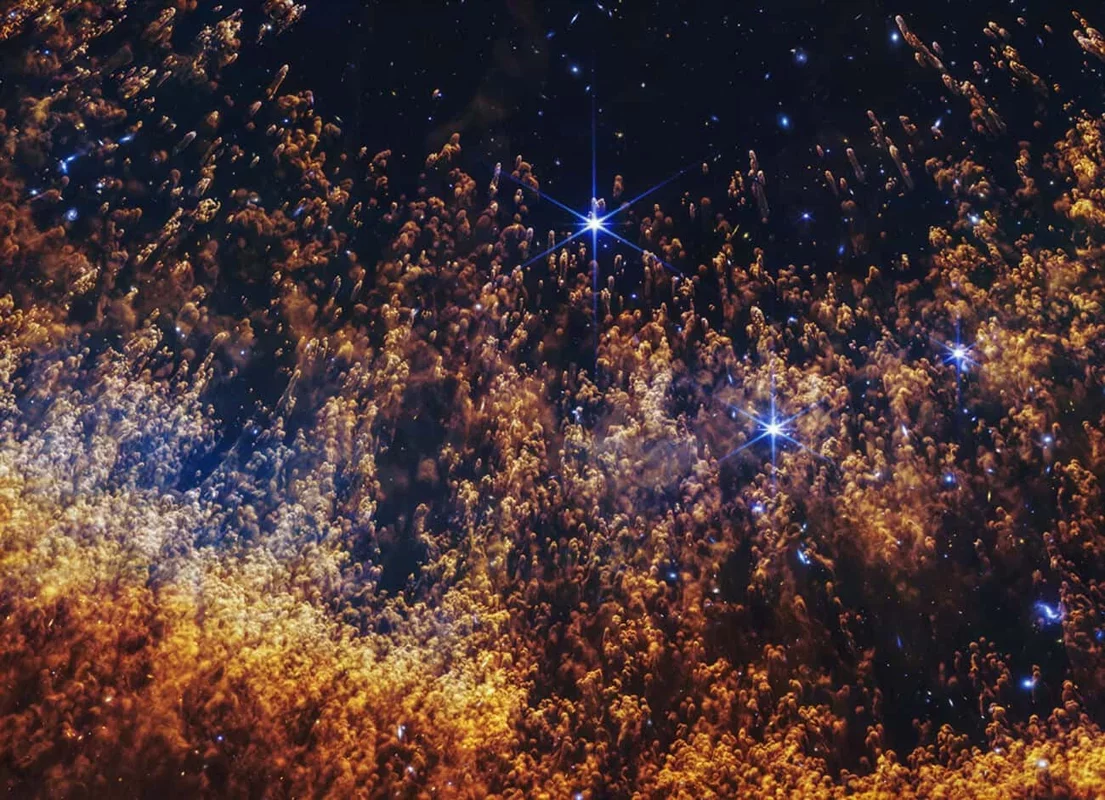
The Helix Nebula, a prominent feature of the interstellar environment, stands out as one of the most celebrated nebulae in our galaxy. Its proximity to our solar system has made it a focal point for astronomers, providing insights into how stars like the Sun expel their outer layers at the end of their life cycles.
Recent observations from the James Webb Space Telescope have revealed extraordinary details about this nebula, showcasing intricate physical processes that were previously obscured in earlier images. The latest infrared images capture a small section of the nebula, where powerful winds from its core interact with older, cooler material that was ejected earlier in the star's life. This interaction results in striking structures, including flame-like pillars and dense knots that resemble comets, illustrating a star undergoing its final transformation.
The Layers of the Nebula
Located approximately 650 light-years from Earth, the Helix Nebula is one of the nearest bright planetary nebulae. Despite its name, it has no connection to planets; rather, it signifies the demise of a star similar to our Sun, which has shed its outer layers after depleting its core's fuel. The remnant is a white dwarf, whose radiation illuminates the surrounding nebula.
In Webb's infrared imagery, the star at the center of the Helix is not directly visible. Instead, its presence is inferred from the effects it has on nearby gas, which becomes ionized and heated by the radiation from the exposed core. As one moves further away, the gas cools and transforms.
Webb's false-color infrared view highlights energetic gas in blue, while yellow tones indicate regions where hydrogen atoms have bonded into molecules. The outermost areas are marked in red, representing the coldest material where gas thins and dust prevails. The detailed observations reveal how fast-moving gas collides with cooler material, creating complex structures and dense knots with bright heads and trailing tails.
These findings enhance our understanding of why planetary nebulae exhibit such diverse forms. Variations arise from factors such as the timing and intensity of stellar winds, the star's rotation, and the distribution of expelled material over time. The Helix Nebula, once perceived as a simple ring, now appears as a dynamic and multifaceted structure.
A Star Like Our Own
The star that formed the Helix Nebula once bore a resemblance to our Sun. In about five billion years, as our Sun exhausts its hydrogen supply, it too will expand into a red giant, shed its outer layers, and leave behind a white dwarf. This transformation will significantly alter our solar system, even if some planets endure.
Webb's imagery transforms this abstract future into a tangible reality, illustrating how stellar materials collide, cool, and reorganize, allowing for the formation of more complex molecules within cooler pockets of gas and dust.
This process is integral to the larger narrative of the cosmos, as stars create heavy elements during their lifetimes, returning them to space upon their death. These elements intermingle in clouds that eventually collapse to form new stars and planets. Thus, planetary nebulae serve not only as endings but also as vital acts of cosmic recycling.
While earlier telescopes like Hubble depicted the Helix as a tranquil, eye-shaped glow, Webb offers a closer look that emphasizes motion, temperature, and chemical composition. It connects the demise of a single star to the broader cycle that constructs galaxies and ultimately leads to life-bearing worlds.